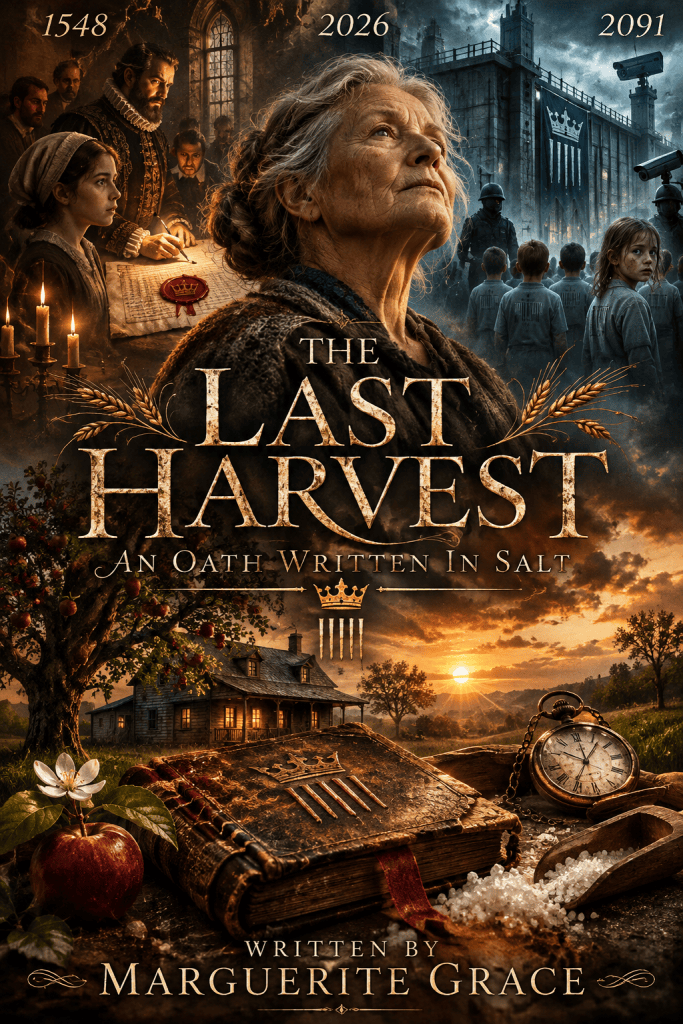
An Oath Written in Salt
A story of memory, inheritance, betrayal, and the terrible price of forgetting.
PROLOGUE — THE THINGS WE ARE NOT SUPPOSED TO REMEMBER
There are things the earth remembers that men have spent centuries trying to bury. There are names beneath the names of nations, graves beneath the foundations of palaces, and promises made in candlelit rooms by men who believed themselves clever enough to bargain with eternity.
There are wars that begin long before the first soldier lifts his weapon, and victories declared while the innocent are still dying. There are children who inherit fortunes, children who inherit kingdoms, and children who inherit nothing but the consequences of decisions made before their grandmothers were born.
And then there are the children who inherit no memory at all.
God help us. God help every last one of us.
For what is a world without memory, if not a world waiting to be conquered again?
CHAPTER ONE — THE FIRST REAL DAY OF AUTUMN | Pennsylvania, October 2026
It was the most beautiful day imaginable for the beginning of the end of the world, which I suppose is precisely why nobody noticed anything unusual about it, and perhaps that is the first thing I ought to explain, although I have found that explaining things only makes people more determined not to believe them.
People have certain expectations about the end of the world. They expect a terrible noise, a tremendous explosion perhaps, or the sudden darkening of the heavens, or some enormous catastrophe that sends the human race running into the streets. They expect someone important to tell them. And that, dear reader, is where the trouble begins.
Sometimes the end arrives as an improvement. Sometimes it comes wrapped in promises of safety, prosperity, stability, and peace, delivered by a handsome man standing behind a polished podium, speaking in a voice so calm and reasonable that even those who have lost everything begin to wonder whether they ought to be grateful.
My name is Eleanor Whitcomb. I am seventy-three years old, a widow of eleven years, a mother, a grandmother, a reasonably competent cook, and the owner of a farm that has been in my husband’s family for generations. Until recently, I believed time moved in one direction. That belief has become rather difficult to maintain.
The rain began just after five, first as a delicate tapping and then as a tremendous, sloppy downpour that threw itself against the farmhouse. The gutters rattled, the floorboards complained, and water found the same little depressions in the gravel that Henry had always promised to fill. I wore his old brown cardigan, the one with the stretched cuffs and the burn mark near the pocket. Even after eleven years, I sometimes turned toward the doorway expecting him to ask where his glasses were. They were usually on his face. Once they were in the refrigerator.
Henry was not a romantic man in the ordinary sense. He forgot our anniversary twice and once gave me a vacuum cleaner for Christmas, but he warmed my side of the bed when my arthritis was bad, and when my mother died he sat beside me on the kitchen floor for three hours because I could not stand. There are men who promise you the moon; Henry would have climbed onto the roof in a thunderstorm to fix a leak so you could sleep without worrying about the rain.
By six I had chicken broth simmering with carrots, celery, onion, thyme, parsley and the bones from Sunday’s hen. Biscuit dough rested beneath a clean flour sack. Outside, the orchard shimmered under rain, the ground littered with fallen apples whose sweet fermenting smell mingled with wet earth and woodsmoke. Beyond it stood the barn and the lower pasture, where the cattle were investigating whether the grass might be greener on the other side of the fence.
The oldest apple tree stood nearest the kitchen window, twisted and hollow in one place. Henry had said it looked like an old woman trying to gather her grandchildren into her arms. I had scattered part of his ashes beneath it, though the rest lay properly beside Saint Matthew’s Church. It was beneath that tree that I saw the man.
He stood without an umbrella in a long brown coat, holding a silver pocket watch by its chain. The rain fell around him, yet he did not move. He lifted the watch, looked at it, then looked straight toward my kitchen window and smiled.
I dropped my coffee cup. It shattered on the linoleum into seven pieces. I counted them twice, then a third time. Seven. I had seen those exact fragments before, down to the little blue flower on the rim and the narrow triangular piece beneath the table leg, arranged in an old woman’s palm in a dream that had not felt like a dream.
I looked toward the orchard again. The man was gone. Not walking away, not disappearing behind a tree. Gone. So I fetched the broom, swept the pieces into an old biscuit tin, and said aloud, to nobody in particular, “Well, that’s just wonderful.” Sarcasm does not defeat terror, but it gives one something to do while deciding whether to scream.
CHAPTER TWO — THE TWELVE MEN WHO PURCHASED TOMORROW | Northern England, 1548
The first time the world was sold, it was sold over supper. There were twelve men at the table: eleven wore velvet, one wore armor. The room smelled of venison, beeswax, damp wool, and the sour breath of men who had drunk too much wine. Outside, snow swallowed the valley, where villagers were beginning to starve.
Lord Chancellor Matthias Voss sat at the head of the table. He wore a ring bearing a crown enclosed in a circle, with seven little lines beneath it. His manner was so quiet that people leaned forward to hear him. He believed the world suffered from too many rulers, too many loyalties, and too many people who imagined they possessed a right to the land beneath their feet.
Captain Adrien de Villiers, the only man in armor, had seen villages burned and soldiers dying for kings whose faces they had never seen. He was brilliant, ambitious, and dangerously certain of his destiny. He had also begun to suspect that courage and obedience were not the same virtue.
A map lay across the table, its corners held by silver goblets. Voss placed a finger upon it. “The mistake of every conqueror,” he said, “is to believe that possession of land is the same as possession of power.”
“Land feeds armies,” said de Villiers.
“And armies must be fed,” Voss answered. “Horses require grain. Soldiers require wages. Roads must be maintained, ships built, messages delivered. A ruler who depends upon another man for these things is not entirely a ruler, however magnificent his crown.”
In the shadows beside the hearth stood Elspeth, a sixteen-year-old servant girl holding a tray of bread. Her family had lost its grazing rights when common land was enclosed, the cattle sold, the cottage abandoned, and her mother lost to illness made worse by hunger. She knew that the word improvement meant different things depending on which side of a fence one stood.
Voss continued: “Let kings keep their banners and their songs. Let them quarrel over borders and dynasties. We shall acquire the means by which their quarrels are sustained.” A merchant asked what would happen if people resisted. “Then we wait,” said Voss. “A man cannot govern beyond his lifetime. An institution can.”
He laid out a parchment with twelve spaces for signatures. It pledged that the signatories’ common interests would outlast their lives and that control of necessities would matter more than conquest of territory. The youngest merchant asked about children. “Children are unfinished,” Voss replied. “An old man remembers the price of bread, the field before the fence, the villages erased from maps. A child knows only what he is taught.”
“And the parents?” asked de Villiers.
“Then we must learn to govern what is remembered.”
Elspeth’s hands trembled. These men were not discussing how to end suffering; they were discussing how to make suffering useful. The captain protested that he had seen war’s cruelty but never heard the destruction of memory discussed like an improvement in agriculture. “You mistake me,” said Voss. “I propose stability.”
“And if stability requires cruelty?”
“Then we must possess the courage to be cruel.”
Eleven goblets rose immediately. The twelfth rose after a hesitation. At the hearth, Elspeth heard an old woman’s voice: “What is the weight of a kingdom, child, when weighed against one tear?” A barefoot woman in a gray dress stood in the doorway, white hair braided almost to her waist. No one else seemed to see her.
“Who are you?” Elspeth whispered.
“Someone who has come too late.”
“Then why have you come?”
“To make certain it is not the last mistake.”
The woman pressed a silver watch into her hand. “Remember.” Then every candle went out, and in the darkness a man screamed.
CHAPTER THREE — THE ORDINARY BUSINESS OF BEING ALIVE | Pennsylvania, 2026
Daniel came into the kitchen smelling of wet hay, diesel, and cattle. He was thirty-one, broad-shouldered like his grandfather, with Henry’s large, work-marked hands. “Grandma, you seen anybody around the orchard?” he asked. The lower gate was open. I suggested that perhaps the cow had developed an interest in freedom. He smiled, but his question had been serious, and I lied when I told him I had seen nobody.
Ruth arrived with Annie, who was eight and forever asking questions that made grown people uncomfortable. Ruth worked at the county hospital, loved us fiercely, and had developed the habit of asking whether I had taken my medication in the tone one uses for an unreliable antique. Annie carried wet leaves she believed were too beautiful to leave outside.
We ate chicken and dumplings, buttered beans, cornbread, and the last blackberry preserves of summer. Annie made a mountain of mashed potatoes. Daniel complained about the tractor. Ruth discussed grocery prices. In the next room the television reported another war overseas, another city without electricity, another damaged water system, another official explanation of why the suffering of ordinary people was unfortunate but necessary.
A little boy stood beside a broken pipe holding a blue plastic cup with one damaged handle and a crack near its bottom. I knew the cup. I had seen it in 2091. The spoon fell from my hand. For a moment I knew what the boy would ask: If the water belongs to everyone, why must we ask permission to drink?
“Grandma, you’re crying,” Annie said.
“Just the onions, sweetheart.”
“But there aren’t any onions.”
There were, of course, chopped finely in the broth. Things could be present without being visible; things could shape a life without ever being recognized. Daniel took my hand. “Don’t worry, Grandma. Whatever happens, this family will be taken care of.” I noticed he did not say we would take care of one another. He spoke as though someone had already made an arrangement.
CHAPTER FOUR — THE GIRL WHO REFUSED TO FORGET | England, 1548
Elspeth lay awake beneath a thin blanket with the silver watch against her breast. Its hands moved backward in sudden, uneven intervals. When she held it to her ear, she heard rain, dishes, laughter, and a strange woman’s voice saying that perhaps a cow had developed an interest in freedom. The voice came from a century she could not imagine.
Voss summoned her the following morning and asked whether she had seen anything unusual at supper. She lied, looking him directly in the eye. He smiled, almost admiringly, and remarked that even a starving servant girl would defend what she believed belonged to her. “That,” he said, “is why memory must be governed.”
De Villiers stopped her as she left and gave her bread. “Whatever he asks you to surrender,” he whispered, “keep one thing for yourself.” She saw shame in his face, not enough to make him innocent but perhaps enough to make him dangerous to Voss.
That night a village burned under orders that would never be written down. The official account blamed a cooking fire. Elspeth had heard the order. With charcoal, she began writing names beneath a loose floorboard: her parents, the children, the dead, the men with torches, and those who watched without acting. When she ran out of space she wrote, “Someone must remember what they have done.”
CHAPTER FIVE — THE KEEPER OF UNFINISHED THINGS | Pennsylvania, 2026
I met the old woman beside the abandoned well, or perhaps I met her on another day and merely remembered this one because the church bells were ringing. Time had become unreliable. I would stand at the sink and suddenly find mud on my shoes; I would wake smelling woodsmoke and hearing horses. Once I found a parchment in Henry’s cardigan bearing the words, “The oath survives because the witnesses die.” I burned it. The following morning it lay unburned beneath my pillow.
The woman had bare feet, a gray dress, and a long white braid. “You’re trespassing,” I told her. “That depends on who owns the land,” she replied. She said she remembered more than she wished and asked whether I loved Annie. More than my life, I said. Would I die for her? Without hesitation. “Would you live for her?” she asked. It was a harder question.
“Are you God?” I asked. “No.” An angel? No. She said she had once been a girl who failed to save her mother, then a woman who failed to save her daughter, and after that something she had never asked to become: a witness.
“Can you stop what’s coming?”
“No.”
“Then why are you here?”
“Because stopping a thing and changing its meaning are not always the same.”
She opened her hand. In it lay seven pieces of my broken coffee cup, although I had locked them in a biscuit tin. “What grows when buried, what speaks without breath, what travels through centuries and outlives a death?” she asked. Then she vanished. Annie came to the kitchen door and asked whom I had been talking to. When I pointed toward the well, she whispered that nobody had been there.
CHAPTER SIX — THE YEAR THAT HAD ALREADY HAPPENED | Pennsylvania, 2091
The farmhouse was still standing. That was the first thing I noticed. The second was that the orchard was gone. I stood beneath a sky the color of dishwater; there were no birds, insects, cattle, power lines, or familiar sounds. I was still seventy-three, still wearing Henry’s cardigan, though sixty-five years had passed.
Inside, the kitchen had been stripped bare and painted white. Across the doorway were the words HISTORY BEGINS WITH THE RECOVERY. A thin girl in gray clothing stood by the window with a metal pail. She said her name was Seventeen. When I asked about her parents, she seemed not to understand the word. She had been taught that children belonged to the Recovery, and that the water house belonged to the Benefactors.
Hundreds of children moved in lines toward an immense fenced building where our neighbor’s dairy farm had stood. A guard stood beneath a circle, a crown, and seven lines. He saw me, went white, and whispered into his radio, “The Witness has returned.”
The child called Seventeen began to cry without sound. I reached toward her. She looked at me with Henry’s blue eyes and whispered, “Grandma Eleanor, why did you leave us?”
CHAPTER SEVEN — THE LIE BENEATH THE LIE | Pennsylvania, 2091
The guard’s name was Thomas. Instead of threatening me, he wept. “You were supposed to come back sooner,” he said. He worked for the Benefactors because his daughter was kept in protected housing. Food, medicine, education: all provided so long as he obeyed. I began to understand that the system did not survive only because cruel men commanded it; it survived because frightened parents made bargains to keep their children alive.
Thomas led me into the farmhouse cellar, where three jars of blackberry preserves still stood upon Henry’s shelves, labeled in my handwriting from August 2026. Behind them was a cabinet filled with photographs, books, and records of wars, floods, fires, displacements, damaged hospitals, and communities left without water.
“Are you telling me all these things were planned?” I asked.
“No,” he said. “That’s what they wanted people to believe once the records began circulating. A lie that explains everything can make the truth harder to find.”
The Benefactors had not caused every disaster. They had learned to turn moments of vulnerability into opportunities for permanent control. Each acquisition—water rights, farmland, roads, communications, food distribution—had been justified as necessary for recovery. Each looked legal. Each moved something essential into fewer hands.
Then Seventeen began singing in the kitchen. It was the song my mother sang while washing dishes, the one I sang to Ruth and Ruth to Annie. The child said no one had taught it to her. “Sometimes I hear it in here,” she said, touching her chest. A name could be taken; a history could be rewritten; but sometimes memory survived in a melody. I sang with her.
CHAPTER EIGHT — THE MAN WHO BELIEVED HE COULD SAVE THE WORLD | Europe, 1551
Adrien de Villiers became a general before his twenty-seventh birthday. His soldiers loved him because he ate beside them, remembered their names, and punished officers who stole from the wounded. He spoke of peace, unity, and a future in which children would no longer inherit the wars of their fathers. Yet villages burned wherever his army marched. He told himself the suffering was temporary, a sacrifice necessary to create a better world.
After a brutal campaign he summoned Voss and demanded grain for the villages, wages for his soldiers, and repairs for the roads. Voss offered reconstruction loans and supplies. The terms appeared generous until de Villiers reached the last page and found that the rights pledged as security could remain with the creditors indefinitely.
“You mean to own the provinces,” he said.
“I mean to make them prosperous.”
“You mean to make them dependent.”
“Dependence is merely another word for cooperation when properly administered.”
De Villiers threw the document across the room. Voss calmly reminded him that his soldiers would soon require wages and that his enemies would rejoice to hear his treasury had failed. The general, who had imagined himself the architect of history, discovered that he might only be an instrument. He signed. It was Voss’s greatest victory and the beginning of the general’s defeat.
CHAPTER NINE — SUPPER BEFORE THE DARK | Pennsylvania, November 2026
At 4:17 on a Thursday afternoon, every telephone in the farmhouse sounded an emergency alert: communications disruption, temporary, no immediate danger, please remain calm. I was peeling potatoes; Daniel was in the barn; Ruth had gone into town for groceries and a prescription; Annie was drawing the farmhouse with five people holding hands, including Henry.
“Why did you draw Grandpa?” I asked.
“Because he’s still here.”
She said he stood by the tree sometimes, beside the man with the silver watch. The man had told her I was supposed to remember this time.
At 4:23 the television went black. At 4:26 the radio stopped. At 4:31 the lights flickered and the refrigerator fell silent. Outside, the cattle bawled. Annie asked whether this was the bad thing. I wanted to promise everything would be fine, but I could only say I did not know. She took my hand. “That’s all right,” she said. “We can be scared together.”
Above her drawing of the farmhouse was a circle, a crown, and seven lines. She said the man had shown it to her and told her the oath was almost finished. Then Daniel screamed from the barn. I ran through the mud and found him with blood on his arm, staring at a symbol painted on the barn door. Beneath it were the words THE OATH HAS NOT EXPIRED.
A black car turned into the driveway. Daniel shut his eyes. “I thought we had more time,” he whispered.
CHAPTER TEN — THE PRICE OF A PROMISE
The man who stepped from the car was tall, silver-haired, and impeccably polite. “My name is Gabriel Voss,” he said. He carried an old parchment bearing twelve signatures and the circle, crown, and seven lines. He spoke of continuity and an agreement surviving nearly five centuries. Daniel stood rigid beside me, frightened not of the stranger but of what I might learn.
I told Gabriel that I was seventy-three years old and had dealt with enough bankers, lawyers, tax collectors, and men who believed a woman could not understand a deed without their help. I was not about to be frightened into surrendering my own property. He smiled. “You’re exactly as described.”
“By whom?”
“By the first Witness.”
He showed me a silver watch, then said that Henry had understood the arrangement. I called him a liar. He produced a photograph of Henry beside the apple tree with Gabriel and the man in the brown coat. On the back, in my husband’s unmistakable handwriting, were the words: “Forgive me, Ellie. I thought I could.”
I knew those letters better than my own. They were the same letters Henry had used for grocery lists and birthday cards and the note that said I love you on our fortieth anniversary. My husband had kept a secret so large it followed him into the grave.
CHAPTER ELEVEN — WHAT HENRY BURIED
After Gabriel left, I made tea. It was an absurd thing to do, but the familiar work of filling a kettle was all that stood between me and collapse. Ruth had not returned. Annie slept upstairs. Daniel sat at the kitchen table and admitted that Henry had shown him a hidden chamber beneath the old well when he was sixteen. The chamber contained books, maps, and documents. Henry had made him promise never to tell me.
“Why didn’t he let me help?” I whispered, staring at the chair where my husband used to sit. I was angry with him for the first time since his death, angry with Daniel for keeping the secret, angry with myself for not seeing it. I wanted Henry alive so I could demand an explanation, forgive him, demand another explanation, and perhaps throw a dish at him for good measure.
Then Annie called from upstairs. She said an old woman with white hair had come into her room. Annie’s face was hot with fever, and she spoke a riddle in a voice that seemed not entirely her own: “When twelve men swear to own the earth, and seven marks divide its worth, the child who knows what came before shall find the key beneath the floor.”
Pressed against her chest was a silver watch. She looked at me and whispered, “Grandma, I think I’ve been here before.”
CHAPTER TWELVE — THE ROOM BENEATH THE WELL
We opened the well at midnight. Daniel carried a lantern, and I carried Henry’s old shotgun, though I doubted my trembling hands could have used it. Rainwater dripped from the stones. Behind a loose section of wall lay a narrow passage leading to a heavy wooden door. Daniel used Henry’s key, the very key my husband had given me on our wedding day.
Inside was a room that should not have existed: shelves of books, sealed boxes, old maps, letters, photographs, and documents in languages I did not recognize. A leather-bound volume lay on a table. Its cover bore the circle, crown, and seven lines. Inside were twelve names and a sequence of dates: 1548, 1632, 1716, 1804, 1889, 1974, 2026, 2091. Many were separated by roughly a human lifetime, long enough for witnesses to die and warnings to become legends.
Beside the dates were notes: Continuity interrupted. Witnesses preserved. Memory transfer incomplete. Recovery unsuccessful.
A photograph slipped from the pages. It showed Henry, much younger, beside the Keeper. On the back he had written, “She says Eleanor has done this before.”
Then I found his letter.
“My dearest Ellie, if you are reading this, then I have failed to protect you from the truth, and I am sorry beyond anything I know how to say. I wanted to tell you. God knows I wanted to. But every time I tried, I remembered what happened the last time. The oldest tree was planted by a woman who came here carrying a silver watch and a book of names. She said the names must never be forgotten. She said one day a woman would come who remembered things that had not yet happened. I laughed at her. Then I met you. You were not chosen because you are special. You became special because, when everyone else was offered a reason to forget, you refused. I have loved you in this life more than anything, but I am beginning to fear it was not the first life in which I loved you, and I am more frightened still that it may not be the last. Forgive me. Your Henry.”
Three knocks sounded beyond the stone wall. A memory opened: Elspeth beside a hearth, de Villiers on a battlefield, a city burning, a woman writing names, the child Seventeen asking why I had left her. I understood that the Keeper had not been warning me about a future that might happen. She had shown me a future that already had, and I had been there. I had failed. Perhaps more than once.
“Why do you keep bringing me back?” I called to the voice beyond the door.
“Because this time,” said the Keeper, “you must remember who opened the door.”
Daniel stood crying. In his hand lay the silver watch, its hands moving backward. “Grandma,” he whispered, “there’s something I need to tell you.”
The knocking came again. I rose slowly, my knees aching and my heart breaking, and understood that remembering was not enough. Someone would have to make a choice. Someone would have to refuse. Someone would have to do something. But first I had to learn what my grandson had done—and what I had done before him.
THE STORY CONTINUES.
Written by
Marguerite Grace
Copyright Protected


