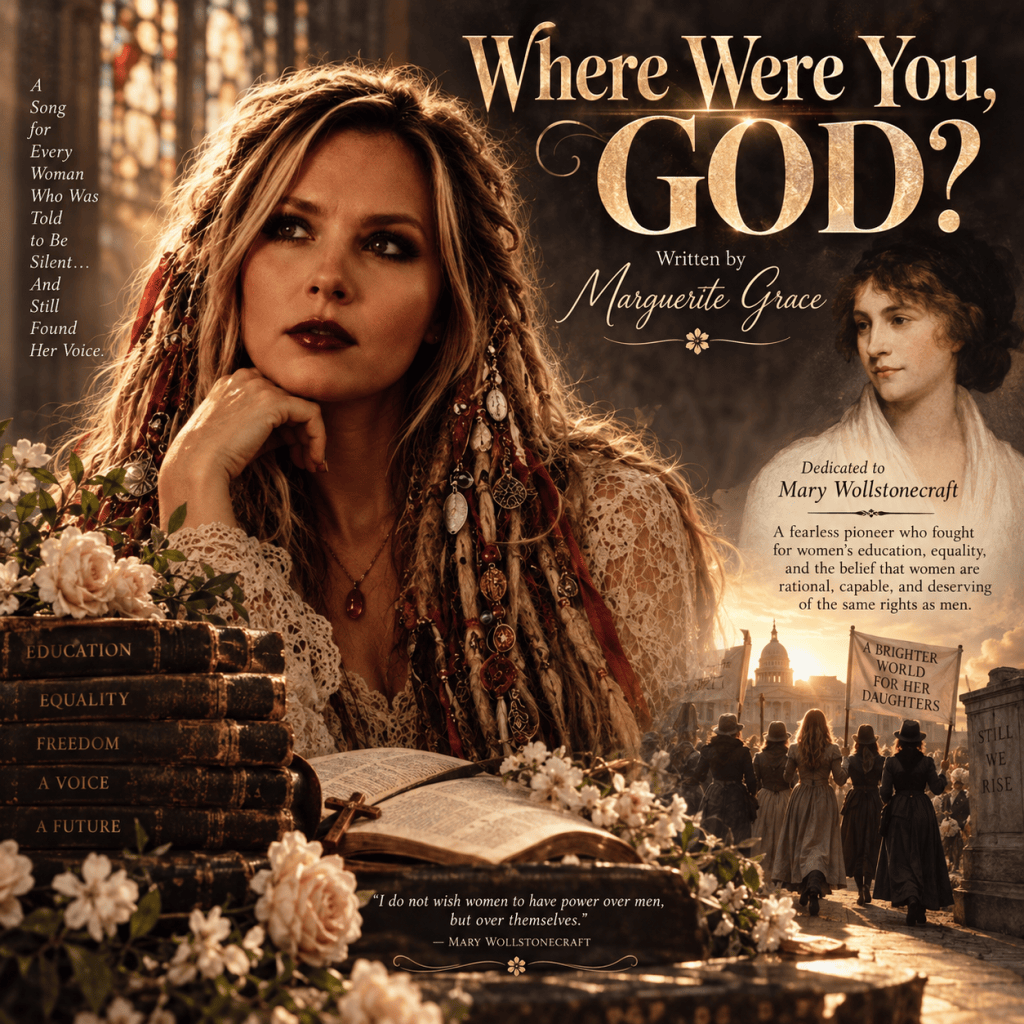
WHERE WAST THOU, GOD?

A Woman’s Lament

I

Where wast Thou, God, when first they bade me kneel,
Not unto Thee—but ‘neath another’s will?
When holy words became the lock and seal,
And Heaven’s name was used to keep me still?

From childhood’s hour they placed the Book in hand:
“Read thou these words. Believe. Obey. Submit.”
Yet none did teach me I might understand,
Or question hands that chose which words would fit.

I learned of Eve before I learned my worth.
Her reaching hand became my ancient stain;
As though one woman’s hunger cursed the earth,
And daughters ever after owed the pain.

“Be silent.”

Thus they said the Scripture spoke.

“Submit.”

Thus was the sacred sentence read.

But now I ask Thee, God—

Was that Thy voice,
Or merely man’s voice
echoing in my head?


II

They showed me Paul:

Let woman learn in quietness.

They showed me:

Let women silent be.

They showed the wife submitting to her husband—

But seldom showed the other words to me.

For Deborah judged beneath the palm.

And Miriam raised her song.

And Huldah spoke the word of God
When learned men had gotten matters wrong.

Phoebe served Thy church.

Priscilla taught.

Junia stood honored among apostles.

Women prophesied.

Women followed.

Women remained beside the Cross
When others fled.

And when the stone was rolled away—

Whom did the risen Christ entrust
To carry resurrection’s news?

A woman.

Mary ran with history upon her tongue.

And still, centuries afterward,

They told her daughters:

“Do not preach.”


III

Tell me, my God:

If woman bears Thine image too,
Why was His image crowned
While hers was covered?

If both were fashioned from Thy thought,
Why was his voice called leadership
And hers rebellion?

Why was his certainty called strength
And hers arrogance?

His anger righteous,
Hers unseemly?

His ambition noble,
Hers unwomanly?

His command authority,
Her command control?

His age wisdom,
Her age disappearance?

Why could a man stand at Thy altar
And tell a room of women
What God required of womanhood—

While the women themselves
Were forbidden from answering?


IV

Perhaps, O Lord, my question frightens men:

Who held the pen?

Who copied parchment?

Who chose the canon?

Who stood behind the pulpit?

Who interpreted the sentence?

Who possessed the school?

Who owned the property?

Who made the law?

Who cast the vote?

Who wore the crown?

Who sat upon the court?

And when a woman whispered,

“But what if God speaks also unto me?”

Who answered,

“Silence.”

Was Scripture written by men
Living in worlds governed by men?

Yes—the fingerprints of patriarchy
Lie upon the centuries.

But was every word designed
As woman’s chain?

That, Lord, I cannot know.

So unto Thee I bring the harder question:

Where ends the voice of God
And where begins
The frightened voice of man
Protecting his dominion?


V

For history hath been a weary courtroom
Where woman entered already on trial.

She asked to own the fruits of her own labor.

They said no.

She asked to own her property.

They said no.

She asked to enter universities.

They barred the gate.

She asked to practice law.

They closed the court.

She asked to vote.

They laughed.

She voted anyway.

They arrested her.

She asked to govern.

They questioned whether woman’s nature
Could withstand the weight.

Yet woman’s nature had withstood
Childbed and grave,
Famine and war,
Widowhood and work,
Violence and abandonment,
While carrying generations
Inside her very flesh.


VI

And here is the mystery
No kingdom fashioned by men can imitate:

Woman makes a chamber of her body
And therein shelters human life.

Her blood becomes a calendar.

Her bones make room.

Her organs yield their place.

Her body builds another body—

A heart she never commanded
begins to beat beneath her own.

She labors at the border
Between life and death,

And from her suffering
A stranger enters history.

Kings came this way.

Presidents came this way.

Popes came this way.

Generals who commanded armies came this way.

Every man who ever stood before a woman
And called her lesser

First entered this world
through woman.

Even Christ—

Whom Christians call the Son of God—

Entered history
through Mary’s body.

Tell me, then:

How became the doorway unto life
unworthy of the doorway to the pulpit?


VII

They called God Father
Until some forgot
That God is greater than the body of a man.

They painted prophets bearded.

Apostles male.

Priests male.

Popes male.

Councils male.

And generation after generation
A little girl looked toward the holy place

And saw authority
wearing only one face.

Then wondered quietly:

Does God look less like me?

But Genesis whispers otherwise:

Male and female
bear the image.

Not he alone.

Not she alone.

Both.

Perhaps Thou art not diminished
When woman stands.

Perhaps man loses nothing
When woman rises.

Perhaps equality was never theft.

Perhaps respect requires no throne
To be surrendered—

Only the ancient lie
that dignity must have a master.


VIII

I think upon the church.

The woman cleaned the sanctuary.

The woman taught the children.

The woman cooked the supper.

The woman organized the charity.

The woman tended the sick.

The woman buried her grief
and came on Sunday anyway.

She sang in the choir.

Raised the children.

Remembered birthdays.

Visited widows.

Fed strangers.

Prayed through midnight.

Kept families breathing.

Filled the pews.

Filled the offering plate.

Filled Heaven with petitions.

And then sometimes a man ascended three steps
onto a platform she had helped prepare

To explain why God
had not called women to stand there.

O Lord—

Canst Thou not hear the contradiction?


IX

They told us submission was holiness.

Sometimes it was love.

Sometimes it was trust.

And sometimes—

let Heaven bear witness—

it became the vocabulary
by which control disguised itself as God.

“Stay.”

“Forgive.”

“Obey.”

“Do not embarrass the family.”

“Do not challenge your husband.”

“Do not challenge your pastor.”

“Do not divide the church.”

And woman learned a terrible arithmetic:

His reputation
plus the institution’s peace

could somehow equal

more than her voice.

Yet what kind of peace
requires another human being
to disappear?


X

Woman asked not to become man.

She asked to become free.

She asked that strength cease being masculine.

That tenderness cease being weakness.

That motherhood be honored
without becoming imprisonment.

That women without children
be no less women.

That intelligence not frighten.

That leadership not offend.

That “No” mean no.

That work receive its worth.

That her body belong first unto herself.

That marriage be partnership,
not ownership.

That faith belong to her conscience.

That God might speak to her
without first obtaining
a man’s permission.

These requests were called radical.

Yet how ordinary they seem:

See me.
Hear me.
Believe me.
Do not own me.
Do not silence me.
Respect me.


XI

And still I will not say
that every man is enemy.

For patriarchy wounds sons also,

Teaching boys that tenderness is shame,
That tears diminish them,
That domination proves their strength,

And teaching men to fear in woman
the very power they should have honored.

There have been fathers who opened doors.

Brothers who stood beside sisters.

Husbands who called their wives equals.

Men who marched beside women
and said:

Her freedom threatens nothing in me.

So mine accusation is not against
the body God called male.

It is against the throne
men built above women

And afterward dared to carve
Thy name upon it.


XII

Therefore I return unto the Book.

Not as the frightened child
who was told merely:

Read.

Believe.

Obey.

But as the woman she became.

I bring my mind.

My questions.

My history.

My anger.

My tenderness.

My scars.

My reason.

My soul.

And if a verse is used to make me small,

I shall read the verse before it.

And the verse after.

I shall ask who spoke,

To whom,

When,

And why.

I shall remember Deborah.

I shall remember Miriam.

I shall remember Huldah.

Phoebe.

Priscilla.

Junia.

Mary.

The unnamed women
whose faith survived though history
forgot to preserve their names.

And I shall remember this:

Silence imposed by man
is not necessarily
silence commanded by God.


XIII

So where wast Thou, God?

Perhaps Thou wert not
upon the throne that silenced me.

Perhaps Thou wert beside me
in the pew.

Perhaps when I swallowed every question,

Thou wert the question.

Perhaps when something deep within me cried,

“This cannot be what love requires,”

that voice was not rebellion.

Perhaps—

it was Thee.

Perhaps Thou hast been waiting
through generations

For daughters to discover
that obedience unto God

and obedience unto men

are not always
the same thing.


XIV — THE RISING

Then rise, thou daughter.

Not above thy brother.

Beside him.

For equality requires no lesser man
and no diminished woman.

Let patriarchal crowns fall down.

Let matriarchy not replace them
with another throne.

Let neither sex become the other’s master.

Let partnership inherit what dominion ruined.

Let woman preach if God hath given words.

Let woman lead if wisdom dwells within her.

Let woman question.

Let woman study.

Let woman govern.

Let woman build.

Let woman heal.

Let woman write.

Let woman discover.

Let woman choose.

Let woman create.

Let woman speak.

And let no mortal man presume
that Heaven gave him ownership
of another soul.


XV — CODA

My whole life
I was taught to read the Bible.

My whole life
I was taught to obey the Bible.

But somewhere along the way
I discovered a terrible possibility:

Perhaps I had sometimes been taught
not obedience to Scripture—

but obedience
to men’s interpretation of Scripture.

And now, O God,

I come not asking permission
to possess the voice
Thou gavest me.

I come asking only this:

When woman rises,

When woman questions,

When woman speaks,

When woman refuses
to disappear—

Where art Thou?

And through the silence
I imagine Heaven answering:

I was never asking thee
to disappear.
Written by Marguerite Grace
Copyright Protected


