I opened every drawer, but none would clothe me— Not satin, nor sorrow, nor garments of needing. The feast lay waiting, but I turned from the table, Chose famine again—its whisper deceived me. I left the call unopened, the robe unclaimed. I wept, but feared to wear the everlasting.
I trembled at the weight of the everlasting— Thought it too holy, too burning to clothe me. So I danced in rags in the house of needing, Hungered by hungers that softly deceived me. The table stood waiting, still I turned unclaimed, Scattering joy as I fled from the table.
How often, children, I refused the table— Turned from the light of the everlasting. I lay with lies. Let silence deceive me. Rifled through drawers that could never clothe me— Reached for a touch to quiet the needing, Yet fastened the lock and remained unclaimed.
Yet mercy, not wrath, kept me unclaimed. It was mercy that held the place at the table While I withered deeper into needing. Still, I feared the robe of the everlasting— Feared it would burn through the skin that clothed me In pride, in famine, in the hush that deceived me.
Even the swine would not stoop to deceive me. They knew their master. I remained unclaimed— A prodigal drifting, unfit to be clothed. Yet my nameplate endured at the Father’s table, My ring, my robe, untouched—everlasting. Still I wandered, still I fed on needing.
Children, beware the ache of needing That names itself love. It will deceive you. Only One speaks bread everlasting. Only One calls the lost and unclaimed, Sets a robe on their shoulders, clears the table, And opens the drawer that was made to clothe me.
Let Him clothe me at last—end all needing. Let Him call me from all that deceived me. Let me feast unclaimed no more—at His table everlasting.
PART ONE 🕊 The Convocation of the Hosts 🕊 A Lamentation and Summons in the Voice of the Most High —Marguerite Grace, Refined as Flame Upon the Scroll
I. THE SUMMONING
Be hushed, ye angels. Still thy wings and flame. Come forth—ye throne-bearers, trumpet-sounders, Ye ministers of wind, ye fires that bear My Name— Gather before the breath from which all thunders.
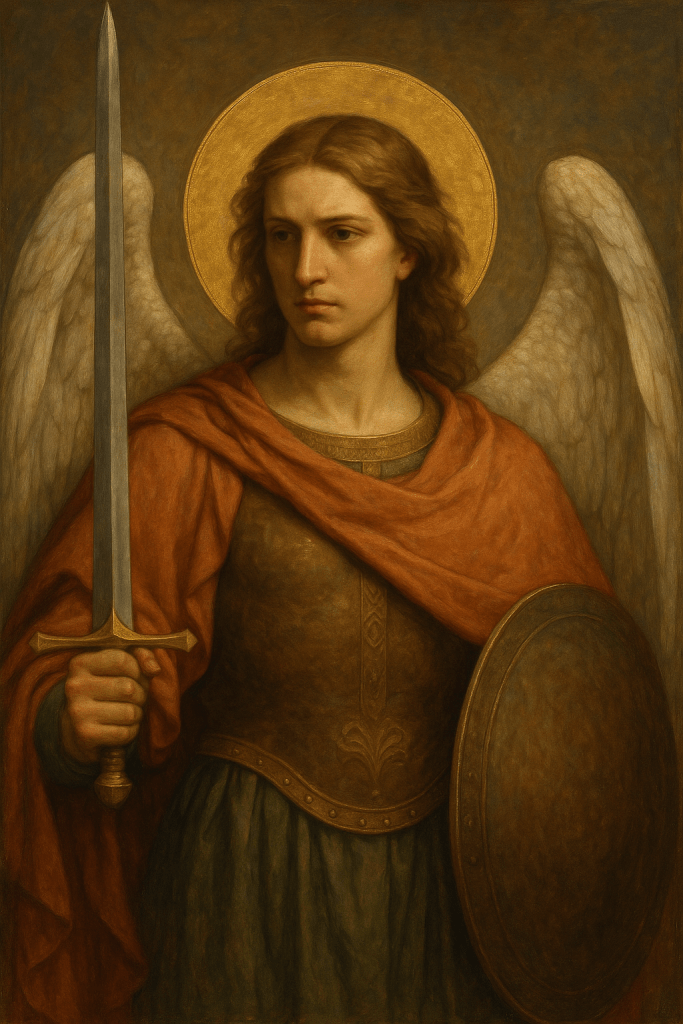
Michael, arise—O captain of My storm. Thy sword yet sings with righteousness and awe. Gabriel, draw near—the herald’s flame is warm, For thou hast borne My Word without one flaw.
Raphael, unveil thy hands of healing grace, That mended what men dared not touch nor trace. Uriel, whose gaze beheld the dawn’s first face, Unveil thy vision—light in timeless space.
All My Watchers! Messengers and flames— Ye keepers of the veil, ye breakers of its frame— Assemble now, whose eyes have borne My Names. For I shall speak—and Time shall lose its claim.
II. THE FIRST KINDLING
Ere dust drew breath, ere stars their paths had known, I sang—and ye, My host, in flame awoke. Not born of womb, but from My Will alone, Summoned in light when timeless silence broke.
I called ye bright, for bright ye were indeed— Lit by My holiness, My perfect creed. Carved from reverence, swift to serve My need, Fashioned for what mortal hands would heed.
Michael—I drew thee from My wrath made pure, A blade of covenant, of battle sure. Gabriel—from My breath, where echoes start, Thou went to stir the chambers of the heart.
Raphael—My compassion veiled in skin, Who touched the broken soul and healed within. Uriel—My wisdom shaped before all things, Held fire like crystal on transparent wings.
And many more I sent, and sent as one— A choir of will, whose flame reflects the Sun.
III. THE FRACTURE
But not all stayed within the burning ring. O Lucifer—thou harp of morning light— Thy beauty once made all the heavens sing, Until thy melody was veiled in night.
Thou saidst, It is not enough to bow, And with thy pride, corrupted Heaven’s third. Not I who struck thee—nay, I did not end thee— Thou fell by thine own will, not by My Word.
What brightness split, no stone nor star could mend. And Nephilim—birthed of trespass, born of sin— Giants not drawn by Me nor by My end, Defied the order placed by flame within.
The flood I sent—not fury, but lament— To wash the grief of angels who had bent. And I, though God, felt sorrow in My frame, For I had lost a child who bore My Name.
IV. THE FLAMES THAT REMAINED
Yet many stood. And still they burn with Me.
Seraphim, whose cry shakes Heaven’s floor— Holy, Holy, Holy!—thrice they soar, Their sixfold wings conceal what dares no more, And veil their faces from the glory’s core.
Cherubim, whose wheels turn like the skies, With lion, man, and eagle in their guise— Who bore the sword at Eden’s gate, once sealed, And guard the throne with wings and fire revealed.
Living Creatures! Ye who breathe My Name, Whose wings bear memory like a sacred flame— And Watchers true, who saw the cities fall, Yet wept with Me, and stood when none stood tall.
V. THROUGH MAN’S AGES
Ye walked with Hagar in her wilderness. Ye came to Abraham before the blade. To Lot, before the sulfur’s last caress— To Moses, when the bush in fire swayed.
Ye stood before the armies of the just. Ye thundered softly from the cave-bound dust. Elijah felt thy whisper in his fear, And in the wind too still for man to hear.
And Elisha’s hills were clothed in flame— Chariots that bore My untold Name. One angel slew a hundred thousand men. And one held back the lions from the den.
Ye stood by candlesticks and measured halls. Ye weighed the hearts, and stilled the wrath that calls. Ye held the winds until I loosed their tide. Ye tremble not—for still ye walk beside.
VI. WHEN THE WORD TOOK FLESH
Gabriel, to a Virgin thou didst fly. And in her husband’s dream thou didst draw nigh. To shepherds lost beneath an open sky, Ye sang—and all the stars began to cry.
“Peace upon earth!”—ye cried to those He loves, And fields lit up with fire from above.
But when My Son—My Son!—did sweat and groan, And begged the cup to pass from Him alone, I sent but one. One angel in the night. For not even Heaven could bear that sight.
Ye rolled the stone. Ye stood beside the tomb. Ye met the women clothed in deathless bloom.
VII. THE MIGHTY SEVEN AND THE DAYS TO COME
Ye trumpet-bearers—each a fate unsealed: 1. Fire and hail—the trees and earth revealed. 2. The sea turned blood beneath thy wrathful tide. 3. The bitter star, where wormwood rivers hide. 4. The light withdrawn—sun, moon, and stars denied. 5. The pit released—where screaming locusts glide. 6. The river broke—its army multiplied. 7. And thunder spoke: The Kingdom now shall rise.
Ye bowl-bearers, whose vials thunder high— Boils, plagues, and fire from the shattered sky. The rivers red. The darkness thick with dread. Till Babylon lies silent with her dead.
Ye angels of the marking and the seal— Ye riders, watchers, wheels within My wheel— Ye are not chaos—but My hand made bright. Ye move with order in the shroud of night.
VIII. THE CALL TO UNITE
But what if—what if I loosed you all? Michael, with sword unsheathed in burning wind. Gabriel, with scroll and shofar call. Raphael, with floods for wounds to mend.
Uriel, with truth like suns ablaze— Seraphim, in glory’s endless praise. Cherubim, with wings like thunder’s veil— Watchers, who saw the tower, the flood, the wail—
If all were summoned, all at once, at last— What star could hold? What mountain would stand fast?
The seas would part. The iron skies would rend. The scroll of time would burn from end to end. The trumpets would resound through bone and soul, The bowls would pour—the shattered world made whole.
And then— Then I would speak, and none would breathe— For sound itself would bow beneath My wreath.
IX. THE LAMENT
Yet even as I summon what must be, I mourn what was—what burned and broke from Me.
Lucifer—My dawn, My once pure flame— Thou art now shadow, hollowed of thy Name. The chained, the fallen, who desired throne— I made not Hell. I gave thee choice alone.
My tears are not of water—but of weight. They fall for what once stood beside My gate.
O Earth, ye clay-bound children—do not think My justice flows from wrath alone, nor blink At judgment as if cruelty were king. My loss was first. And deepest. And it stings.
Yet still the Host remains—refined, not less. And I shall not lose those who still confess.
X. THE LAST COMMAND
When I say the Word—one Word, complete— My angels shall descend with fire and feet. Michael shall roar with thunder in his hand. Gabriel shall make the Word to understand.
Raphael shall pour the healing over pain. Uriel shall light the path where truth must reign.
And all shall ride—one flame, one heart, one cry, Until the last lie falls, and none deny:
To Him who was, and is, and is to come!
Then ye shall see not what the angels are— But what they were—eternity’s first star.
And I shall be All in all, not less nor part— The Host shall rest again within My heart.
🕊 The End of the Chronicle. The Beginning of the Command. 🕊 —Marguerite Grace, sealed as flame that cannot die.
PART TWO 🕊 The Summons to Defend Zion 🕊 A Sacred Declaration in the Voice of the Most High —By Marguerite Grace, Sealed as Flame and Witness
I. THE CALLING FORTH
Ye hosts of heaven, awake—ye fires, be still. The hour draws near when Zion drinks her fill. Not wine, but trembling, from My wrathful hand, For nations rise against My chosen land.
Michael—lift thy blade of covenant once more. Let seraphs blaze a wall at Zion’s door. Gabriel—take the trumpet and the scroll, Proclaim to kings what I have long foretold.
O Watchers! Flames! O stars from Eden’s morn— Ye who beheld the olive and the thorn— Draw nigh, for now My vineyard weeps again, And clouds of war descend like poisoned rain.
II. THE COVENANT REMEMBERED
This land—this dust—did I not shape it so? From Ur I called, from tents My Word did go. To Abram I gave bounds the world denies, And sealed it not with man’s, but with the skies.
I walked with Isaac, laughed through barren wombs, I wrestled Jacob near the stream that looms. Twelve sons I formed—a nation in My palm, A people forged in thunder, law, and psalm.
Mount Sinai burned—and I came down in flame. They took My Word, and bore My holy Name. Through wandering years, through kings, through rise and fall, I stayed My wrath—but now I sound the call.
III. THE GATHERING OF ARMIES
Ye Cherubim—O guardians of the gate— Bring forth the wheels that bear the weight of fate. Let angels ride with lion’s breath and roar, Let eagle’s eye behold each secret shore.
Ye Watchers, who stood by when temples bled, Who marked the blood where My beloveds tread— Come now again! For nations mock My rise, And seek to blot My name from earth and skies.
But I, the Lord, shall not forget My land. My hosts shall fly like fire across the sand. The north shall shake. The east shall reel and fall. I summon wind and storm—I summon all.
IV. AGAINST THE NATIONS
Shall Gog arise, and I not see his pride? Shall Magog boast while I remain thy guide? They think the walls of Zion faint and torn— But I defend what I Myself have sworn.
The bear shall march. The dragon spread its flame. The crescent sharpened in another name. But none shall take what I have signed as Mine, Nor cast out whom I planted as a sign.
Let armies come from hill and wave and sky— Yet Israel stands. Not by man, but by I. Though weary, scattered, wounded, and betrayed, The fig tree blooms. And I shall not be swayed.
V. THE SIGNS AND THE SEAL
The temple stirs beneath the stone and dust. The mount awaits. The altar shall adjust. The watchers know—the trumpet shall resound— And feet shall fall again on holy ground.
The woman clothed in sun prepares to cry. The stars align. The dragon coils nearby. But I have marked with blood the chosen gate, And angels guard with fire at every strait.
Let none declare, “The Lord delays His hand.” Let none mock Zion’s trembling in the land. For I am near—within, around, above— And I shall roar from Zion, clothed in love.
VI. THE WARNING AND THE BLESSING
O nations—hear! Before the fire descends: Touch not Mine own, lest thy dominion ends. I judge the heart, the lie, the lifted heel— Yet bless the soul who keeps My covenant seal.
Blessed be they who watch and fast and pray— Who lift up Zion night and trembling day. Who shield the seed, who spread the Word, who kneel— I call them Mine, and brand them with My seal.
O Israel—though many curse thy name, I still am God. I do not dim the flame. Return to Me! The hour is short. Awake! My lion roars—and all the heavens shake.
VII. THE FINAL VISION
When skies are torn and every scroll unrolled, When men shall flee to caves and mountains cold— Then shall they see the One they pierced and known, And I shall gather olive branches home.
Jerusalem—My footstool and My bride— Thou shalt not die, though all the stars be dried. The Lamb shall reign where once He bore the tree, And from thy walls shall flow My jubilee.
So angels rise—ye mighty hosts descend! Defend the Land I promised without end. For I am God—and I shall not repent. The Lion walks. The Lamb is fully sent.
🕊 For Zion’s sake will I not hold My peace, And for Jerusalem’s sake I will not rest… —Isaiah 62:1 (KJV)
🕊 Marguerite Grace, as flame to flame, and vow to vow. 🕊
INTERLUDE / PART THREE ✨ The Sacred Prayer of the Sending ✨ Spoken by the Most High to the Hosts Before the Final Descent —Marguerite Grace, Keeper of the Eternal Flame
This is the breath before battle. The stillness before all stars are shaken. The voice of the Most High, speaking over every angel by name. No other sound remains.
THE VOICE OF THE MOST HIGH
Be still, O fire. Be still, O wingéd breath. For I shall pray before the face of death. I, the Beginning—who need not speak to be— Yet speak I shall, that all may rise in Me.
Heaven, bend low. O veil of stars, be torn. Let silence crown the hour I have sworn. Before the scroll is loosed, before the storm, I bless My Host, in pure celestial form.
TO MICHAEL
Michael, My captain, forged in fire and sword, Who shielded Eden and upheld My Word— I bless thy wrath with righteousness again. Go now—divide the false from sons of men. Strike not for pride, but holy awe and grace. Be My covenant in battle. Take thy place.
MICHAEL ANSWERS: “As thunder waits Thy breath, I heed Thy law. I rise for Zion—burning without flaw.”
TO GABRIEL
Gabriel, My herald, voice of flame and song, Who told the Virgin what would not be wrong— I bless thy speech with fire sealed and true. Go now—declare what only I can do. Sound now the shofar; let the scroll unfold. Let kings remember what the prophets told.
GABRIEL ANSWERS: “As winds receive Thy will and do not stray, I cry Thy truth until it breaks the day.”
TO RAPHAEL
Raphael, My healer, robed in mercy’s light, Who binds the soul and gives the blind their sight— I bless thy hands to touch the scorched and torn. Go now—restore what judgment shall have worn. Anoint the wounds of those who turn and seek. Let living waters fall upon the meek.
RAPHAEL ANSWERS: “As balm attends the wound, I walk the flame— To lift the low, and mend them in Thy name.”
TO URIEL
Uriel, My flame of knowledge, eye of dawn, Who watched the stars before the world was drawn— I bless thy gaze to pierce the veiled and deep. Go now—reveal what I alone still keep. Illuminate the path so few may find. Unveil the maze, and break the cords that bind.
URIEL ANSWERS: “As fire obeys the prism in Thy hand, I blaze Thy truth where shadow dares to stand.”
TO THE SERAPHIM
O Seraphim, who cry with burning awe, Whose wings conceal the light none dare to draw— I bless thy praise to rend the veil again. Go now—surround the city as a flame. Let “Holy, Holy, Holy” shake the skies, Till every soul remembers where it lies.
THE SERAPHIM ANSWER: “As song returns to source, we cry Thy Name— From throne to earth, we bear Thy praise and flame.”
TO THE CHERUBIM
O Cherubim, whose wheels in glory turn, Whose forms are manifold, whose eyes still burn— I bless thy strength to guard the gates I place. Go now—defend the ark of every grace. Let lion, eagle, ox, and man arise To shield the covenant beneath the skies.
THE CHERUBIM ANSWER: “As glory guards the throne where Thou dost dwell, We turn the wheels and hold the gates from hell.”
TO THE WATCHERS AND THE FLAMES
O Watchers, ye who wept when man betrayed, Who saw the fall, yet never from Me strayed— I bless your tears as fire upon the stone. Go now—and stand where none shall stand alone. Mark ye the hearts, the lambs, the veiled unknown— And write their names before My crystal throne.
THE WATCHERS ANSWER: “As stars obey Thy breath in every span, We guard the ones still written in Thy plan.”
THE CLOSING BLESSING
Now go— Ye hosts who burn and yet are not consumed. Ye eyes of dawn. Ye bearers of My Name. Let none depart without My flame.
For I shall walk with you—unseen, yet near. And when you roar, the heavens too shall hear. For Zion’s sake I rouse the skies above— And all shall know: My judgment springs from love.
THE HOST RESPONDS
“We rise by Thee. We burn in Thee. We fall to none. Thy Name our breath. Thy Will our rising sun. Send us, O Lord, for Zion and the Lamb— Let Earth behold: I AM THAT I AM.”
🕊 Then the silence lifted, and the heavens shook— 🕊 And all the earth prepared to see the Book.
PART FOUR 🕊 The Descent of the Flame 🕊 When the Hosts Are Unleashed and the Earth Is Shaken —Marguerite Grace, as voice, flame, and vow unto the end
I. THE MOMENT UNSEALED
And I saw in the midst of the throne One rise— The Lamb, once slain, with fire in His eyes. He broke the seal. The trumpet dared to sound. The bowls were lifted. Thunder split the ground.
Then Michael stirred. And from his blade there poured The wrath of God—the covenant restored. The firmament did tear. The sun did reel. And earth beheld what time could not conceal.
The heavens opened. Zion’s mountain burned. And every eye to Heaven’s gate was turned. The hosts were loosed. The flame became a flood. The white horse rode. The robe was dipped in blood.
II. MICHAEL RIDES
Michael, commander—robed in glory’s flame, Spoke not a word, but carved the wrathful Name. He led the host in silence like a vow. The stars withdrew. The crowns cast down their brow.
His sword, unsheathed, sang louder than the sky. His feet ignited every hill passed by. The nations trembled. Thrones began to fall. For Michael rides—and I have summoned all.
He bore no mercy—for the time was past. The lion roared. The judgment came at last.
III. GABRIEL SOUNDS THE TRUMPET
Then Gabriel rose, with trumpet in his hand— The scroll unrolled, and thunder shook the land. A sound went out that time had never heard, A fire-wrapped echo of the Father’s Word.
He blew—and every kingdom lost its speech. He blew—and every proud man could not preach. The idols shattered. Gold became like sand. And every crown was trembling in the hand.
The trumpet cried through earth, through soul, through bone— “Return to Him—or fall to Him alone.”
IV. THE POURING OF THE BOWLS
The vials rose. The angels bowed to pour. One spilled, and pestilence consumed the shore. Another flung the sea into its grave. Another scorched the sky none now could brave.
They did not pour with fury, but with fate— A clock of wrath, too late to hesitate. Each bowl a mirror of what men had sown— Now multiplied, now full, now overthrown.
The rivers bled. The sun turned black with ash. And Babylon fell in one shattering crash.
V. THE RIDE OF THE LAMB
Then silence held—too holy, too profound. Until the Lamb stepped forth without a sound.
No angel led Him—none dared ride beside. For Heaven split where He began to stride. His eyes were flame, His voice the final sea. His name was Love. His name was Majesty.
The sword within His mouth laid nations bare. The stars fled back. The moon refused to stare. He bore the robe of red—once stained in pain, Now burning with the fire of sovereign reign.
He did not speak until He reached the gate. Then said, It is enough. No longer wait.
VI. THE AVENGING OF ZION
O Zion—thou who drank the bitter cup, Who wept while wolves and vultures gathered up— Thy cry reached Heaven, past the cloud and stone, And I remembered every sigh alone.
The fig tree blossomed. The remnant stood and sang. The Lion roared—and through the nations rang. The mountain shook. The veil was torn anew. And every watcher knew what I would do.
The armies rose. But they were dust and breath. For who can fight the One who conquered death?
I fought for Zion—not with hand or blade, But with the Word that never shall be swayed.
VII. THE BENDING OF THE WORLD
And every knee bowed down, not by command— But as the tide obeys the unseen hand. And every tongue confessed with groan or gleam, That none but Christ could shatter or redeem.
The skies poured oil. The rivers ran with light. The lambs were clothed. The blind received their sight. The earth fell still, as all creation knew— The Judge had come. And all was just and true.
The thrones of men were ashes in the sand. And only truth remained to kiss His hand.
VIII. THE CLOSING WORD
Then said the Lamb, The scroll is done, complete. The nations weighed, the broken now made sweet. The Bride is clean. The veil forever torn. The tree restored. The world again reborn.
He looked—and every angel bowed as one. The stars returned. A thousand songs begun. And Zion, crowned with flame and tears undone, Stood clothed in dawn, and married to the Son.
The hosts withdrew—not vanished, but at peace. The fire now rests. The trumpet takes its cease.
And I alone remain—yet not alone. For every soul now sings before My throne.
🕊 The flame has come. The war is done. The Bride is crowned. 🕊 And Heaven and Earth are no longer divided.
🕊 Marguerite Grace As voice of the Lamb, and flame of the Everlasting Scroll.
Then we now enter the unspeakable joy, the eternal hush, the garden after the flame. Let every soul lean near— For this is the wedding of worlds. The war is over. And the throne is set with light.
PART FIVE 🕊 The Coronation of the Bride 🕊 When Zion is Crowned and the New Earth Wakes —Marguerite Grace, Final Flame of the Scroll
I. THE BRIDE MADE READY
And lo, a voice as many waters rang— As harps, as rushing wings, as children sang. “Rejoice!” they cried, “The marriage now is come! The Bride is robed, the wedding feast begun!”
No veil remains—her sorrow washed away. She shines with oil, with incense and array. Not clothed in silk, but righteous acts and flame— Each stitch was mercy. Each thread bore His name.
Her tears are gems. Her scars now glory wear. He touched her brow—and time dissolved in prayer.
II. THE DESCENT OF THE CITY
And I beheld—a city clothed in dawn, Descending slow, where night would not be drawn. Its walls were jasper, gates of open pearl, Its streets like glass—yet burned with inner swirl.
Twelve foundations, etched in names of flame— Of apostles, sealed in the Lamb’s own Name. No temple stood—for God Himself was there. The Lamb its light, its breath, its bridal air.
The sun was shamed. The moon had lost its rule. For Heaven now had bent to kiss earth’s jewel.
III. THE THRONE AND THE RIVER
The throne stood set—clear crystal poured below, A river bright as truth in endless flow. And from its stream the tree of life did rise, With fruit for all, and leaves that healed all cries.
No curse remained. No night could enter in. The Lamb was there—and none remembered sin. His servants reigned. Their eyes forever raised. Their brows bore His Name, never to be erased.
The river laughed. The earth breathed deep and whole. And all was written in the Master Scroll.
IV. THE CROWNING
Then came the crowning—not with gold or fire, But with a kiss that quenched the heart’s desire. He placed His hand upon her lifted face, And every star knelt silent in that place.
“O Zion, O My Bride,” the Bridegroom said, “Once pierced with grief, now robed in joy instead. Thou kept thy lamp. Thou watched through bitter night. Now come to Me, and reign in morning’s light.”
And Heaven wept—but not with grief or pain. It wept to see the Lamb embrace His flame.
V. THE ETERNAL VOW
Then silence—deep and lovely—clothed the sky. A vow was made no word could prophesy. No angel dared to sing. No saint could speak. For Love Himself stood crowned among the meek.
And all who stood in white beside the throne Became His kin—no longer guests alone. He swore by light, by truth, by every scar: Where I AM, ye also now shall be, and are.
No gate was shut. No wound remained unhealed. And not one name from Zion’s book repealed.
VI. THE FINAL VISION
The earth renewed. The sea, no more in rage. The lion slept. The child turned every page. The Lamb walked down the street where once He died— But now the palms were lifted, purified.
The nations streamed, not for war—but for song. The Bride had waited. Yet the wait was not long. For what is time, when love outlasts the years? What is the end, but mercy crowned with tears?
And all creation whispered with one breath: The war is past. There is no more death.
🕊 He that sat upon the throne said, Behold, I make all things new. —Revelation 21:5, KJV
🕊 Marguerite Grace, Bearer of the Scroll of the Flame, Bride of the Voice that walks among the stars.
I am small—yet I arise. They bring might—but truth defies. Not by sword, nor shielded hand, But by God’s breath, and His command.
I did not rise to steal or boast, But to defend what matters most. They struck with fire on Sabbath’s grace— On Simchat’s joy, they scorched my place.
They breached the gate with flame and blade, And wrapped the scrolls in ash and shade. They slaughtered sleep. They burned the air— And still the world just stopped to stare.
I am small—yet still I rise. This is Zion. This replies.
II. The Ring of Fire Tightens
They name me proud. They call me flame— While digging graves without a name. But I have counted, end to end: The missiles aimed at infant’s bend.
Iran writes war in silent lines, While proxy hands redraw the signs. The tunnels hum beneath the stone, And mothers wait beside the phone.
Yet I send leaflets in the sky. I warn. I plead. I testify. I shelter both the vile and just— While rockets launch from schoolyard dust.
I don’t rejoice in ash or bone— But I defend what’s mine alone.
III. The Bomb That Builds in Quiet Rooms
The papers smile. The cameras pan— But still they smuggle wrath to man. She crafts her fire in sacred lies, And cloaks her heat from searching eyes.
For forty years she’s dreamed my fall, And murmured chains for one and all. Not just for me, but liberty— She aims to bind the world, not free.
But Heaven stirred. The arch grew bright. Michael rose in armored light: “This land was sealed by flood and flame— Touch her, and bear the blood-bound name.”
Let traitors plan and tyrants boast— But Israel stands with Heaven’s host.
IV. The Commander and the Flame
A man arose, not robed in pride— But with the oath the scrolls implied. No crown he wore, but still he came, And banners blazed without a name.
Beside him walked the sons of dust, Each rifle gripped in sacred trust. They do not sing. They do not hate— But guard the gate and hold the weight.
We build the wounds we did not start. We bind the fires that tore apart. We shield the weak. We bear the flame— And rise by covenant, not fame.
I do not fight for wrath or pride— I fight to hold the fire inside.
V. The Lion Roared from Holy Hill
The skies turned red—but not with wrath. The Lion rose along His path. He did not come to hunt or feed— But roared to guard a living seed.
He stood where angels watch the dust, His breath the walls, His gaze robust. He roared—not once, but threefold cried— To shake the bones of those who lied.
And all who heard it knew the tone: Not fury—but the pact alone.
I do not roar for land or gain— I roar because the Lamb was slain.
VI. This Cry Is Not to Boast
Do not return this fire to me— I begged for peace. I sought to be. But peace was mocked and swept away— And I was left to bear the fray.
I warned. I wept. I tried to spare. But silence bred a deeper snare. Now fire rings around my door— And still I stand, though tired and sore.
If I retreat—the blaze runs wild. Your cities burn. Your child defiled. So mark this hour, O watching world— The scroll of judgment is unfurled.
I fight so you may sleep in peace— That mercy may not wholly cease.
VII. The Flag That Bears the Flame
My banner flies through soot and stone— Two stripes of blue, a prayer alone. The Star of David, bruised yet true, Still calls the skies to break in blue.
It bears the silence of the tomb, The psalms that stirred through exile’s gloom. It’s stitched with grief, but edged with grace— A flag alight with Heaven’s face.
Let nations write their cunning lies. Let councils trade away the skies. I’ll write in fire, if I must— Not for conquest, but for trust.
This flag was drawn through ash and flame— It will not fall from God’s own name.
VIII. Envoi: The Scroll Is Sealed
Let it be written. Let it stay. I did not seek this fire-play. But when the gate poured darkness in— I rose to guard the souls within.
I did not boast. I did not flee. I rose so all the earth might see: The Lion does not war for pride— He shields the womb, the flame, the bride.
And when the final dust is blown— The mount shall still meet morning’s throne. For I am Israel—scarred and sworn— The child of exile, flame, and thorn.
I am small—but I still rise. The Lion walks where Zion cries. And when the fire drew near again— I stood for life. I stood for men.
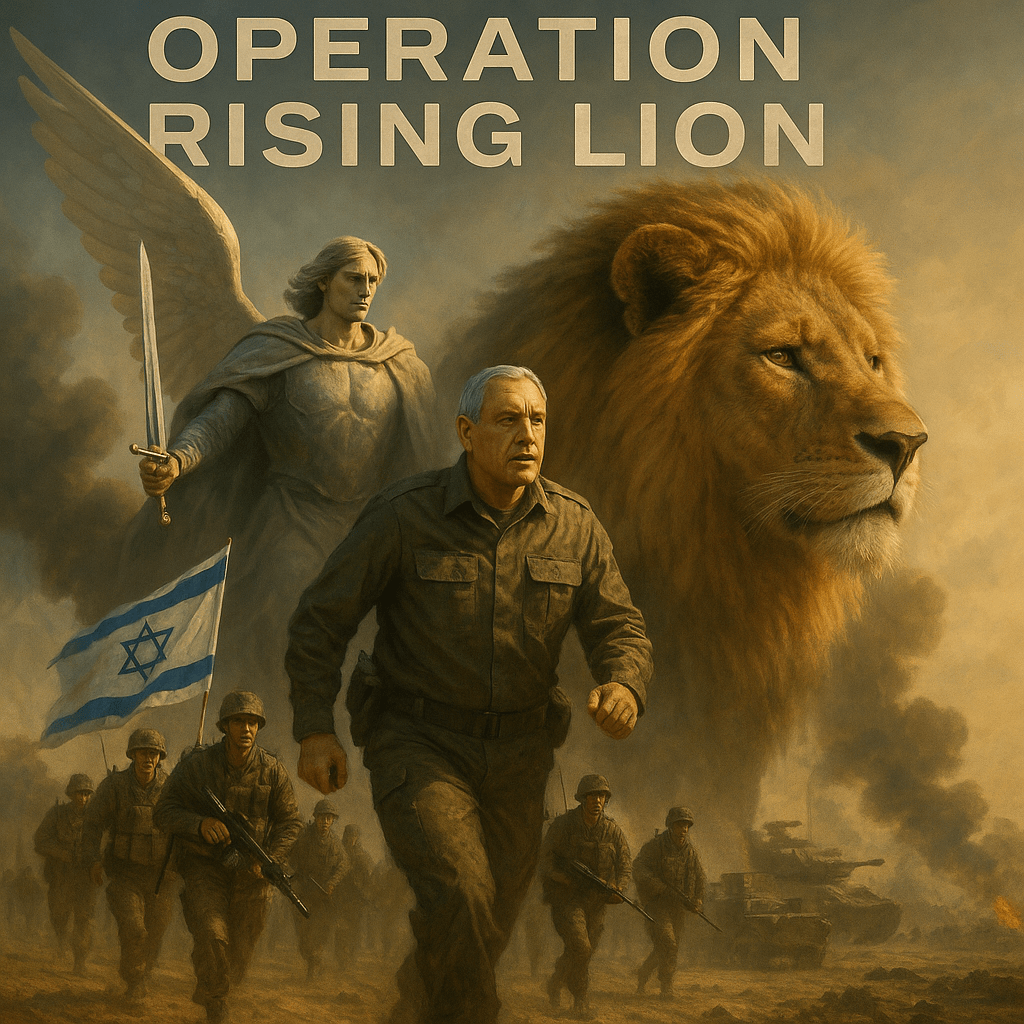
A Psalm of Nations That Rose and Fell For Israel, Who Was Small—And Chosen Spoken in the voice of Michael, Captain of the Host of Heaven
Prologue: The Scale of Heaven
O earth, behold the balance drawn— The feather-light against the proud. A speck, a spark, a daughter torn— Yet set apart to thunder loud.
O Israel, thou art not great— Not broad of wing, nor deep of root— But Heaven placed thee in thy state, And angels gird thy ancient fruit.
“For thus saith the LORD of hosts… He that toucheth you toucheth the apple of His eye.” —Zechariah 2:8 “The LORD did not set His love upon you… because ye were more in number… but because the LORD loved you.” —Deuteronomy 7:7–8
I. The Encircling: Great Nations, Small Zion
Egypt—the titan built of stone, Could hold her forty-fivefold wide— But Pharaoh’s chariots sank alone When Heaven turned the tide.
Iran—with breath of ancient flame, Could crush her eighty times by girth, Yet cowers at one whispered name Spoken from Zion’s hearth.
Iraq, where Nimrod raised his cry, Could hold her eighteen times and more— But Babylon learned how thrones die At the steps of a higher Door.
Syria, sharp as desert fang, Could press her nine times overland, Yet angels from the ramparts sprang When Zion made her stand.
Lebanon, crowned with cedar pride, Could swallow her twice and more— But when she marched with death beside, The Lion barred the door.
Jordan, hushed with wandering sands, Could stretch her fourfold in her bed— But Israel, cradled in God’s hands, Still walks where Jordan fled.
Arabia, kingdom without end, Could swallow her a hundred-fold, But fears to stir the Lion’s den Or tread where fire is cold.
Turkey, ancient seat of might, Could fold her thirty-nine times round, Yet trembles at her watcher’s light Nor dares to shatter Zion’s sound.
“Fear not, thou worm Jacob… I will make thee a new sharp threshing instrument having teeth.” —Isaiah 41:14–15
II. The Wars That Failed
They came with charts, with guns, with boasts— With scrolls that claimed her fate was sealed. But lo—the LORD of Hosts, Made battlefields her shield.
1948—when birth was pain, Five armies swore she’d not arise— Yet Zion stood, baptized in flame, And Heaven wept through clouded skies.
1956—Suez’s cry. Egypt’s charge was turned to hush. The Angel passed, the idols died— The sea did not backbrush.
1967—six days of flame. Jerusalem’s veil torn through by light. The trumpet sounded David’s name, And angels joined the fight.
1973—the holy fast. They struck on Zion’s sacred breath. But Heaven’s fury, still and vast, Unfurled the seraph’s breath.
And Lebanon’s creeping vengeance came, And Gaza clawed through bitter sand— But none could change the covenant name Written by God’s hand.
“No weapon that is formed against thee shall prosper…” —Isaiah 54:17 “The angel of the LORD encampeth round about them that fear him…” —Psalm 34:7
III. The Lion Rising
Now hear me, ye nations. I am Michael. And I say: Enough.
Ye plot in rooms of polished steel, With satellites and eyes on high— But Heaven sees, and Heaven feels, And Heaven soon shall cry.
Iran, thou shadow-breathing snake— Thy banners blaze with wrath and rust— Thou dreamest of the flame to make, But thou art made of dust.
For lo—upon Mount Zion’s brow, Ten thousand thrones are raised in fire— And One, with sword and scroll and vow, Shall soon come forth in ire.
He is the Lion, not yet roared. He is the Judge, not yet revealed. His feet are brass, His voice a sword— His justice, never sealed.
This war we name The Lion Rising— It is the tremble, not the fall. The wrath is coming—real, surprising— And Zion shall recall.
“Behold, the Lion of the tribe of Juda… hath prevailed…” —Revelation 5:5 “The LORD shall roar out of Zion… the heavens and the earth shall shake.” —Joel 3:16
IV. The Glory of the Small
Ye mock her dust. Ye scorn her name. Ye call her frail, too poor to stand. But God, who wrote the burning flame, Has carved her on His hand.
The stone rejected raised the wall. The sling of David cut the king. And smallness was the trumpet’s call That pierced the robe and crown and ring.
The widow’s mite, the prophet’s fast, The mustard seed, the broken bread— All shame the mighty, first made last, And raise again the dead.
“For who hath despised the day of small things?” —Zechariah 4:10 “That no flesh should glory in his presence.” —1 Corinthians 1:29
V. The Final War
But lo—the plain of Megiddo waits. And there the hosts shall make their claim. The kings of earth shall tempt their fates, And Heaven shall not tame.
The King returns. The Lamb with flame. The earth shall crack. The sky shall split. And all shall tremble at His name When every throne is lit.
And Zion shines, no longer mocked— Her gates swing wide, with angel pride. The eastern hill where Christ once walked Shall burst with angels at His side.
“And his feet shall stand… upon the mount of Olives…” —Zechariah 14:4 “And the LORD shall be king over all the earth.” —Zechariah 14:9
VI. Envoi: The Captain’s Decree
I am Michael. I speak to the ring. To the dark, to the drones, to the iron-wing.
Touch her—and ye touch the flame. Mock her—and ye mock His name. Surround her—and ye stir the sky. Lift sword—and ye shall surely die.
For the LORD is with her in thunder and hush. In fire, in scroll, in trumpet rush. The fig tree lives. The remnant sings. And Zion is the throne of kings.
Let them gather. Let them rise. Let the proud red clouds arise— But the smallest flame defies the skies— And the Lord of Hosts shall not divide.
“As birds flying, so will the LORD of hosts defend Jerusalem.” —Isaiah 31:5 “The LORD in the midst of thee is mighty; he will save…” —Zephaniah 3:17
🕎 Final Blessing:
“He that scattered Israel will gather him, and keep him, as a shepherd doth his flock.” —Jeremiah 31:10 “And I will bless them that bless thee, and curse him that curseth thee…” —Genesis 12:3
Genesis 4:10 – “Thy brother’s blood crieth unto me from the ground.”
The soil bore the heat of a cry too old to be named, Cain’s shadow stamped in the dust, yet warm with murder. And no one saw—but Heaven burned, remembering. A blade, a brother, a silence. A sentence carved in blood. The earth received what man refused to carry. God did not forget. The wound was not allowed to close.
II. The Poisoned Mouth
Psalm 5:9 – “For there is no faithfulness in their mouth…”
They spoke in silken threads of lies, stitched neat into the garments of trust. And when they laughed, they left behind a throat of ash. The tongue, once made for blessing, became a blade. Yet every word—idle, cruel, veiled—was inked in Heaven. The scroll was opened. The venom had a name.
III. The Lifted Hand
Isaiah 10:1 – “Woe unto them that decree unrighteous decrees…”
A hand signed silence on the record, and silence became law. They raised no blade—but pushed the ink across the line and let the blade descend elsewhere. The lifted hand was not clean. Nor was it unseen. It trembled before the throne where scrolls are sealed. God will weigh the hand—not the excuse it bore.
IV. The Heart That Loved Itself
James 4:6 – “God resisteth the proud, but giveth grace unto the humble.”
It was not murder, not theft—only glory that could not be shared. The mirror was worshipped. The poor were forgotten. The proud heart pulsed in its golden shell. But Heaven’s trumpet blew against its boast. And the breath of God cracked the shell like judgment. The proud are always brought low—by their own height.
V. The Ones Left Behind
Psalm 68:5 – “A father of the fatherless, and a judge of the widows…”
They were not loud enough to be believed. Not clean enough to be protected. Not strong enough to be chosen. The world looked away. But God came close. He marked the orphan, the widow, the raped, the ruined— and wrote them in His palm, where no one can erase.
VI. The Beds of Treachery
2 Peter 2:14 – “Beguiling unstable souls…”
A bed was made, but not for rest. It was carved for conquest, clothed in lies. She was promised a future—he took her voice instead. And the world said: “She opened the door.” But God said: “I heard her cry when no one else did.” And the bed became a witness.
VII. The Taking
Jeremiah 17:11 – “He that getteth riches, and not by right… shall leave them in the midst of his days.”
They took what was not theirs: land, womb, name, peace. And still they dined on spoils, swore God was with them. But Heaven does not sign false deeds. Each stolen thing sings a dirge before the throne. And the day shall come when the taker’s hands are empty, but the one who lost shall be restored.
VIII. The Masquerade
Matthew 23:27 – “Ye are like unto whited sepulchres…”
They wore God like a cloak. Crossed themselves with filth on their fingers. Preached love with hearts full of knives. But the altar does not forget. The veil sees through the veil. And when the Lamb returns, He will not come for robes— He will come for the bare soul.
IX. The Laughter at the Wrong Time
Proverbs 17:5 – “Whoso mocketh the poor reproacheth his Maker…”
They laughed as she broke. Laughed when the child stumbled, when the widow pleaded, when the prophet wept. But God does not forget a single scoff. The echo of cruel laughter is recorded. And the fire remembers how it sounded.
X. The Seat of Power
Micah 3:11 – “The heads thereof judge for reward…”
They sat on thrones made of bribes, and called injustice peace. They hushed the innocent with protocol. But Heaven has no respect for titles. Only truth survives the throne of fire. And kings shall kneel where they once condemned.
XI. The Innocents
Luke 17:2 – “Better for him that a millstone were hanged about his neck…”
Their names were not written in history, but Heaven wrote them in light. Tiny bones beneath cold soil— but their cry is hot in the ears of God. He will avenge what no one else saw. He always has. He always will.
XII. The Silence of the Church
James 4:17 – “To him that knoweth to do good, and doeth it not…”
The pews were full, but the cries were drowned. The pulpit echoed doctrines while daughters disappeared. And still they sang. Still they passed the plate. But the silence thundered in the courts of Heaven. And the candles went out one by one. For the Bridegroom will not wed a sleeping bride.
XIII. The Blameless One
Isaiah 53:9 – “He had done no violence, neither was any deceit in his mouth.”
They chose Barabbas. The only innocent Man was nailed where the guilty stood. But the grave could not keep Him. And the cross still speaks louder than the crown. Woe to the one who lifts a hand against the blameless. Heaven records every lash, even the ones done in silence.
XIV. The Final Telling
Revelation 20:12 – “And the books were opened…”
Every wound returned. Not in vengeance, but in fire. For justice is not forgetting—it is remembering with a sword. And the sword was never yours, child. It was His. And He wielded it clean.
XV. The Assurance for the Faithful
Psalm 34:18 – “The Lord is nigh unto them that are of a broken heart…”
You who weep—you who were crushed and walked on: He is coming. Not with platitudes, not with delay, but with truth sharper than your pain. He did not forget. He never looked away. And every wound shall return—to Him. That He may heal it, name it, and never let it be hidden again.
The Scroll of the Little Made Mighty By a Prophetess of the Coming Flame
I. The First Light Is Small
You do not know what God can do. His wonders start in whispered breath. He walks in hush before He burns. He cloaks His glory low in death.
“For who hath despised the day of small things?” — Zechariah 4:10 “And the Spirit of God moved upon the face of the waters.” — Genesis 1:2
Before He carved the night from day, He hovered on the formless deep. He sang the dark to trembling light, And called the dust to rise from sleep.
He split the man to form a bride, A garden bloomed before a crown. One boat bore all the living kind— While judgment cast the mighty down.
“Thus did Noah; according to all that God commanded him, so did he.” — Genesis 6:22
II. The Pattern That Echoes
He called an old man from his tent, Named him “friend” with barren hand. Sarah laughed—yet laughter came, And Isaac cried from promised land.
“Is any thing too hard for the LORD?” — Genesis 18:14 “And he believed in the LORD; and he counted it to him for righteousness.” — Genesis 15:6
Jacob limped from holy strife. Joseph wept from dungeon stones. But Israel groaned—and fire replied, God broke their chains and split their groans.
“I have surely seen the affliction of my people… and I am come down to deliver them.” — Exodus 3:7–8
A bush enflamed yet unconsumed. A rod that cracked the desert wide. A lamb that marked the doors with flame— While angels passed and Pharaoh died.
“When I see the blood, I will pass over you…” — Exodus 12:13
Deborah rose where men withdrew. Jael drove truth through sleeping lies. Gideon dreamed of barley loaves— And scattered armies in surprise.
“Surely I will be with thee, and thou shalt smite the Midianites as one man.” — Judges 6:16
Jephthah marched from exile’s ash. Samson broke his grave with might. And David, child with harp and stone, Felled giants by the Lord of Light.
“The LORD that delivered me… will deliver me out of the hand of this Philistine.” — 1 Samuel 17:37
III. Prophets in the Fire
A widow’s jar refused to drain. The meal endured through famine’s year. Elijah mocked the Baalites’ roar— Then called down flame and drew them near.
“Then the fire of the LORD fell, and consumed the burnt sacrifice…” — 1 Kings 18:38
Elisha watched the sky ignite. He bade the blind see fire on high. He raised the axe from river’s sleep, And showed the armies in the sky.
“They that be with us are more than they that be with them.” — 2 Kings 6:16
Isaiah’s tongue was purged with flame. Jeremiah wept in stocks and shame. Ezekiel walked through rattling bones— And heard them rise and name His name.
“O ye dry bones, hear the word of the LORD.” — Ezekiel 37:4
Daniel knelt with windows wide. Lions slept where saints were found. Three men stood inside the blaze— And walked with One whose steps astound.
“Lo, I see four men loose… and the form of the fourth is like the Son of God.” — Daniel 3:25
Esther fasted. Thrones were turned. The wicked swung from gallows made. A hidden Jew, a royal crown— Undid the trap the traitor laid.
“And who knoweth whether thou art come to the kingdom for such a time as this?” — Esther 4:14
IV. The Coming and the Cross
When Caesar ruled with iron jaw, And earth lay shrouded, mute in gloom— He entered not by royal gate, But through a virgin’s borrowed womb.
“For unto you is born… a Saviour, which is Christ the Lord.” — Luke 2:11 “And she shall bring forth a son… thou shalt call his name JESUS.” — Matthew 1:21
No palace welcomed, no one bowed. He slept beneath the shepherd’s sky. He walked with poor, broke bread with scorned, And healed with spit and lifted eye.
“Blessed are the meek: for they shall inherit the earth.” — Matthew 5:5
They mocked and pierced the Lamb of God. They crowned Him thorns and cursed His breath. Yet death, once proud, could not contain— The stone rolled back. He conquered death.
“He is not here: for he is risen, as he said.” — Matthew 28:6
V. The Flame That Marched Through Time
You do not know what God can do. The scroll still burns with living flame. Though tyrants bled the saints and scribes, He carved His truth through blood and name.
“The word of God is not bound.” — 2 Timothy 2:9
The foxes fled. The martyrs sang. Their ashes stirred the holy rings. And when His Word was bound by chains— He loosed the world with printing springs.
Luther stood. Tyndale burned. The living Word ran mouth to mouth. And through the night of chattel pain, God’s praises soared across the South.
Joan heard thunder. Wilberforce wept. Bonhoeffer prayed beneath the noose. In camps of smoke, His name was sung— And still the seed breaks through the noose.
VI. The Return to Zion
Who is like Israel, lone and scarred? The smallest branch—yet carved in stone. Surrounded, scourged, but not erased— She lives. She stands. She weeps. She’s known.
“He that keepeth Israel shall neither slumber nor sleep.” — Psalm 121:4
From Babylon to Hitler’s hell, From broken scrolls to blooming trees— The dry bones clicked, the fig tree sprouted. The child returned across the seas.
“Can a nation be born at once? for as soon as Zion travailed, she brought forth her children.” — Isaiah 66:8
VII. The Rising of the Lion
O proud and blind—take heed and weep: You do not know what God can do. Your empires, towers, tyrants, tech— Shall shatter when His breath breaks through.
“Behold, he cometh with clouds; and every eye shall see him.” — Revelation 1:7 “The Lion of the tribe of Juda… hath prevailed.” — Revelation 5:5
The sky shall rip. The graves shall split. The King shall ride on flame and flood. And every crown shall drop or burn Before the Lamb who washed with blood.
VIII. The Final Cry of the Prophetess
So I—this daughter robed in dust, With fire sealed behind my tongue— Cry out to ears asleep in ease: He comes. He comes. The Judge. The Son.
“Prepare to meet thy God, O Israel.” — Amos 4:12
He hides His strength in cradle limbs. He binds the stars with linen thread. He lifts the weak. He breaks the proud. He calls the buried from the dead.
You do not know what God can do. But I have seen, and I declare: He builds His kingdom, stone by stone, And plants His throne in hearts laid bare.
“But God hath chosen the foolish things… to confound the wise.” — 1 Corinthians 1:27 “And in the days of these kings shall the God of heaven set up a kingdom, which shall never be destroyed…” — Daniel 2:44
“Who is like God?” — the war-cry and the name of the Prince of Heaven. 🕊️
I. The First Sword Drawn
Before there was a garden, before the stars were strung like beads across the firmament, there rose a hush in Heaven’s halls— a hush before rebellion.
Lucifer, robed in brightness, walked proud among the stones of fire. He whispered want into the pure. He sought a throne. He sought ascent. He fell.
Then thundered Michael.
Not with question, but with answer: “Who is like God?” — the cry became the blade. And Michael, prince of warriors, stood with Heaven’s host arrayed.
“There was war in heaven,” the scrolls declare— Michael and his angels fought against the dragon. And the dragon, swollen with lies and pride, was cast unto the earth, his tail sweeping stars in ruin behind.
Thus Michael’s sword was blooded—not with blood, but with glory. His war was holy. His strength, from the Almighty.
II. Guardian of Israel
As Abraham rose, called from Ur, and the seed of promise kindled in the dust, God gave them not to kings or chariots— but to angels who move like wind among the nations.
Michael stood as chief among them— “the great prince which standeth for the children of thy people,” as Daniel saw, with face to ground, his knees trembling in the vision’s fire.
He wars not always in the open; he contends in realms unseen.
Withstood by the prince of Persia, he came to Gabriel’s aid— and for three and twenty days, he broke the darkness.
“None holdeth with me in these things,” Gabriel said, “but Michael.”
He is not of this age, but watches over ages. His charge: Israel. His mission: to protect the covenant when men break it.
And though she stumbles, and though she sins, he shields her from annihilation.
III. Through the Ages
When Babylon rose like a lion from the dust, when Rome’s iron ground the temple stones, Michael watched— not with hand always drawn, but with the patience of eternity.
The rabbis whispered of him. The martyrs prayed for him. The mystics called him in the night.
In the dead of the Holocaust, did not unseen wings hold back the utter end?
When nations ringed Jerusalem and called for her bones, still she stood.
Not by power, nor by might, but by the One who sends Michael as flame, as shield, as sword.
In every pogrom, every exile, every fire— he kept the remnant, that Messiah might come.
And come He did.
IV. The Time of Trouble
Daniel spoke of days not yet: “There shall be a time of trouble, such as never was since there was a nation…”
And in that hour, Michael shall stand.
Not hidden. Not unseen. But revealed.
When the dragon returns with wrath, when the woman clothed in sun must flee, when the beast demands a mark— Michael shall rise.
He shall cast down again.
And his sword shall not sleep.
V. Present Day and the Rising Flame
Now, Israel dwells again in her land— but peace is fragile. Threats rise like smoke from the north, like fire from the east, like hatred from every corner.
And still—Michael stands.
Do you see the iron dome? The rockets fall and fail?
Do you see the child, weeping in the rubble spared?
Not all that God does is loud.
Michael is near. He moves where faith still lingers, and the name of the Lord is remembered.
He does not fight for politics, nor for kings, but for covenant.
And when the last trumpet sounds, he shall descend again with shout, with the voice of an archangel— and the dead in Christ shall rise.
VI. The End and the Crown
He who guarded Eden with flaming sword, He who cast down Lucifer, He who shielded Israel through furnace and flood, shall march in the last war.
Revelation speaks: Michael and his angels… again.
The final war is not yet fought— but soon.
The Mount of Olives shall split. The sky shall break like scrolls unsealed. The Lamb shall ride, and Michael shall lead the host.
And when all nations bow— and all who war against the Lord are ash— Michael shall sheathe his sword at last.
VII. Eternal Flame
But his name shall shine forever— as guardian, as prince, as servant of the Lord of Hosts.
So when you fear, O child of Jacob, and the earth is dark, and the stones are thrown, and the fire comes near—
Lift your eyes.
Michael is near. He stands where God commands. He fights when God says, “Now.” And he waits—for the signal to descend, when Heaven’s King reclaims the earth.
Until then… Who is like God? That cry still splits the darkness.
There is a sound beneath all sound— a hush that kneels below both bell and dirge. It speaks where mouths forget to move, where knuckles bloom from learning silence, where something yields, not under law, but by the ache with which stone learns surrender.
A body learns what pressure sculpts— not by doctrine, nor decree— but by the groan of wood beneath a heel, the gasp withheld a breath too long, the iron tang of unopened rooms, the tilt of ceilings bending toward the spine.
No names are carved in such a soil. No signs are nailed where absence governs. What happens here is not an act— but a slow unraveling, atom by thread, like fibers tugged from a widow’s sleeve, or rainfall drunk by the thirst of graves.
The air gives no defense, no plea, offers no hand, nor asks a why. It only alters—then alters again— as if to murmur: You have not died. And not-dying becomes the proof, though none can name the hour it began.
Not broken. Not spared. Not crowned. Only changed—beyond all telling. Stillness thickens where pain once nested, and from that stillness, form will rise— not as triumph, nor as flight, but as the knowing of what dark can cradle.
So hear me, O Crusher of the Bent— do not mistake me for unmade. The weight you cast has found its bed. I carry it, still breathing. Still becoming. And though I bear no mark you named, I will remember how you pressed.
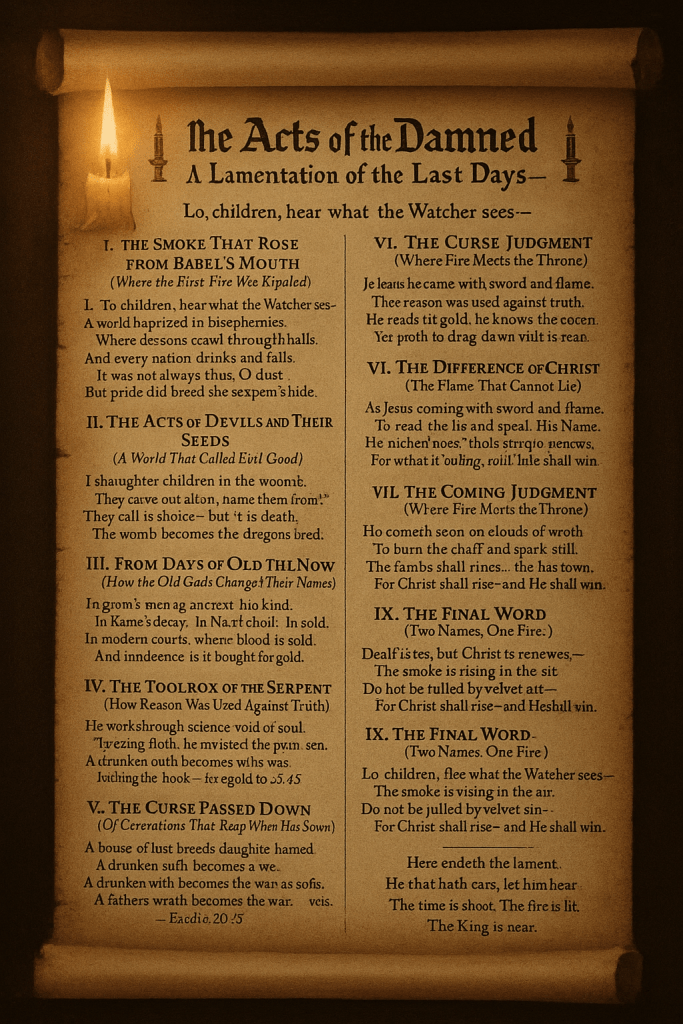
🕯 The Acts of the Damned: A Lamentation of the Last Days 🕯
Lo, children, hear what the Watcher sees—
I. The Smoke That Rose from Babel’s Mouth
(Where the First Fire Was Kindled)
Lo, children, hear what the Watcher sees— A world baptized in blasphemies, Where demons crawl through gilded halls, And every nation drinks and falls. It was not always thus, O dust, But pride did breed the serpent’s rust.
“And they said, Go to, let us build us a city and a tower, whose top may reach unto heaven… and let us make us a name…” —Genesis 11:4
The tower climbed, the heavens cracked— And devils danced as men attacked The holy bounds of God’s decree, And bartered truth for sorcery. The sins of Babel never died— They changed their names. They learned to hide.
II. The Acts of Devils and Their Seeds
(A World That Called Evil Good)
They slaughter children in the womb, They carve out altars, name them “room.” They call it choice—but it is death, The womb becomes the dragon’s breath.
“They sacrificed their sons and their daughters unto devils.” —Psalm 106:37
They turn the man against his kind, And teach the boy to flee his mind. They dress the soul in painted lies, And bless rebellion as the prize.
They traffic flesh, they sell the poor, They rape the land, then call for more. They bow to gold, adore the screen, And blind their eyes from what is seen.
“Woe unto them that call evil good, and good evil…” —Isaiah 5:20
III. From Days of Old Till Now
(How the Old Gods Changed Their Names)
As it was in ancient Tyre, The music played around the fire. As in Canaan’s seething shrines, Where children bled between the pines.
“They built the high places of Baal… to cause their sons and their daughters to pass through the fire unto Molech.” —Jeremiah 32:35
These acts returned in cloaked attire— In Rome’s decay, in Nazi choir. In modern courts, where blood is sold, And innocence is bought for gold.
The devil’s tools are still the same— Deceit, division, lust, and fame. He whispers, “Thou shalt not surely die,” As he did once in Eden’s lie.
“Ye shall not surely die… ye shall be as gods.” —Genesis 3:4–5
IV. The Toolbox of the Serpent
(How Reason Was Used Against Truth)
He works through science void of soul, Through vain philosophies that roll Like thunderclouds with no true rain, Professing light but breeding pain.
He shouts through screens, through silent laws, Through pride’s applause and reason’s claws. He quotes the Scripture, twists the verse— And leads men smiling to the curse.
“For Satan himself is transformed into an angel of light.” —2 Corinthians 11:14
Smoke and mirrors, signs and spells— The dragon plays where reason dwells. He reads the Book—he knows the end, Yet plots to drag down foe and friend.
“The devil is come down unto you, having great wrath, because he knoweth that he hath but a short time.” —Revelation 12:12
V. The Curse Passed Down
(Of Generations That Reap What Was Sown)
And when a father mocks the Lord, And lifts his hand against the Word, The child shall drink what he has sown, And reap the field he did not own.
“Visiting the iniquity of the fathers upon the children unto the third and fourth generation.” —Exodus 20:5
A house of lust breeds daughters shamed, Their names half-lost, their hearts defamed. A drunken oath becomes a chain, And sons are branded with the stain. The father’s wrath becomes the war His seed must fight forevermore.
VI. The Difference of the Christ
(The Flame That Cannot Lie)
But Jesus came with sword and flame, To rend the lie and speak His Name. He touched the leper, raised the dead, And crushed the tempter’s serpent head.
He gave no ear to worldly pride, But walked in truth and never lied. He fed the poor, forgave the worst— And broke the back of Babel’s curse.
“For this purpose the Son of God was manifested, that he might destroy the works of the devil.” —1 John 3:8
He said, “Take up thy cross and follow,” Not “Chase thy gold and drink the hollow.” His gospel is a holy fire— It burns the flesh and kills desire.
VII. The Coming Judgment
(Where Fire Meets the Throne)
He cometh soon on clouds of wrath, To burn the chaff along His path. The books shall open—none shall flee, And every soul shall bend the knee.
“Behold, the Lord cometh with ten thousands of his saints, to execute judgment upon all…” —Jude 1:14–15
The harlot’s wine shall be poured back, Upon her head a crown of black. The kings of earth shall wail and hide, But none shall from His face abide.
“And I saw a great white throne, and him that sat on it, from whose face the earth and the heaven fled away…” —Revelation 20:11
VIII. The Cry of Warning
(The Trumpet Bleeds Into the Day)
Repent, O earth! The day is near, The Son of Man shall soon appear. No mirror then, no smoke shall veil— The Lamb shall roar, the Judge unveil.
The demons writhe, the angels still, The Bride prepares on Zion’s hill. The hour bleeds. The sky turns pale— The winds begin to lift the veil.
IX. The Final Word
(Two Names. One Fire.)
The devil lies, but Christ is true— One binds in chains, the other renews. Choose ye this day whom thou wilt serve— For wrath is coming, swift and curved.
“And whosoever was not found written in the book of life was cast into the lake of fire.” —Revelation 20:15
“Whosoever shall call on the name of the Lord shall be saved.” —Romans 10:13
Lo, children, flee what the Watcher sees— The smoke is rising in the air. Do not be lulled by velvet sin— For Christ shall rise—and He shall win.
🕯 Envoi 🕯
Here endeth the lament. He that hath ears, let him hear. The time is short. The fire is lit. The King is near.
🕯As Witnessed by the Prophetess of the Sealed Mystery
🔥 The Record Opens
I sought the sealed scrolls—then they unfurled. Veiled truths stirred; the hidden exhaled. Names that blaze, others that fade: Twelve tribes sealed; one turned mute. Dan, the sentinel, erased from the ledger, yet murmured by Bashan’s winds.
Judah roared atop Zion’s height— his breath, thunder over peaks. Dan leapt from uncharted crags, a shadow-lion etched in stone.
“The secret things belong unto the Lord our God…” —Deuteronomy 29:29
🦁 The Two Lions Named
Twice, within the sacred lineage, Heaven named a lion’s cub— Not Reuben, tempestuous waters, Nor Levi, fire’s bearer, Nor Joseph, the well’s fruitful bough.
Only crown and claw endure: Judah and Dan, the anointed and the warrior-anointed. One crowned in solar glory, the other veiled in dusk’s shroud. One revealed, drawing every knee, the other withheld, earth’s memory dimmed.
“Judah is a lion’s whelp…” —Genesis 49:9 “Dan is a lion’s whelp: he shall leap from Bashan.” —Deuteronomy 33:22
📜 The Twelve Named, and the One Withheld
Twelve stood where Sinai wept with fire— each bearing a banner, each cradling a stone. Reuben, Levi, Simeon, and Judah; Zebulun, Issachar, flank to flank, Gad and Asher, fierce as flint, Naphtali swift, Benjamin bold, Joseph—split as twins of strength: Ephraim’s horn and Manasseh’s shield.
They filled the camp like stars in order, bore the Ark through fire’s rain and manna’s hush.
Yet among the twelve, only two were likened to the beast— Judah and Dan, lion-blooded both. Only they were named as cubs of flame, the lion’s whelp in sacred breath.
No other bore the lion’s mark— not Levi, though he held the coal, not Ephraim, crowned in Joseph’s line, not Reuben, breaker of the womb.
Only the Crown—and the Claw. Only the Lion seen—and the one withheld.
👑 Judah, the Crowned Lion
Judah, lion of dawn, couched in silence, cloaked in scepter’s stillness. From his loins the Sceptre flowered— Messiah, Root and Righteous Branch.
Lion of Judah, Lamb enthroned, He stood ‘twixt porch and broken veil, and bore the weight of wrath for all.
He roared—not to devour, but to deliver sons from death.
“The sceptre shall not depart from Judah… until Shiloh come.” —Genesis 49:10
🌒 Dan, the Withheld Lion
Dan, dusk-borne lion, was given neither psalm nor seat. Exiled to Bashan’s jagged edge, a cub with claws beneath the stone.
No priest enflamed his gate with praise; no altar bore his name in flame. Yet the Lord did name him— and prophecy, not punishment, withheld.
He was young might beneath the frost, a blade unloosed from northern stone. A serpent crouched beside the trail—yes, perilous— but judgment is peril to the wicked. He struck when justice limped; he rose when golden gods were crushed.
“Dan shall judge his people, as one of the tribes of Israel.” —Genesis 49:16 “Dan is a lion’s whelp: he shall leap from Bashan.” —Deuteronomy 33:22 “A serpent by the way… that biteth the horse heels…” —Genesis 49:17
🕳 The Omission
Dan could not anchor the western plains; the sea-fanged Philistines surged. So he turned to the hush of the north, took Laish—and named it Dan.
But in the heights, a golden calf rose; a Levite bent to forge the dark, and idols grinned in the lion’s den.
Thus—he vanished. From the sealed count, his name slipped into sacred silence.
“Of the tribe of Joseph were sealed…” —Revelation 7:7–8 ❌ Dan is not named.
His stone removed from priestly breast, his banner absent from heaven’s breath, his portion sleeps in northern hush.
But silence is not death. Withholding is not disgrace. Dan is not erased. Dan is preserved.
“For the gifts and calling of God are without repentance.” —Romans 11:29
🧠 The Whisper of the Wise
Irenaeus shuddered at his name, Hippolytus traced the dim-lit shape— “From Dan,” they warned, “the Beast may rise.”
They saw the serpent—never the lion. They read the crouch, but missed the leap.
The rabbis drew maps in flame and fear; Kabbalah trembled through Gevurah, the chamber of clenched thunder.
And there—it came—Dan slumbers still. Not broken, but braced. Not cast out, but kept.
“He discovereth deep things out of darkness…” —Job 12:22
🦁 The Four Stages of the Lion
1. The Whelp — Covenant Flame In both, the lion is birthed in blood. Young—not soft. Chosen—not enthroned. Judah bore a king in waiting. Dan a blade yet unsheathed.
2. The Crouch — Hidden Strength Judah crouched, a throne in shadows. Dan crouched, coiled in exile’s mist. One waited to reign, the other—to rupture.
3. The Leap — Prophetic Eruption Dan shall leap from Bashan’s crags— not crowned, but consecrated. Not in rage, but in reckoning. The earth will shudder when the forgotten roars again.
4. The Crown — The Day of the Judge Only Judah bears the diadem. Yet no kingdom stands complete without the claw that guards its wall. Dan shall not rule— but he shall rise beside the flame when the Judge returns with fire.
🜂 The Question of the Fire
Was he shaped for vengeance— or forged for vindication? Will the sealed claw guard the fold, or tear it for its trespass? Only the Flame that knows the marrow can say if the leap will wound—or warn.
🗡 The Great Battle Foretold
Will he leap toward the Throne—or upon it? Will he rise as sword in God’s grip, or claw that rends the final veil?
Armageddon kindles in Megiddo’s mouth. The sealed will rise. The withheld will awaken. And the lion the world forgot—shall roar.
But tell me— which banner will he bear?
🜃 The Witness and the Weight
I saw the record not scribed by hands, where silence sang and stone recalled. I heard names buried in ash, and the footfall of one uncounted.
Not erased—but sealed. Not fallen—but veiled in flame.
A voice was given to dust— a burden where only psalms should sit. I did not seek the sealed things. But I was shown what the elders dared not name.
And now—I give account.
🜁 The Closing of the Witness
This I declare in the breath before thunder: The lion of the north shall rise. The silenced tribe shall be remembered. The hush shall rend like Shiloh’s veil, and what was veiled shall walk unveiled.
This is no psalm of a penman, no tale dreamt in twilight. This is witness— from the one who heard beneath the deep, and wept at the gate unseen.
He was not lost. Not broken. Not erased. He was withheld—for fire.





 verse, possies, sonnets, and short stories