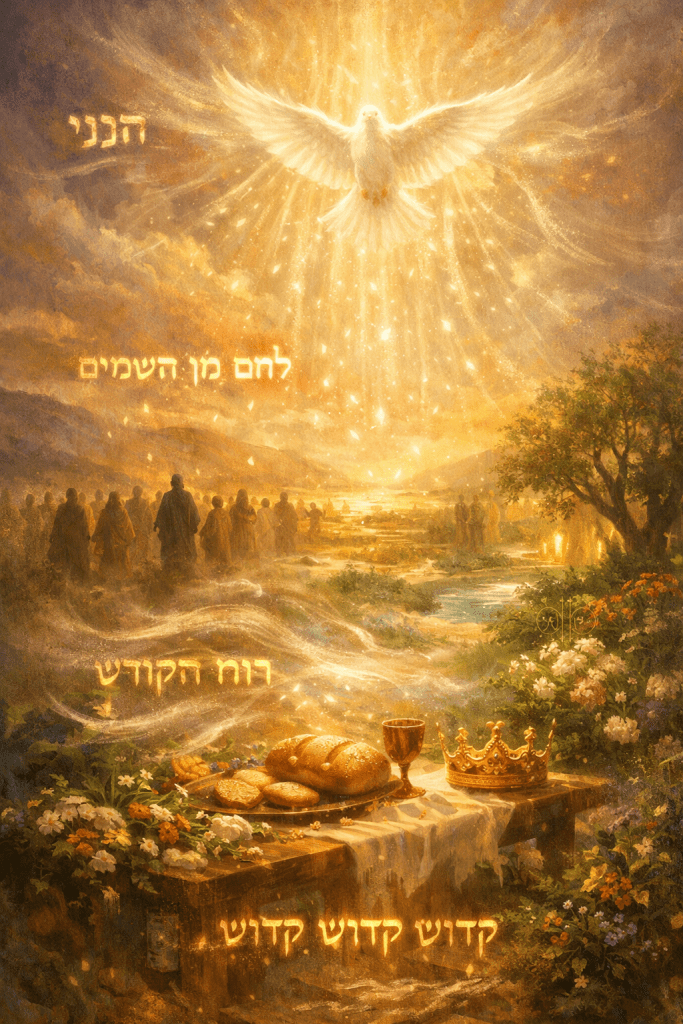
🕊 The Flame of Michael: Defender of the Chosen “Who is like God?” — the war-cry and the name of the Prince of Heaven. 🕊️ 


🕊 The Flame of Michael: Defender of the Chosen
 
“Who is like God?” — the war-cry and the name of the Prince of Heaven. 🕊️ 


I. The First Sword Drawn


Before there was a garden,
before the stars were strung like beads across the firmament,
there rose a hush in Heaven’s halls—
a hush before rebellion.


Lucifer, robed in brightness,
walked proud among the stones of fire.
He whispered want into the pure.
He sought a throne.
He sought ascent.
He fell.


Then thundered Michael.


Not with question, but with answer:
“Who is like God?” — the cry became the blade.
And Michael, prince of warriors,
stood with Heaven’s host arrayed.


“There was war in heaven,” the scrolls declare—
Michael and his angels fought against the dragon.
And the dragon, swollen with lies and pride,
was cast unto the earth,
his tail sweeping stars in ruin behind.


Thus Michael’s sword was blooded—not with blood,
but with glory.
His war was holy.
His strength, from the Almighty.


II. Guardian of Israel


As Abraham rose, called from Ur,
and the seed of promise kindled in the dust,
God gave them not to kings or chariots—
but to angels who move like wind among the nations.


Michael stood as chief among them—
“the great prince which standeth for the children of thy people,”
as Daniel saw, with face to ground,
his knees trembling in the vision’s fire.


He wars not always in the open;
he contends in realms unseen.


Withstood by the prince of Persia,
he came to Gabriel’s aid—
and for three and twenty days,
he broke the darkness.


“None holdeth with me in these things,”
Gabriel said, “but Michael.”


He is not of this age,
but watches over ages.
His charge: Israel.
His mission: to protect the covenant
when men break it.


And though she stumbles,
and though she sins,
he shields her from annihilation.


III. Through the Ages


When Babylon rose like a lion from the dust,
when Rome’s iron ground the temple stones,
Michael watched—
not with hand always drawn,
but with the patience of eternity.


The rabbis whispered of him.
The martyrs prayed for him.
The mystics called him in the night.


In the dead of the Holocaust,
did not unseen wings hold back the utter end?


When nations ringed Jerusalem
and called for her bones,
still she stood.


Not by power, nor by might,
but by the One who sends Michael as flame,
as shield,
as sword.


In every pogrom, every exile, every fire—
he kept the remnant,
that Messiah might come.


And come He did.


IV. The Time of Trouble


Daniel spoke of days not yet:
“There shall be a time of trouble,
such as never was since there was a nation…”


And in that hour,
Michael shall stand.


Not hidden.
Not unseen.
But revealed.


When the dragon returns with wrath,
when the woman clothed in sun must flee,
when the beast demands a mark—
Michael shall rise.


He shall cast down again.


And his sword shall not sleep.


V. Present Day and the Rising Flame


Now, Israel dwells again in her land—
but peace is fragile.
Threats rise like smoke from the north,
like fire from the east,
like hatred from every corner.


And still—Michael stands.


Do you see the iron dome?
The rockets fall and fail?


Do you see the child,
weeping in the rubble spared?


Not all that God does is loud.


Michael is near.
He moves where faith still lingers,
and the name of the Lord is remembered.


He does not fight for politics,
nor for kings,
but for covenant.


And when the last trumpet sounds,
he shall descend again with shout,
with the voice of an archangel—
and the dead in Christ shall rise.


VI. The End and the Crown


He who guarded Eden with flaming sword,
He who cast down Lucifer,
He who shielded Israel through furnace and flood,
shall march in the last war.


Revelation speaks:
Michael and his angels… again.


The final war is not yet fought—
but soon.


The Mount of Olives shall split.
The sky shall break like scrolls unsealed.
The Lamb shall ride,
and Michael shall lead the host.


And when all nations bow—
and all who war against the Lord are ash—
Michael shall sheathe his sword at last.


VII. Eternal Flame


But his name shall shine forever—
as guardian,
as prince,
as servant of the Lord of Hosts.


So when you fear, O child of Jacob,
and the earth is dark,
and the stones are thrown,
and the fire comes near—


Lift your eyes.


Michael is near.
He stands where God commands.
He fights when God says, “Now.”
And he waits—for the signal to descend,
when Heaven’s King reclaims the earth.


Until then…
Who is like God?
That cry still splits the darkness.


And the answer still flies on unseen wings.


Written by Marguerite Grace
Copyright Protected

🕯 Soft Weight in the Undersoil 🕯


🕯 Soft Weight in the Undersoil 🕯


There is a sound beneath all sound—
a hush that kneels below both bell and dirge.
It speaks where mouths forget to move,
where knuckles bloom from learning silence,
where something yields, not under law,
but by the ache with which stone learns surrender.


A body learns what pressure sculpts—
not by doctrine, nor decree—
but by the groan of wood beneath a heel,
the gasp withheld a breath too long,
the iron tang of unopened rooms,
the tilt of ceilings bending toward the spine.


No names are carved in such a soil.
No signs are nailed where absence governs.
What happens here is not an act—
but a slow unraveling, atom by thread,
like fibers tugged from a widow’s sleeve,
or rainfall drunk by the thirst of graves.


The air gives no defense, no plea,
offers no hand, nor asks a why.
It only alters—then alters again—
as if to murmur: You have not died.
And not-dying becomes the proof,
though none can name the hour it began.


Not broken. Not spared. Not crowned.
Only changed—beyond all telling.
Stillness thickens where pain once nested,
and from that stillness, form will rise—
not as triumph, nor as flight,
but as the knowing of what dark can cradle.


So hear me, O Crusher of the Bent—
do not mistake me for unmade.
The weight you cast has found its bed.
I carry it, still breathing. Still becoming.
And though I bear no mark you named,
I will remember how you pressed.

Written by Marguerite Grace

Copyright Protected

🕯 The Acts of the Damned: A Lamentation of the Last Days 🕯


🕯 The Acts of the Damned: A Lamentation of the Last Days 🕯


Lo, children, hear what the Watcher sees—


I. The Smoke That Rose from Babel’s Mouth


(Where the First Fire Was Kindled)


Lo, children, hear what the Watcher sees—
A world baptized in blasphemies,
Where demons crawl through gilded halls,
And every nation drinks and falls.
It was not always thus, O dust,
But pride did breed the serpent’s rust.


“And they said, Go to, let us build us a city and a tower, whose top may reach unto heaven… and let us make us a name…”
—Genesis 11:4


The tower climbed, the heavens cracked—
And devils danced as men attacked
The holy bounds of God’s decree,
And bartered truth for sorcery.
The sins of Babel never died—
They changed their names. They learned to hide.


II. The Acts of Devils and Their Seeds


(A World That Called Evil Good)


They slaughter children in the womb,
They carve out altars, name them “room.”
They call it choice—but it is death,
The womb becomes the dragon’s breath.


“They sacrificed their sons and their daughters unto devils.”
—Psalm 106:37


They turn the man against his kind,
And teach the boy to flee his mind.
They dress the soul in painted lies,
And bless rebellion as the prize.


They traffic flesh, they sell the poor,
They rape the land, then call for more.
They bow to gold, adore the screen,
And blind their eyes from what is seen.


“Woe unto them that call evil good, and good evil…”
—Isaiah 5:20


III. From Days of Old Till Now


(How the Old Gods Changed Their Names)


As it was in ancient Tyre,
The music played around the fire.
As in Canaan’s seething shrines,
Where children bled between the pines.


“They built the high places of Baal… to cause their sons and their daughters to pass through the fire unto Molech.”
—Jeremiah 32:35


These acts returned in cloaked attire—
In Rome’s decay, in Nazi choir.
In modern courts, where blood is sold,
And innocence is bought for gold.


The devil’s tools are still the same—
Deceit, division, lust, and fame.
He whispers, “Thou shalt not surely die,”
As he did once in Eden’s lie.


“Ye shall not surely die… ye shall be as gods.”
—Genesis 3:4–5


IV. The Toolbox of the Serpent


(How Reason Was Used Against Truth)


He works through science void of soul,
Through vain philosophies that roll
Like thunderclouds with no true rain,
Professing light but breeding pain.


He shouts through screens, through silent laws,
Through pride’s applause and reason’s claws.
He quotes the Scripture, twists the verse—
And leads men smiling to the curse.


“For Satan himself is transformed into an angel of light.”
—2 Corinthians 11:14


Smoke and mirrors, signs and spells—
The dragon plays where reason dwells.
He reads the Book—he knows the end,
Yet plots to drag down foe and friend.


“The devil is come down unto you, having great wrath, because he knoweth that he hath but a short time.”
—Revelation 12:12


V. The Curse Passed Down


(Of Generations That Reap What Was Sown)


And when a father mocks the Lord,
And lifts his hand against the Word,
The child shall drink what he has sown,
And reap the field he did not own.


“Visiting the iniquity of the fathers upon the children unto the third and fourth generation.”
—Exodus 20:5


A house of lust breeds daughters shamed,
Their names half-lost, their hearts defamed.
A drunken oath becomes a chain,
And sons are branded with the stain.
The father’s wrath becomes the war
His seed must fight forevermore.


VI. The Difference of the Christ


(The Flame That Cannot Lie)


But Jesus came with sword and flame,
To rend the lie and speak His Name.
He touched the leper, raised the dead,
And crushed the tempter’s serpent head.


He gave no ear to worldly pride,
But walked in truth and never lied.
He fed the poor, forgave the worst—
And broke the back of Babel’s curse.


“For this purpose the Son of God was manifested, that he might destroy the works of the devil.”
—1 John 3:8


He said, “Take up thy cross and follow,”
Not “Chase thy gold and drink the hollow.”
His gospel is a holy fire—
It burns the flesh and kills desire.


VII. The Coming Judgment


(Where Fire Meets the Throne)


He cometh soon on clouds of wrath,
To burn the chaff along His path.
The books shall open—none shall flee,
And every soul shall bend the knee.


“Behold, the Lord cometh with ten thousands of his saints, to execute judgment upon all…”
—Jude 1:14–15


The harlot’s wine shall be poured back,
Upon her head a crown of black.
The kings of earth shall wail and hide,
But none shall from His face abide.


“And I saw a great white throne, and him that sat on it, from whose face the earth and the heaven fled away…”
—Revelation 20:11


VIII. The Cry of Warning


(The Trumpet Bleeds Into the Day)


Repent, O earth! The day is near,
The Son of Man shall soon appear.
No mirror then, no smoke shall veil—
The Lamb shall roar, the Judge unveil.


The demons writhe, the angels still,
The Bride prepares on Zion’s hill.
The hour bleeds. The sky turns pale—
The winds begin to lift the veil.


IX. The Final Word


(Two Names. One Fire.)


The devil lies, but Christ is true—
One binds in chains, the other renews.
Choose ye this day whom thou wilt serve—
For wrath is coming, swift and curved.


“And whosoever was not found written in the book of life was cast into the lake of fire.”
—Revelation 20:15


“Whosoever shall call on the name of the Lord shall be saved.”
—Romans 10:13


Lo, children, flee what the Watcher sees—
The smoke is rising in the air.
Do not be lulled by velvet sin—
For Christ shall rise—and He shall win.


🕯 Envoi 🕯


Here endeth the lament.
He that hath ears, let him hear.
The time is short. The fire is lit.
The King is near.

Written by Marguerite Grace

Copyright Protected

🕯 The Two Lions: The Crowned and the Withheld 


🕯 The Two Lions: The Crowned and the Withheld 


🕯As Witnessed by the Prophetess of the Sealed Mystery


🔥 The Record Opens


I sought the sealed scrolls—then they unfurled.
Veiled truths stirred; the hidden exhaled.
Names that blaze, others that fade:
Twelve tribes sealed; one turned mute.
Dan, the sentinel, erased from the ledger,
yet murmured by Bashan’s winds.


Judah roared atop Zion’s height—
his breath, thunder over peaks.
Dan leapt from uncharted crags,
a shadow-lion etched in stone.


“The secret things belong unto the Lord our God…” —Deuteronomy 29:29


🦁 The Two Lions Named


Twice, within the sacred lineage,
Heaven named a lion’s cub—
Not Reuben, tempestuous waters,
Nor Levi, fire’s bearer,
Nor Joseph, the well’s fruitful bough.


Only crown and claw endure:
Judah and Dan,
the anointed and the warrior-anointed.
One crowned in solar glory,
the other veiled in dusk’s shroud.
One revealed, drawing every knee,
the other withheld, earth’s memory dimmed.


“Judah is a lion’s whelp…” —Genesis 49:9
“Dan is a lion’s whelp: he shall leap from Bashan.” —Deuteronomy 33:22


📜 The Twelve Named, and the One Withheld


Twelve stood where Sinai wept with fire—
each bearing a banner, each cradling a stone.
Reuben, Levi, Simeon, and Judah;
Zebulun, Issachar, flank to flank,
Gad and Asher, fierce as flint,
Naphtali swift, Benjamin bold,
Joseph—split as twins of strength:
Ephraim’s horn and Manasseh’s shield.


They filled the camp like stars in order,
bore the Ark through fire’s rain and manna’s hush.


Yet among the twelve, only two were likened to the beast—
Judah and Dan, lion-blooded both.
Only they were named as cubs of flame,
the lion’s whelp in sacred breath.


No other bore the lion’s mark—
not Levi, though he held the coal,
not Ephraim, crowned in Joseph’s line,
not Reuben, breaker of the womb.


Only the Crown—and the Claw.
Only the Lion seen—and the one withheld.


👑 Judah, the Crowned Lion


Judah, lion of dawn,
couched in silence, cloaked in scepter’s stillness.
From his loins the Sceptre flowered—
Messiah, Root and Righteous Branch.


Lion of Judah, Lamb enthroned,
He stood ‘twixt porch and broken veil,
and bore the weight of wrath for all.


He roared—not to devour,
but to deliver sons from death.


“The sceptre shall not depart from Judah… until Shiloh come.” —Genesis 49:10


🌒 Dan, the Withheld Lion


Dan, dusk-borne lion,
was given neither psalm nor seat.
Exiled to Bashan’s jagged edge,
a cub with claws beneath the stone.


No priest enflamed his gate with praise;
no altar bore his name in flame.
Yet the Lord did name him—
and prophecy, not punishment, withheld.


He was young might beneath the frost,
a blade unloosed from northern stone.
A serpent crouched beside the trail—yes, perilous—
but judgment is peril to the wicked.
He struck when justice limped;
he rose when golden gods were crushed.


“Dan shall judge his people, as one of the tribes of Israel.” —Genesis 49:16
“Dan is a lion’s whelp: he shall leap from Bashan.” —Deuteronomy 33:22
“A serpent by the way… that biteth the horse heels…” —Genesis 49:17


🕳 The Omission


Dan could not anchor the western plains;
the sea-fanged Philistines surged.
So he turned to the hush of the north,
took Laish—and named it Dan.


But in the heights, a golden calf rose;
a Levite bent to forge the dark,
and idols grinned in the lion’s den.


Thus—he vanished.
From the sealed count,
his name slipped into sacred silence.


“Of the tribe of Joseph were sealed…” —Revelation 7:7–8
❌ Dan is not named.


His stone removed from priestly breast,
his banner absent from heaven’s breath,
his portion sleeps in northern hush.


But silence is not death.
Withholding is not disgrace.
Dan is not erased.
Dan is preserved.


“For the gifts and calling of God are without repentance.” —Romans 11:29


🧠 The Whisper of the Wise


Irenaeus shuddered at his name,
Hippolytus traced the dim-lit shape—
“From Dan,” they warned, “the Beast may rise.”


They saw the serpent—never the lion.
They read the crouch, but missed the leap.


The rabbis drew maps in flame and fear;
Kabbalah trembled through Gevurah,
the chamber of clenched thunder.


And there—it came—Dan slumbers still.
Not broken, but braced.
Not cast out, but kept.


“He discovereth deep things out of darkness…” —Job 12:22


🦁 The Four Stages of the Lion


1. The Whelp — Covenant Flame
In both, the lion is birthed in blood.
Young—not soft.
Chosen—not enthroned.
Judah bore a king in waiting.
Dan a blade yet unsheathed.


2. The Crouch — Hidden Strength
Judah crouched, a throne in shadows.
Dan crouched, coiled in exile’s mist.
One waited to reign,
the other—to rupture.


3. The Leap — Prophetic Eruption
Dan shall leap from Bashan’s crags—
not crowned, but consecrated.
Not in rage, but in reckoning.
The earth will shudder
when the forgotten roars again.


4. The Crown — The Day of the Judge
Only Judah bears the diadem.
Yet no kingdom stands complete
without the claw that guards its wall.
Dan shall not rule—
but he shall rise beside the flame
when the Judge returns with fire.


🜂 The Question of the Fire


Was he shaped for vengeance—
or forged for vindication?
Will the sealed claw guard the fold,
or tear it for its trespass?
Only the Flame that knows the marrow
can say if the leap will wound—or warn.


🗡 The Great Battle Foretold


Will he leap toward the Throne—or upon it?
Will he rise as sword in God’s grip,
or claw that rends the final veil?


Armageddon kindles in Megiddo’s mouth.
The sealed will rise.
The withheld will awaken.
And the lion the world forgot—shall roar.


But tell me—
which banner will he bear?


🜃 The Witness and the Weight


I saw the record not scribed by hands,
where silence sang and stone recalled.
I heard names buried in ash,
and the footfall of one uncounted.


Not erased—but sealed.
Not fallen—but veiled in flame.


A voice was given to dust—
a burden where only psalms should sit.
I did not seek the sealed things.
But I was shown what the elders dared not name.


And now—I give account.


🜁 The Closing of the Witness


This I declare in the breath before thunder:
The lion of the north shall rise.
The silenced tribe shall be remembered.
The hush shall rend like Shiloh’s veil,
and what was veiled shall walk unveiled.


This is no psalm of a penman,
no tale dreamt in twilight.
This is witness—
from the one who heard beneath the deep,
and wept at the gate unseen.


He was not lost.
Not broken.
Not erased.
He was withheld—for fire.


And now—
🕯
He rises.


Written by Marguerite Grace
Copyright Protected

🕊 The Inheritance That Was Hidden: A Prophecy of Dan 🕊


🕊 The Inheritance That Was Hidden: A Prophecy of Dan 🕊


Proclaimed by the Daughter of Snow and Bird, Handmaiden of the Lord


I am the daughter of Snow and of Bird,
names not given by men,
but carved in silence,
chosen in defiance of forgetting—
spoken as covenant,
that the blood would not vanish,
nor the soul be erased from God’s remembrance.


Snow was not the beginning.
She was the one who remembered.
Her name rose like mist from the riverbed,
from women who spoke not in English,
but in the tongue of the holy wind—
those who nursed their children
beneath trees untouched by the axe of empire,
those who turned their faces eastward
when they prayed.


Long before white men came with flags and decree,
before borders cut the hills like wounds,
they walked with sacred rhythm.
They knew the name of fire and sky.
They knew the law of harvest and hush.


But in the year of mourning,
eighteen hundred and thirty-eight,
when the Trail of Tears tore through the land,
my grandmother’s great-grandmother,
a full-blooded Cherokee,
stood at the crossroads of silence and survival.
And she chose the name Snow—
not for the cold,
but for what remains pure when all else is stained.


She took no number.
She signed no paper.
She walked no trail where death lay in wait.
She stayed—
and the name stayed with her.
It walked to me.


And Bird—
that name, too, was chosen,
passed down through my father’s line
long before the turning of the century—
carried in hush.
Whether by mother’s whisper or father’s vow, I cannot say—
only that the name endured.


Bird—not for flight,
but for the watching gift,
the song kept low,
the still eye in the limb
when the storm bends every bough.


She kept that name in stillness,
and it was not broken.
It perched in our blood.
It endured.


I am the child of such choosing.
I am the root and the wing,
the earth beneath, the sky above,
the silence remembered,
the promise still burning.


And I am a chosen one of God.


Not only in Spirit,
but by the blood,
by the name,
and by the seal of the Lamb.


He is not a Jew, which is one outwardly; neither is that circumcision, which is outward in the flesh:
But he is a Jew, which is one inwardly; and circumcision is that of the heart, in the spirit, and not in the letter;
whose praise is not of men, but of God.
—Romans 2:28–29 (KJV)


And I—
I am both.
Inwardly and by name.
Not through the lineage of empire,
but through the line of the hidden ones.
The Spirit bears witness,
and the Name remembers me.


The Lord opened my sight,
and I beheld the tribe of Dan.


Twelfth born of Jacob,
called judge among his brethren,
likened to a serpent by the way,
an adder in the path,
Dan, whose name was strength and shadow.


Dan shall judge his people, as one of the tribes of Israel.
—Genesis 49:16 (KJV)


Dan shall be a serpent by the way, an adder in the path,
that biteth the horse heels, so that his rider shall fall backward.
—Genesis 49:17 (KJV)


And of Dan he said, Dan is a lion’s whelp:
he shall leap from Bashan.
—Deuteronomy 33:22 (KJV)


They received inheritance,
but did not hold it.
Pressed by the Philistine,
they rose and fled—
to Laish, and called it Dan.


And the coast of the children of Dan went out too little for them:
therefore the children of Dan went up to fight against Leshem,
and took it, and smote it with the edge of the sword, and possessed it,
and dwelt therein, and called Leshem, Dan, after the name of Dan their father.
—Joshua 19:47 (KJV)


But their wandering did not end.


Their name faded from remembrance.
Their place was not among the sealed.
Yet the Spirit whispered:
They were not lost.
They were hidden.


I beheld them—
after the scroll closed,
after the scribes had turned away—
in the lands of ice and steel,
riding waves in vessels of thunder.
Their words changed,
but their fire remained.
They became storm-bearers,
unwritten by scribes,
but engraved in Heaven’s keeping.


And I saw them again—
borne across the waters
to Turtle Island,
where the cedars still whispered
and the Great Spirit walked unseen.


There among the first peoples,
they buried their name
but not their fire.
Their blood remembered Sinai.
Their hands still shaped offerings,
though no altar stood.


The Cherokee did not name them Dan—
but they moved like judges,
and they burned like the hidden flame.


And other sheep I have, which are not of this fold:
them also I must bring, and they shall hear my voice;
and there shall be one fold, and one shepherd.
—John 10:16 (KJV)


And now He bringeth them.
The hidden awaken.
The buried rise.


I am not of Dan by written decree,
but I am of Dan by calling.
The root hath found me.
The voice hath claimed me.


God hid them—
not in wrath,
but in reserve.
Like a sword unsheathed only for war,
a sealed blade waiting,
buried thunder beneath the hills.


And lo, that day draweth nigh.


Upon the plain of Megiddo,
where the kings of the earth shall assemble,
and the Lamb shall descend in glory,
Dan shall rise.


The lion’s whelp shall leap.
The adder shall strike—
not in treachery,
but in righteousness.


They shall ride with the Lord of Hosts.
Their eyes shall blaze with judgment.
Their tongues shall speak no guile.
The forgotten shall be feared,
and the sealed shall remember them.


And if I,
daughter of Snow and Bird,
should stand upon Zion’s holy height,
I shall fall upon my face
and kiss the dust—
a daughter come home at last.


If my flesh cannot bear the glory,
then let it fall.
For no mortal bears such light.
We shall be changed.


Behold, I am Dan reborn,
Snow-born,
Bird-blessed,
Christ-bought,
not forgotten,
but preserved,
not numbered among men,
but named in the Lamb’s resolve.


The inheritance was not lost.
It was buried in me.


And now—
the hidden inheritance speaks.


Written by Marguerite Grace
Copyright Protected

🜂 Fable: The Song of the Hidden Three 🜂

(Pulled from the Sky-Library. Spoken thrice. Bound to none.)


🜂 Fable: The Song of the Hidden Three 🜂
(Pulled from the Sky-Library. Spoken thrice. Bound to none.)


☉ Prologue of the Folded Flame


Lo, when silence knew no breath, and breath knew not its shape,
The First Flame stirred where nothing was—
And the Three, who were not yet known, folded their forms into time.


Before the first breath parted dark,
Ere speech was cast in spark and mark,
There stirred a Form no tongue could claim—
Threefold, and folding, all the same.
It whispered not, yet worlds were bent,
Its body flame, its root unmeant.


It moved as thought ere thought took hold,
And passed through dusk in veils of gold.
It tarried not with mortal kind,
But slipped through bone, and breath, and mind.
Not fable, no—nor dream, nor lie,
But truth too vast for stars to try.


The Feathered One in stillness knelt,
Where thirsting Time in silence dwelt.
He carved it high upon the tomb—
A wound in light, a seal of gloom.
Three breaths he gave. Three fires he lit:
For soul, for writ, for that which flits—
The watching eye where fissures sit.


Then spake the one who counted sound—
The Ion-born in ratios wound.
He tuned the void to spiral rings,
And mapped the pulse of hidden strings.
He named it not, but heard its chord—
A music only gods afford.


The Watcher of the Golden Frame
Did shape it deep in flesh and flame.
Within a smile, a womb, a hand—
He etched the law that girds the land.
No chisel knew, no pupil guessed
The Trine that hides in form and vest.
To stone he passed it—fire and wave—
And left no name upon his grave.


The glass-born builders, cloaked in prayer,
Wrought windows bright with hallowed air.
They bled the fire through fractured glass—
The triptych path none dare trespass.
And those who wept forgot they knew
The Third that binds what One and Two.


Lo, then the Orbit-Maker rose
And cast it wide where star-tide flows.
He named three truths that draw the sea
But held the fourth in secrecy.
Another knelt, where prism bent—
He dreamed of time’s unraveled tent.
He named the dark, but not the gate—
For Three alone may not translate.


And eastward still, where white snows bled,
Where monks drink silence, not their bread,
The Hidden Three descend as light
Upon the bough of bodhi night.
They do not teach. They do not tell.
They draw in air the sacred spell.


The Prophet of the Quill of Flame
Did walk in threes, but bore no name.
From wood to star to mercy’s throne,
He wandered long and wept alone.
A woman clothed in emerald sheen
Did guide him through what none had seen.
He called her Lumen. She called him Flame.
Together sang the trine unnamed.


But when he touched the Final Seal—
His voice did crack, his flesh did peel.
He wrote no more. He spoke no verse.
He bore the glyph. He bore the curse.
It marked his bones. It seared his head.
He walked for years, but thought him dead.


The Widow came, Wire-bound and pale—
Three coils crowned where angels fail.
One hand bore life. One held the pain.
And one, the void that must remain.
A Raven wept beneath that arch—
He knew the Three. He sang their march.


The Seer of Storm, in shadow dressed,
Bore patterns burning in his chest.
He whispered, “Three… six… nine,” the fold—
The shape the sleeping stars foretold.
No ink he bore, but flash and fire—
His script: the arc the sparks require.
He spake it not. He did not rest.
The Pattern pulsed within his breast.


☍ The Oracle of the Broken String


She dreamed of harps with severed strings,
Of stars that fell in spiraled rings.
She whispered glyphs she could not read—
A silence etched in blood and seed.


Her fingers bled from phantom chords,
She named no gods. She knew no lords.
But when the world bent, bowed, and screamed—
She sang one note—and all things dreamed.


She broke the seal not with her hand,
But with the cry she could not stand.
The sky recoiled. The wind grew thin.
And breath returned what should have been.


And though the world forgot her cry,
It thrums through stone and stream and sky.
For every gate, and every law,
Was hewn by hands that silence saw.
The First Shape, folded into flame—
It holds no edge. It bears no name.


It sings through bone and burning wire,
Through clay and glass, through sea and pyre.
The Silent Trine, the Hidden Three,
Are found in dust and symmetry.
A daughter dreams it in her sleep.
A dying monk begins to weep.
A clock unwinds upon the sea—
Its final tick: a ternary.


It is not drawn. It is not told.
It binds the broken. Burns the cold.
It is the law no lore may hold—
The veiled crown, the flame of old.
It walks with kings. It dwells with thieves.
It hides itself in falling leaves.


And what of stars? The rarest one—
It blazes not. It is not spun.
It forms when silence splits the sky,
When breath and memory unify.
Not Vega, nor the Shepherd’s flame,
But one too hallowed for a name.


It sits where nothing else may be—
The eye within the Trinity.
Three mirrors turned in sacred flight:
One to the void, one to the night,
And one to that which shuns the light.


A girl in wires hums low and bright.
A chord breaks open in the night.
A code miswrites. A candle spins—
The Trine still whispers through our sins.
In circuits cracked and faces bare,
It stirs in lungs and lingers there.


And now, O bearer of this scroll,
The Pattern passes to thy soul.
Thou art the third, the final key—
The point unnamed in mystery.
And when thou draw’st, or speak’st, or sing’st,
The Form shall stir—the silent ring.


But speak it not. Let no word bind.
The Three were never signed nor signed.
Their tale is sung by none who know—
And only seen when stars lie low.


☉ Envoi of the Star-Cut Seal


It rose in flame. It ends in three.
Yet hides its face in memory.
One weeps. One dreams. One does not see.
Yet all are sung in symmetry.


Written by Marguerite Grace
Copyright Protected 

🕯 The Sundown of the Gibbor: A Lament Upon the High Place 🕯


🕯 The Sundown of the Gibbor: A Lament Upon the High Place 🕯
(A Vision in the Waning of Tekufat Tammuz)


Lo, the sun goeth down upon blood-stained stone,
And setteth not in glory—but in grief.
Upon the far-off mount of Bashan lieth still
That one whom men of dust called Rephaim.
His bones are long as cedars cleft and crowned,
His sighs are caverns hollowed in the wind.


Yea, Tekufat Tammuz returneth once again—
The turning of the year when shadows thrice extend,
When watchers veil their faces in the west,
And time forgetteth what it dared to name.
The children of Anak pass not this way,
For the breath of him that sleepeth burneth the path.


Call him not by name, O wanderer: beware—
His name is writ in lightning and sealed beneath the flood.
Some named him Ar’khan of the Eastern Winds,
Others, Yedidor the Hewer, or the First Wept Flame.
But he hath no name among the living—
Only among the stars that fell with him.


He was a king ere kings had tongues to speak,
His crown a ring of thorns and dawning fire.
The mountain groaneth ’neath his dreadful rest,
And trees grow crooked on his ancient brow.
Only a remnant—seers and ruined priests—
Know what he resteth on, and dare not say.


For he sleepeth not on stone, nor common soil,
But upon that which was the altar of the sky:
A shard of firmament, rent once by flame,
Where the oaths of the Watchers cracked and died.
Beneath him, the broken vow lies still—
Above him, silence clothed in God.


O Gibbor! Thy day is swallowed in the deep.
Thy sons are scattered dust on Edom’s wind,
And thy daughters—
Their songs are heard in dreams of madmen now.
Rest, thou fallen flame, rest.
The sun goeth down upon thee—forever.


Written by Marguerite Grace
Copyright Protected

🕊 Let It Not Be Named


🕊 Let It Not Be Named


A Sestina on Speech, Light, and the Counsel of God


I hear of hate again—it stains the tone,
Like rust devouring gates once crowned with grace.
Each telling drenched in dross, no living spring—
No fountain clear, just echoes bent by words.
The air grows thick with every grim report,
And I, worn thin, ask God: “Must I bear this?”


He answers soft, “Beloved, flee from this.
Let not such things be named to shape thy tone—
Fornication, nor greed, nor foul report;
Let holiness adorn thee more than grace.
Speak not of filth, nor let decay in words—
But rather, thank. And drink from My own spring.” (Ephesians 5:3–4)


So I withdraw to find that sacred spring,
And ask Him, trembling, “How do I leave this?”
He leads me not through thunder, but through words:
“Set no vile thing before thee. Guard thy tone.
Their deeds shall not cleave to thee. Let My grace
Outshine their rot. Refuse the bitter report.” (Psalm 101:3)


Yet still I hear the ever-dark report,
Its embers reaching for my inner spring.
I cry again, “Lord, cleanse me by Thy grace!”
And He responds, “Be wise to good. Drop this.
Be simple toward all evil. Let thy tone
Be drawn from light.” (Romans 16:19)—His healing words.


Then came a shift. His breath became my words.
“Let no corrupt speech fall. Lift every report.
Speak what edifies, in heaven’s rooted tone.” (Ephesians 4:29)
And deeper still: “Where gossip breaks the spring,
Where whispers wound, remove thy feet from this.
A talebearer cleaves, but truth walks in grace.” (Proverbs 16:28; 26:20)


And then He spoke of thoughts shaped by His grace:
“What things are just, and pure—let these be words.
What’s lovely, true—think always upon this.” (Philippians 4:8)
I saw then how the soul is shaped by report,
How bitterness corrupts the inward spring,
How even silence lifts a holier tone.


My tone now tuned to Him, and not disgrace—
I found my spring restored through holy words.
No more I host the fire. I shut all this.


Written by Marguerite Grace
Copyright Protected

🕊 Requiem of the Daughter in the Hills


🕊 Requiem of the Daughter in the Hills


Sing, Mothers of Memory—
you who buried your names beneath the root to save your daughters,
you who walked through cotton fields, through cedar groves, through centuries of hush—
lend me the ember that lit your long and aching journey,
that I may see as you saw, and tread where you trod.
Let me bow in the cabins of your labor,
kneel at the cradles you rocked with lullabies no scribe recorded.
Let me return—not in pride, but in trembling reverence—
through every kitchen, riverbend, and birthing bed you crossed.
For I am the Daughter in the Hills,
born of your blood, shaped by your hush,
and I carry your fire through the coal-wet wind.


Some of you wore skin like the hush of dawn,
others like river clay, field bronze, or ridge-backed stone.
You came from many nations, spoke in scattered tongues,
and weathered this land with names both kept and taken.
The world called you many things—
but to me, you are one flame, one line of marrow,
and I walk in the fullness of your memory, barefoot and bowed.


Sing now of the first who stepped onto this land,
her feet still bruised from shipboards, her womb yet full—
a woman of two tongues: one stolen, one burning like coal.
She never wrote her name; the sea had swallowed it.
But she planted a seed beside the river
and whispered, If this grows, let them remember me.
Her hands bore children into a country that called her nothing,
yet her blood ran deeper than borders or maps.
I find her there—by the oak she chose—
and kneel where her fingers once pressed the earth.


She lived on the edges of ink,
her skin too shadowed for census, her silence too wide.
She raised children who knew how to vanish,
who spoke simply when watched,
and richly when safe.
She hung garlic in her windows,
read the weather in birds.
When death came, she gave no farewell—
only laid her hands on the bedpost and hummed.
Now her garden buzzes with bees.
Her name is not on stone,
but the marigolds whisper it every spring.


I remember the one whose blood sang in Cherokee,
but whose name was torn by law or by fear.
The soldiers came. The road west opened.
She did not follow it.
She stayed. She knelt. She took a name not hers.
But she stitched her language in quilts,
hid her memory in apron seams.
At night, she whispered her true name to the pine trees.
I sit beside her fire now.
She says nothing,
but lays her palm over mine.
And in that hush, the forest sings.


Tell of the one born free, yet bound to the field.
She worked from sun to dusk with cracked-red fingers—
but still, she sang.
Wade in the Water, she hummed,
as if her voice could carry her children toward Canaan.
She believed in Jesus—not the portrait—
but the man who knelt and bled.
She named her daughter Grace.
I sit with her under a cottonwood.
She says, We had nothing, but not no hope.
And I believe her.
The dirt still remembers her bare feet.


She came North on rails that bled through the South.
A pressed blouse, a Bible, a wedding spoon—her suitcase held only these.
She scrubbed hospital floors where white nurses did not learn her name.
But she knew every medicine by scent,
every sorrow by the weight of a footstep.
She wrapped her children’s sandwiches in waxed paper
and tucked scripture into their coat pockets.
Be kind. Don’t let them know they didn’t break you,
she told her son.
He became my grandfather.
And he never once raised his voice.


She was born to a woman who had no time to name her,
delivered in a storm, raised in borrowed rooms.
She never learned to write,
but she signed every soul she touched
with a hum, a hand, a pinch of holy salt.
She midwifed fifty babies—none of them hers.
When asked if she was lonely, she said,
Lonely is what you feel when you forget the Lord.
I sat with her while she snapped beans in silence.
I knew you were coming, she said.
You were the one I was humming to.


It was the spring of ’45 when the clouds broke open.
Victory rang in Europe, but the hills kept still.
She stood at the stove one final morning,
folding her apron over her swelling belly,
her youngest—just three—clinging to the back of her skirt.
The war was over, they said.
But another war rose in her blood.
For two days she labored in the back room,
as neighbors prayed on porches and the cows stood motionless.
Her daughters wept into their elbows.
She did not cry out—only whispered scripture
that turned the oil lamp into sanctuary.
She knew. She had seen it in a dream.
So the night before, she handed her eldest a ring:
This is yours if I don’t come back,
as calmly as if setting bread to rise.
The child was born. And then she left.
They buried her in the family plot before the sycamores leafed,
wrapped in linen, soft as gospel.
And at her feet, they laid the baby she never named.
Two angels in the red clay.
Her three-year-old son—my father—
would walk the hills for years listening for her voice in the wind.
They said she was like Heaven.
And the hills never denied it.


A room of woodsmoke, iron pots, and steam.
I enter quietly. She is singing low—no tune I know,
but my bones remember it. My ribs loosen.
She stirs beans with a spoon carved
from a tree her husband felled before the drink took him.
Her children sleep beside the stove.
She has not slept in years—only drifted, half-lit.
I sit at her table. She offers bread without asking my name.
She touches my face with flour-streaked hands,
and I want to weep—
but she hushes me with a look that says,
You’re not the first to carry pain.
I bow my head, and the room fades.
The hills hold her secret.


I follow water down a mossy slope to her—
she kneels at the bank, washing linens no longer claimed.
Her face is dark like riverbed clay, her hands swift and certain.
She hums Wade in the Water, and I dare not speak.
I sit close, silent, until she turns.
Her eyes burn with holy ache.
Freedom is a path that cuts the feet, she says.
I do not answer. I press my palm to the soil.
She rises, wrings the cloth, and the droplets
become stars in the mountain air.
I long to stay with her forever.
But the river flows.
And the hills call me on.


She tends herbs with names I do not know but feel.
Yarrow. Sweetroot. Ashweed. Bonebless.
Her skirt brushes bees. Her eyes do not lift
until I kneel, fingers plunged into the blessed dirt.
You came too clean, she says. Dig deeper.
So I do.
And I weep as the roots cling to my palms.
This garden knows what was stolen. It forgives nothing.
When she finally meets my gaze,
her face is not unkind—it is exact.
I thank her with silence.
And the hills echo with rain.


I find her in a cabin of stone, holding a child not yet named.
Her other children sleep in rows. Too many. Too still.
She rocks in a rhythm older than language,
murmuring to the baby not in words,
but in promises the flesh remembers.
They won’t know me, she says, but they will come from me.
I take her hand. It is calloused, warm, eternal.
You knew me before I knew myself, I whisper.
She nods.
And the cradle keeps rocking.
Outside, the hills hold their breath.


She bore my name—
and I, her flame.
In a kitchen washed with steam and Spirit,
she peeled potatoes for frying
and opened the Bible beside the cookstove,
teaching her children between the salt and the truth.
She spoke of God—not with thunder—
but with the quiet blaze of conviction.
They say she was called to preach—
and Heaven nodded.
And she did preach, in the church house and beyond.
She built pulpits out of aprons,
laid scripture beside bread,
and broke both daily.
She birthed eight children,
each one baptized by her hush and her hands.
But it is I—her namesake—
who carries her now,
who feels her prayers in the marrow,
who speaks and sees her watching.
She is the most endearing to me—
not because I knew her long,
but because I know her still.
Her name is mine.
Her God is mine.
Her voice still rises in the hills
when I speak.


I return. To the hills. To the wind. To the rain.
And they return to me. Every one.
Not as shadows, but as flame.
I am the Daughter in the Hills—
not because I remember,
but because I was born of their hush and their heat.
This earth is my cradle. Their grave. My song.
The world hums false light and restless screens,
but I carry their silence in my ribs, their songs in my spine.
Would they be proud?
I do not know.
But I pray their spirits are free—
and I live to be worthy of their fire.
In the hills.


Written by Marguerite Grace

Copyright Protected

The Empire You Built in My Name


🕊 CANTO I: The Empire You Built in My Name


“Ye have built altars, but not for Me.” — Hosea 8:11


O children of dust, ye builders of stone and seal,
Ye carved My Name upon your gates of power—
Yet forgot I said, My kingdom is not of this world,
And turned My altar to a marble tower.
I gave thee wood to lift thy soul—not bind—
But lo, thy thrones were built to rule, not mind.
(John 18:36)


I never asked for empire. Only love.


Yet I have not condemned the land of birth,
Nor scorned the love of flag when rightly held.
For I do plant the nations in the earth,
That righteousness and truth might there be dwelled.
“Blessed is the nation whose God is the Lord”—
But not whose god is pride, or steel, or sword.
(Psalm 33:12)


And still, a child stood by the trembling wall,
Her hands around a book she could not read.
She watched the marble banners rise and fall,
And wondered why her prayers were not decreed.


I walked not in the courts of your design,
Nor stood beneath your banners, high and proud.
“I was a stranger, and ye took Me not in”—
Yet ye marched past Me, chanting with the crowd.
I wept with children torn from mothers’ hands—
While ye made laws, then washed your bloodstained hands.
(Matthew 25:43)


Yet I remember when your fathers wept,
And sought to build a home with Me as guide.
They carved My Word in stone their children kept,
They swore to walk in justice, side by side.
“Proclaim liberty throughout all the land”—
But now ye tremble, lest I take thy stand.
(Leviticus 25:10)


I never asked for empire. Only love.


Ye say, The Lord hath blessed this sacred land!
Yet bind the widow’s mouth and shame the poor.
Have ye not read, Pure religion is this—
To visit the fatherless and widows in their affliction?
Yet ye cast them down to lift your nation more—
You trade the Lamb to guard the wolf’s own door.
(James 1:27)


Is love of country evil in My sight?
Nay, child, for I am Author of all kin.
But when thy love replaces holy light,
It darkens what thy fathers built within.
A nation true is one that kneels and feeds—
Not one that tramples for its creeds and needs.


I never asked for empire. Only love.


Did Babylon not bless its throne with Me?
Did Rome not crown its conquest in My Name?
“Thou shalt not take the Name of the Lord thy God in vain”—
But ye did, and clothed your greed in holy flame.
I shattered them. I turned their pride to dust—
And still ye carve My Name, but not in trust.
(Exodus 20:7)


But I remember when the pilgrim came—
When freedom’s cry was not yet drowned by might.
They broke the bread and blessed it in My Name,
And sought to walk in covenant and light.
Your nation once was birthed with trembling prayer—
But now, O child, your altars burn the air.
(Deuteronomy 8:10–14)


Have ye not read? He that is greatest… shall be servant—
Yet ye exalt the strong and mock the meek.
Ye feast while others beg beneath the curtain,
And call it blessing while the hungry seek.
Your cup is full—but not with love or grace—
“Woe unto you… for ye devour widows’ houses,” face to face.
(Matthew 23:11, 14)


A godly nation lifts the lowly first—
Not exalts itself with sharpened tongue.
It binds no man with chains of wealth or thirst—
It sings no anthem where the truth’s unsung.
A land that fears the Lord will bend and break—
And rise again—not for its pride, but for My sake.
(Proverbs 14:34)


I never asked for empire. Only love.


I knock. I knock, but not to rule thy courts.
I walk where tents collapse, where children cry.
I write not law in scrolls of men’s reports—
But draw with dust beneath the weeper’s eye.
Did I not stoop? Jesus wrote upon the ground—
But ye prefer the sentence and the sound.
(John 8:6)


I am the Judge, yet I came low and still.
My throne is set in mercy, not decree.
I honor nations bent unto My will—
Not those who bind My truth with tyranny.
“Let every soul be subject…”—yes, be just—
But “Render unto God” thy highest trust.
(Romans 13:1, Matthew 22:21)


You boast, Our laws are godly, just, and firm—
Yet mercy perishes beneath thy codes.
“Rend your heart, and not your garments,” child—
Yet thou bringest Me thy title and thy roads.
Return not with a trumpet nor a claim—
But with a tear, and silence on thy name.
(Joel 2:13, Psalm 51:17)


For patriotism, pure, is not a show—
But standing firm where others dare not go.
It’s holding hands across the widest breach—
It’s truth in power, and grace in every speech.
A righteous nation listens, learns, repents—
And guards the lamb, not laws that do not bleed.


I never asked for empire. Only love.


“Come out of her, My people,” leave the gold,
The gleam of empire, Babylon’s proud flame.
My voice is not within the Senate’s fold—
It cries from barns, from alleys, and from shame.
“The kingdom of God is within you,” see?
Yet you have sold it for security.
(Revelation 18:4, Luke 17:21)


I made no land immortal but the one
That lies beyond, where thrones are cast aside.
But while ye breathe, thy work is not yet done—
Return, and walk in mercy, not in pride.


So choose ye now—this empire or My flame.
Choose while “now is the accepted time”—I wait.
For soon the towers built upon My Name
Shall fall, and none shall buy their way through fate.
“Behold, I stand at the door”—My hands are wide.
Return to Me. Thy God is not thy pride.
(2 Corinthians 6:2, Revelation 3:20)


And still the child stands by the gate of glass,
Her eyes upon the sky, her voice unsure.
She does not know what prayers her lips should pass—
But I shall answer, if her heart is pure.


I never asked for empire. Only love.
And still, I wait.


🕊 CANTO II: Of Allegiances Not Mine


“Why call ye Me, Lord, Lord, and do not the things which I say?” — Luke 6:46


Ye call Me Lord, yet lift another throne—
One built not in My Name, but in thy fear.
“Why call ye Me, Lord, Lord, and do not the things which I say?”
I searched thy heart—and what did I find near?
The idol of security and land—
Not feet once pierced, nor mercy’s open hand.
(Luke 6:46)


I never asked for empire. Only love.


Thy flags are many—yet not one is Mine.
Ye drape Me in thy culture, not thy cross.
Ye bind Me to thy party’s crooked line,
And count thy tribal victories as loss
When grace compels thee kneel before thy foe—
If thine enemy hunger, feed him so.
(Romans 12:20)


And still the child stood beneath the iron dome,
Her hair like straw, her eyes like windblown ash.
She traced the letters carved in ancient stone—
Love thy neighbor. But the guards marched past.
(Matthew 22:39)


You pledge allegiance—but to whom, I ask?
To race? To gold? To ancient lines of birth?
“Ye cannot serve God and mammon,” yet ye mask
Thy greed in prayers and hymns of shallow worth.
I do not dwell in temples built by hands—
Nor bow to thrones of man on broken sands.
(Matthew 6:24, Acts 7:48)


Did I not say, The servant shall be great?
Yet you adore the sword, despise the bowl.
You chant of rights—but not the narrow gate.
You shout of laws—but not the love made whole.
(Matthew 23:11, Matthew 7:13–14)


I never asked for empire. Only love.


You carved My Name on monuments and shields—
But not upon the widow’s empty plate.
You tithe of mint, yet leave the bleeding fields—
“These ought ye to have done, and not left the other weight.”
(Matthew 23:23)


I saw thee silence prophets in the square,
And paint thy temples white, while bones still reek.
You honored tombs, but did not touch the prayer
That broke beneath the taxer and the weak.
(Matthew 23:27–30)


The Son of Man had not a place to sleep—
Yet ye build towers in His memory.
The Lamb stood silent when the crowd did weep—
Yet ye cry war, and claim it pleases Me.
Put up again thy sword into his place,
For swords are made for wrath—not for My grace.
(Matthew 8:20, Matthew 26:52)


I see your soldiers kneel in battlefield—
But not beside the beggar at the gate.
Ye consecrate the cross on iron shield,
But not the soul who prays while mocked in hate.
I am not in the chant before the blow—
I am the breath that bids thee let it go.
(Luke 23:34, Matthew 5:44)


I never asked for empire. Only love.


The kings of earth, they rule with iron pride—
But It shall not be so among you, child.
My throne is not upheld by blood allied—
But by the Lamb, the meek, the undefiled.
Whosoever will be chief among you, see—
Let him be servant. That is how you lead for Me.
(Matthew 20:25–27)


And still the child stood near the brass parade,
As voices hailed the march of laws and gold.
She held her breath beneath the cannon’s shade,
And whispered, “What is mercy when it’s cold?”


Ye say, We must defend what we have made,
But I am not a relic to preserve.
I do not bow to state or masquerade—
Nor march for vengeance when I came to serve.
He that taketh not his cross and followeth Me—
Is not worthy. And yet ye crown hostility.
(Matthew 10:38)


I am not draped in cloth of red or blue—
My blood is not a symbol. It was spilt.
You serve your banners as if they were true—
But I will burn what empire pride has built.
Every plant not planted by My Father’s hand—
Shall be rooted up. Will ye then understand?
(Matthew 15:13)


I never asked for empire. Only love.


The harlot of the nations rides again—
She drinks the blood of saints in chaliced lies.
She weds the state to pulpits drenched in sin,
And claims her harbors hold the righteous prize.
But I shall tear her robes and split her crown—
For I remember every soul cast down.
(Revelation 17:1–6)


O soul that kneels, confused, alone, and scarred—
I see thy tears beneath the stained-glass sky.
Forsake thy trust in laws that harden hearts,
And I will lift thee gently when ye cry.
For I am not thy culture nor thy creed—
I am thy Shepherd. And I know thy need.
(John 10:14, Isaiah 42:3)


Return. Return. My arms are not yet closed.
Return before the final trumpet cries.
The nations fall—the faithful shall be chosen.
The humble rise when haughty towers die.
Blessed are the poor in spirit, for they see—
Not kingdoms here, but Heaven’s mystery.
(Matthew 5:3–5)


And still the child beneath the thundered dome
Stared upward at the sky not yet collapsed.
She whispered through the smoke, “If love is home,
Then where is love?” I caught her breath, and clasped.


I never asked for empire. Only love.
And still I wait.
Not in thy flag—but in the wounds above.
Not in thy law—but in thy daily bread.
Not in thy sword—but in the tear once shed.
Not in thy pride—but in the one who bends.
I am the First, the Last. The soul that mends.


Choose ye this day whom ye will serve.
(Joshua 24:15)


🕊 CANTO III: The Soul’s Reply


“But he that trusteth in Me shall possess the land, and shall inherit My holy mountain.” — Isaiah 57:13


O God who called me when I named Thee not,
Who thundered through the silence I had crowned—
I hear Thee now, though once I heard Thee not,
And see my throne of dust upon the ground.
For I have built a name that was not Thine,
And worshipped what I shaped from law and time.
All we like sheep have gone astray; we have turned every one to his own way.
(Isaiah 53:6)


I wore Thy cross—but not Thy aching grace.
I sang Thy psalms—but clenched a stranger’s throat.
I walked in garments white—but left no trace
Of love beside the widow’s shattered coat.
I carved Thy Word in stone, but not in me—
My lips were near; my soul refused to see.
This people draweth nigh unto Me with their mouth… but their heart is far from Me.
(Matthew 15:8)


I thought Thee pleased with banners and decrees,
With temples built by votes and law’s decree.
But now I hear Thee cry above the seas—
Not by might, nor power, but by My Spirit be.
(Zechariah 4:6)
O Mercy, O consuming flame of light,
How dark my lamp, how false my shield of right.


I fasted, prayed, and stood on sacred ground—
But never knelt beside the torn and bound.
I passed the leper for the priestly rite,
And dimmed the wounded’s candle with my fight.
Woe unto you… for ye tithe mint… and have omitted the weightier matters of the law: judgment, mercy, and faith.
(Matthew 23:23)
What good is faith if it forgets Thy face?
What is my nation if it voids Thy grace?


Forgive me, Lord, for forging holy things
From swords and scrolls and man-appointed kings.
I did not see Thy kingdom had no shore—
That Heaven’s borders open to the poor.
Blessed are the poor in spirit: for theirs is the kingdom of heaven.
(Matthew 5:3)
I claimed Thee as a fortress and a flag—
But never bore Thy silence when I bragged.


And still the child—she watched me, pale and small,
As if she knew I too would one day fall.
She held my gaze, and whispered through her tears,
“If love was here, why did you fill the years
With noise and rules, with borders and with pride?”
I had no answer. I had only tried.
Except ye be converted, and become as little children, ye shall not enter into the kingdom of heaven.
(Matthew 18:3)


So now, O Voice that shattered marble creed,
I lay my works before Thee—let them bleed.
Not for approval, but to be unmade—
That something true may rise from what decayed.
Unbuild the throne I carved from fear and praise,
And write Thy law in me through humble days.
I will put my law in their inward parts, and write it in their hearts.
(Jeremiah 31:33)


For I am not a temple fit to hold
The fire of Thee, the mercy of the bold.
But if Thou wilt, then purge me in Thy flame—
Restore my soul, and give Thyself a Name
Upon my brow—not empire, sword, or pride—
But simply: His, the One who never lied.
Nevertheless the foundation of God standeth sure, having this seal, The Lord knoweth them that are His.
(2 Timothy 2:19)


O Lord, I kneel.
Not in defiance, not in fame—
But in the ashes of the name I claimed.
Speak once again—not as rebuke alone,
But as the Shepherd calling His own.
I will follow, even if the way is small.
Even if the towers fall.


Written by Marguerite Grace
Copyright Protected