✨ Chronicles of the Multiverse: Beyond Worlds and Years ✨

A heart pumps.

A lung breathes.

A writer writes.

— Marguerite Grace

✨ Chronicles of the Multiverse Beyond Worlds and Years ✨

📚 Coming Soon — Summer 2026 🌞

A heart pumps

A lung breathes.

A writer writes.

— Marguerite Grace

🌐 write-with-grace.com 💻

#ChroniclesOfTheMultiverse #MargueriteGrace #ComingSummer2026 📖🔥

#WritingCommunity ✍️✨ #AuthorLife 📚💫

#AHeartPumpsALungBreathes ❤️🍃 #AWriterWrites ✍️💛

#WriteWithGrace 🌙

THE DRESSING ROOM OF NIGHT

THE DRESSING ROOM OF NIGHT

An Epic Hospital Canticle of Victory Over Death

(A Canto-Poem in Blank Verse, KJV woven throughout)

CANTO I — The Machines That Breathe for Men

Night in a hospital is not quiet—

it only learns to whisper like a sea

behind a wall: the soft alarms, the carts,

the paper gowns that rasp like winter leaves,

the distant elevator’s throat of steel,

and nurses’ shoes that pass like measured rain.

Two beds. Two curtains half-remembered closed.

Two men the day had named terminal—

as if a word could fence eternity.

The older one lay angled toward the dark,

a weathered jaw, a throat that held its grit

the way old barns hold nails and old storms’ scars.

His hands were broad, but thinner now,

as though the body had been paying out

its final rope, strand by strand.

Across from him, the younger man—

not young as children mean it, but as flame

means young: still burning hard, still aimed.

He wore a patient band and pale-blue gown,

yet under that, the posture of a soldier,

the eye that stays awake at any sound.

A minister—new-ordained, still fierce with wonder—

who’d walked with Scripture like a pocket knife,

and carried prayer the way some carry breath.

A nurse came in at nine, checked drips,

left the room with practiced gentleness;

the hallway swallowed her and shut its mouth.

The clock continued, faithful as a pulse.

And then the younger man began to pray—

not loudly, but with such bright gratitude

it seemed to lift the ceiling by a hair:

“Thank you, Lord, for every mercy given—

for breath, for blood, for light through hospital blinds.

Thank you that I soon shall see thy face—

for Jesus Christ hath made the passage sure.”

He paused, and smiled into the unseen world,

as if the air itself were full of promise.

That was when the older man spoke up—

a stone in the still water. Rough. Awake.

“Hey. Hear now. I don’t want to hear this.

Not tonight. Not your… God-talk.”

The younger turned, surprised but not offended,

as one who’s trained to welcome honest wounds.

The old man’s voice grew sharper with his fear:

“Who are you praying to? And why? And where?

How do you do it—talking to the air—

like someone’s listening?”

The minister’s eyes lit like struck flint.

“Friend,” he said, “I’m praying to the Lord—

the living God—who made us, and who sent

his only Son to save us from our sins.

And prayer is simply speaking truth to Him,

and listening, too—though listening is slow.”

The old man snorted, half contempt, half ache.

“Show me,” he said. “Don’t give me pretty lines.

You’ve got a book? A verse? Something that holds?”

The younger nodded, eager and steady.

“I do,” he said, “and much of it by heart.

You asked me why—so hear what God has said:

‘For God so loved the world, that he gave

his only begotten Son, that whosoever

believeth in him should not perish,

but have everlasting life.’” (John 3:16)

The old man shifted, eyes narrowing.

“Everlasting,” he muttered. “That’s a big word

for men with tubes in them.”

The minister did not flinch.

“And Jesus said—when death was standing close

beside a sister’s grief—He said this plain:

‘I am the resurrection, and the life:

he that believeth in me, though he were dead,

yet shall he live:

And whosoever liveth and believeth in me

shall never die.’” (John 11:25–26)

The old man stared at the ceiling tile

as if it might crack and show a different sky.

A cart squealed faintly down the hall.

Somewhere, a monitor pulsed its green heartbeat—

a steady metronome for mortal time.

The older man said, softer now:

“You talk like you’re not scared.”

The minister smiled—not proud, but certain.

“I’m not,” he said, “the way I used to be.

Because the Word says this of Jesus—

‘Knowing that Christ being raised from the dead

dieth no more; death hath no more dominion

over him.’” (Romans 6:9)

“And what about us?” the old man snapped.

“You gonna tell me we get the same deal?”

The minister breathed in like a man

about to lift a heavy, holy thing.

“The gift is offered,” he said. “And yes—

for those in Christ. For it is written:

‘He that heareth my word, and believeth

on him that sent me, hath everlasting life,

and shall not come into condemnation;

but is passed from death unto life.’” (John 5:24)

The old man’s mouth opened—then shut again,

as if his arguments had lost their map.

A nurse returned at ten, adjusted the IV,

wrote something down, asked “pain?”—then left.

The room grew inward, like a prayer itself.

CANTO II — The Vision with Chains

The older man swallowed twice.

“I didn’t believe,” he said at last.

“Not really. Not ever. I didn’t hate it.

I just… never thought about it much.”

He paused, and in that pause the machines

seemed to listen.

“Until the other night,” he said.

“Something strange happened to me.”

The minister’s body went still—

the stillness of a watchman seeing smoke.

“What happened?” he asked.

The old man’s voice roughened, as if memory

had teeth.

“I was in my living room. TV on.

And then—without warning—I wasn’t there.”

He shook his head slowly.

“I went somewhere else. And I heard a sound

not of this world. Not like any noise

that ever came from pipes or engines.

It was… heavy. Like metal thunder.”

The minister leaned forward.

“And I saw them,” the old man whispered.

“Large beings. Miles away at first,

but I could see them and I could hear them—

as if distance didn’t matter.”

He licked his lips, and fear passed through his eyes

like a dark bird.

“They were floating—feet off the ground—

and chains… chains like eight inches round—

huge links, like ship-anchor links.

And their noise was deafening.”

He gripped his blanket, knuckles white.

“I knew they were coming after me.

The dread… the hopelessness…

it’s unmatched. Unimaginable.”

He turned his face toward the younger man

as if asking for a verdict that could save.

“What do you think that was? What I saw?”

The minister did not mock him.

He did not cheapen terror into metaphor.

He spoke gently, but with iron underneath:

“I don’t claim to know the shape of what you saw,

but I know this: there is an enemy—

and death has fear as one of its tools.

Yet Scripture says of Jesus:

‘Forasmuch then as the children are partakers

of flesh and blood, he also himself likewise

took part of the same;

that through death he might destroy him

that had the power of death, that is, the devil;

And deliver them who through fear of death

were all their lifetime subject to bondage.’”

(Hebrews 2:14–15)

The old man blinked, hard.

“Destroy,” he repeated. “Deliver.”

The minister nodded.

“And the Word says—Christ—

‘hath abolished death, and hath brought life

and immortality to light through the gospel.’”

(2 Timothy 1:10)

A silence spread—wide as an ocean trench.

The old man whispered:

“I can’t say what happened next.

I just woke up here—hospital bed.

My daughter found me. Ambulance.

Now I’m here.”

He stared at the minister’s hands.

“Well… if what you’re saying is true—

then I don’t want those things again.”

The minister’s eyes softened.

“Friend,” he said, “I have faith you never have to.

I can’t promise you won’t die—because we will—

but I can promise what God has promised:

that death is not the final room.”

He lifted his chin toward the dim ceiling.

“This place—these beds—these gowns—

it’s a dressing room.”

The old man frowned.

“Scripture for that?” he challenged weakly.

The minister answered at once:

“For we know that if our earthly house

of this tabernacle were dissolved,

we have a building of God,

an house not made with hands, eternal in the heavens.”

(2 Corinthians 5:1)

“And also: ‘For here have we no continuing city,

but we seek one to come.’” (Hebrews 13:14)

The older man’s eyes shone briefly—

not with belief yet, but with longing.

CANTO III — Death Swallowed Whole

The minister’s voice deepened, becoming

both witness and weapon—tender and sure.

“You asked how I can thank God near death.

Because of victory—listen:

‘So when this corruptible shall have put on incorruption,

and this mortal shall have put on immortality,

then shall be brought to pass the saying that is written,

Death is swallowed up in victory.

O death, where is thy sting? O grave, where is thy victory?

…But thanks be to God, which giveth us the victory

through our Lord Jesus Christ.’” (1 Corinthians 15:54–57)

The old man’s breath caught.

“Swallowed,” he murmured. “In victory.”

The minister continued, steady as scripture itself:

“The prophet said it long before:

‘He will swallow up death in victory;

and the Lord GOD will wipe away tears

from off all faces.’” (Isaiah 25:8)

“And again:

‘O death, I will be thy plagues;

O grave, I will be thy destruction.’” (Hosea 13:14)

The old man shut his eyes.

A single tear gathered, not yet falling.

The minister spoke the promise at the end of days:

“And in Revelation:

‘And God shall wipe away all tears from their eyes;

and there shall be no more death, neither sorrow, nor crying,

neither shall there be any more pain.’” (Revelation 21:4)

“And: ‘And death and hell were cast into the lake of fire.’”

(Revelation 20:14)

The old man’s face tightened, then loosened—

as if some knot had begun to untie.

The minister lowered his voice.

“And for those who mourn, the Word says:

‘I would not have you to be ignorant, brethren,

concerning them which are asleep,

that ye sorrow not, even as others which have no hope…

For if we believe that Jesus died and rose again,

even so them also which sleep in Jesus will God bring with him.’”

(1 Thessalonians 4:13–14)

The room felt warmer, though the thermostat

had not changed.

The older man whispered:

“I’m scared.”

The minister replied at once, as if handing him

a torch in a tunnel:

“‘Yea, though I walk through the valley

of the shadow of death,

I will fear no evil: for thou art with me.’”

(Psalm 23:4)

“And this:

‘For I am persuaded, that neither death, nor life…

shall be able to separate us from the love of God,

which is in Christ Jesus our Lord.’” (Romans 8:38–39)

The old man swallowed again.

“Is it… too late?” he asked.

“Younger, I mean—if I never believed?”

The minister’s answer was quick, like mercy:

“It’s not too late while you can still hear.

The wages of sin is death—yes—

but hear the whole verse:

‘For the wages of sin is death;

but the gift of God is eternal life

through Jesus Christ our Lord.’” (Romans 6:23)

The old man’s lips trembled.

CANTO IV — How a Man Is Saved

The minister leaned closer, not pressuring—

inviting, like a door held open.

“Friend, salvation is not earned by good works,

or by joining a church, or by being “religious.”

It is received.

‘For by grace are ye saved through faith;

and that not of yourselves: it is the gift of God:

Not of works, lest any man should boast.’”

(Ephesians 2:8–9)

The old man stared.

“Then what do I do?” he asked, voice smaller.

The minister answered with Scripture like bread:

“First: believe who Jesus is.

He said: ‘I am the way, the truth, and the life:

no man cometh unto the Father, but by me.’” (John 14:6)

“Then: receive Him.

‘But as many as received him,

to them gave he power to become the sons of God,

even to them that believe on his name.’” (John 1:12)

“And confess Him.

‘That if thou shalt confess with thy mouth the Lord Jesus,

and shalt believe in thine heart that God hath raised him

from the dead, thou shalt be saved.’” (Romans 10:9)

“For: ‘Whosoever shall call upon the name of the Lord

shall be saved.’” (Romans 10:13)

The old man’s eyes filled, this time openly.

A tear ran down into the crease of his cheek,

and he did not wipe it away.

The minister softened further:

“And when a man asks, ‘What must I do to be saved?’

Scripture answers:

‘Believe on the Lord Jesus Christ,

and thou shalt be saved.’” (Acts 16:31)

The old man nodded once—

a motion small enough to miss,

yet large enough to move a soul.

He rasped:

“I never thought I’d be here—

believing anything.”

The minister said quietly:

“Even Job spoke hope beyond the grave:

‘For I know that my redeemer liveth…

and though after my skin worms destroy this body,

yet in my flesh shall I see God.’” (Job 19:25–26)

“And Solomon said:

‘Then shall the dust return to the earth as it was:

and the spirit shall return unto God who gave it.’”

(Ecclesiastes 12:7)

“And the Psalms say:

‘But God will redeem my soul

from the power of the grave:

for he shall receive me.’” (Psalm 49:15)

“‘Precious in the sight of the LORD

is the death of his saints.’” (Psalm 116:15)

The old man breathed out shakily.

“And what about… after?” he asked.

“Is it really… different?”

The minister’s voice became almost luminous:

“Yes. And at the end, the last enemy falls:

‘The last enemy that shall be destroyed is death.’”

(1 Corinthians 15:26)

“And Jesus promised:

‘Because I live, ye shall live also.’” (John 14:19)

The old man stared at him a long time,

as if weighing a bridge.

Then—hoarse, humbled:

“Would you… pray with me?”

CANTO V — The Handheld Prayer

The minister nodded, and rose slightly in bed.

He reached across the small space between worlds.

The old man hesitated—then placed his hand

into the minister’s.

Their fingers clasped—

bone and warmth and time and grace.

The minister began aloud.

First, thanksgiving—

as if gratitude were the key that turns

the lock of fear:

“Lord God Almighty,

I thank thee for breath in this night.

I thank thee that thou art near to the brokenhearted,

and that even here—among beeping machines—

thy Word is living and powerful.

I thank thee for Jesus Christ,

who came not to condemn, but to save.

I thank thee that thy promise stands,

though our bodies fail.”

The old man watched him, silent.

Another tear slipped free.

Then the prayer changed—

from thanks into rescue.

“And now, Lord—

you have said in your Word,

‘For God so loved the world, that he gave

his only begotten Son,

that whosoever believeth in him

should not perish, but have everlasting life.’

And Jesus, you have said,

‘I am the resurrection, and the life.’

And you have said,

‘He that believeth in me, though he were dead,

yet shall he live.’”

The minister squeezed the old man’s hand.

“Lord, my friend here calls upon thee now.

You have said,

‘Whosoever shall call upon the name of the Lord

shall be saved.’

And you have said,

‘Believe on the Lord Jesus Christ,

and thou shalt be saved.’”

The old man’s lips quivered;

he did not speak, but his eyes begged yes.

“Father, we confess: we have sinned.

We cannot purchase heaven with our hands.

But you have said,

‘For by grace are ye saved through faith…

it is the gift of God.’

So we receive the gift.

Lord Jesus, we believe you died for us,

and rose again.

Your Word says,

‘That if thou shalt confess with thy mouth the Lord Jesus,

and shalt believe in thine heart

that God hath raised him from the dead,

thou shalt be saved.’”

The old man’s thumb moved faintly—

a small press, a silent amen.

“And Lord, for the fear of death,

we hold your victory:

‘Death is swallowed up in victory…

thanks be to God,

which giveth us the victory

through our Lord Jesus Christ.’

We ask you now—wash him clean.

Bring him from death unto life.

Let the dread of those chained terrors

never touch him again.

Let your angels encamp round about him.

And when his breath grows thin,

let him be carried into peace.

For you have promised:

‘Because I live, ye shall live also.’

And you have promised:

‘And God shall wipe away all tears…

and there shall be no more death.’”

The old man’s face softened

like earth after rain.

The minister whispered the close:

“In Jesus’ name. Amen.”

The room held still—

as if heaven had leaned closer.

And then a nurse opened the door.

“Sir,” she said, gentle, professional,

“We need to take you down for tests.”

The minister released the old man’s hand reluctantly,

as if letting go of a rope between ships.

“I’ll be back,” he promised.

The older man nodded—

and for the first time, his eyes were not hard.

CANTO VI — A Different Sound

Time passed like slow water.

The minister went down sterile hallways,

under white lights and medical speech,

and returned with fatigue in his limbs—

yet peace running deeper than the pain.

When he came back, the room was changed.

A few people stood near the older man’s bed—

and at the bedside, a woman—his daughter—

folded over him, crying into his shoulder

as though trying to hold him inside the world.

The minister stopped in the doorway.

The daughter looked up, face wet, eyes wide.

She recognized him—someone had told her

the other patient was “a preacher.”

She rose, trembling.

“He’s gone,” she said—

and somehow her grief carried light inside it,

as though sorrow had found a secret door.

The minister stepped closer, quiet as reverence.

The daughter wiped her face and spoke fast,

as if afraid the miracle might fade:

“Before he left… he looked at me and said—

‘Do you hear them?’”

She swallowed.

“I said, ‘Hear who, Dad?’”

And then her voice broke open.

“He said, ‘I hear the angels in Heaven.

They are thousands upon thousands of them.

I’m singing with them.

I can’t understand what they are saying—

but I’m singing with them.’”

She pressed her hand to her mouth, sobbing.

“And then… he just… rested.”

She looked at the minister through tears

that were no longer only grief.

“I know Dad made it,” she said.

“I know it.”

The minister bowed his head—

not triumph, but awe.

In the background, the machines continued,

but the room had learned a holier sound—

a hush like wings, a silence full of song.

And somewhere beyond the dressing room of time,

beyond the beeps and midnight corridors,

a promise stood—unchanged, unbroken:

“Death is swallowed up in victory.”

Written by Marguerite Grace

Copyright Protected

THE OATHS OF THE LORD

THE OATHS OF THE LORD

God is not a man, that He should lie;

neither the son of man, that He should repent.

Hath He said, and shall He not do it?

Or hath He spoken, and shall He not make it good?

BOOK I

I began not with light.

I began in sunder.

My thoughts kept not one path.

Memory crossed prayer.

Prayer outran resolve.

Questions compassed me without rest:

If Thou art good, why this wound?

If Thou art near, why this hush?

And betwixt the questions—

not thunder, not rebuke—

a word was laid within me.

So I stood amid my numbered days

and lifted up my face.

Yet Thou art with me.

CANTO I

I passed through chambers

where love once answered swift,

and now returned but echo.

Silence laid its hand upon me, saying:

All things depart.

All bonds loosen.

So it seemed—even of God.

Yet the ground gainsaid it.

I will never leave thee, nor forsake thee.

Not as ease.

As oath.

Not a passing thing,

but that which undergirds the foot.

And the first step upward was this:

I set my foot upon His promise,

and I fell not.

Yet Thou art with me.

CANTO II

The way grew strait,

and former days rose up against me.

They named the loss.

They rehearsed the failing.

They called delay an end.

Yet the Lord spake beyond my seeing

while mine eyes still turned backward:

Thoughts of peace, and not of evil,

to give thee an expected end.

I beheld not that end.

Yet it was appointed.

So I walked toward what had been made ready,

bearing this alone—

my days were already known unto Him.

Yet Thou art with me.

CANTO III

Here the ascent unclothed me.

Here no ornament remained.

I came apart without cry,

as a vessel yields when strength is spent.

And there—

not after, not afar—

He abode.

The LORD is nigh unto them that are of a broken heart.

Not to weigh me.

Not to chasten.

To dwell.

And I learned the Most High draweth nearest

when nothing is offered

save truth.

Yet Thou art with me.

CANTO IV

I bore my years as scattered stones—

days misaligned,

hours yet burning the hand.

Some wounds would not seal at my bidding.

Some remembrances refused their grave.

The word excused not the pain.

It gathered it.

All things work together for good

to them that love God.

Not singly.

Not clean.

Together.

As shards are made a window

when held in order.

Yet Thou art with me.

CANTO V

The climb lengthened.

Waiting waxed heavy.

My strength waned.

My breath grew short.

Then He spake—unhasting, sure:

They that wait upon the LORD

shall renew their strength.

Not restored.

Reforged.

And I rose—

not by haste,

but by continuance.

Yet Thou art with me.

CANTO VI

Here dread named the heights.

Here it named the depths.

It spake of distance.

Of death.

Of love undone.

Then was the decree set against it:

Nor height, nor depth,

shall be able to sever us

from the love of God.

Let it be spoken

till dread be struck dumb.

Nothing withdrawn.

Nothing rent.

Yet Thou art with me.

CANTO VII

After this He drove me not onward.

He bade me lay the burden down.

Come unto Me,

and I will give thee rest.

Rest was not departure.

It was release.

I laid aside the weight

I was never appointed to bear.

Yet Thou art with me.

CANTO VIII

Then the vision widened.

Sorrow was measured—

not denied,

but fulfilled.

God shall wipe away all tears.

Not forgotten.

But last touched

by God Himself.

And death was named

as that which shall not abide.

Yet Thou art with me.

CANTO IX

The throne stood fast,

and from it went forth the word:

Behold, I make all things new.

Not mended.

Not returned.

New.

As morning is new,

though night was true.

And it was shown me:

ruin is not the final work.

Yet Thou art with me.

CANTO X

At length the way turned inward.

I go to prepare a place for you.

Prepared is purposed.

Prepared is remembered.

And the ascent ended

not in flight,

but in belonging.

Yet Thou art with me.

Thus were the promises set as steps.

Thus the word bore weight.

And I, once sundered,

stood gathered.

The Lord failed not His oath.

Amen.

BOOK II

I descended from the height

not diminished,

but entrusted.

The world knew not the ascent.

It demanded signs.

It demanded haste.

It demanded strife-shaped speech.

But I bore no contention—

only that which upheld me.

Yet Thou art with me.

The city received me in clamor:

many voices,

many names exalted.

I passed among them

as one who hath beheld the end of sorrow

and will not barter it

for lesser truth.

Some scorned the quiet of my tread.

Some mistook meekness for frailty.

The LORD is my light and my salvation; whom shall I fear?

So I strove not.

I answered not every cry.

Yet Thou art with me.

Here the promises were tried by flesh.

Hunger returned.

Weariness returned.

Old wounds found voice.

And the question rose anew:

If Thou art with me,

why doth the way yet wound?

My grace is sufficient for thee.

So I learned that victory

is not the lifting of burden,

but the refusal to bow

before false altars.

Yet Thou art with me.

I stood among mourners.

Among the exalted.

Among those who forgot

they are dust.

I spake sparingly.

When I spake, I spake what was given—

neither softened,

nor honed.

Some turned aside.

Some drew near.

The word fulfilled its errand.

It shall not return unto Me void.

And it was shown me:

I was not sent to prevail,

but to abide.

Yet Thou art with me.

Night returned,

as appointed.

Yet it ruled not my measure.

I had learned the shape of morning

ere it appeared.

Weeping may endure for a night,

but joy cometh in the morning.

So I kept watch—

not in dread,

but in surety.

Yet Thou art with me.

At length the way inclined inward again—

not to flee the world,

but to set it in order.

All that was gathered

returned unto the same ground

where first the foot was set.

And it was shown me:

the ascent and the descent

were one path.

Yet Thou art with me.

The word stood whole.

Surely goodness and mercy shall follow me

all the days of my life,

and I shall dwell in the house of the LORD for ever.

Not flight.

Not delay.

Dwelling.

And the voice once sundered

stood gathered again.

By Yet Thou art with me.

Written by Marguerite Grace

Copyright Protected

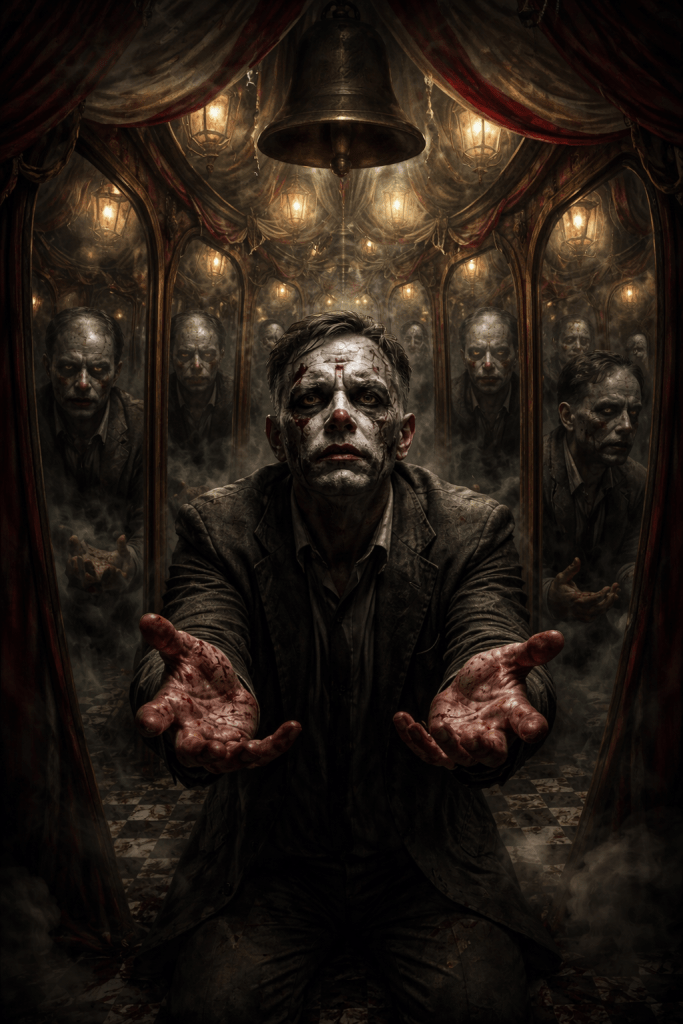
MIRROR MAZE

MIRROR MAZE

MOVEMENT I — THE TENT

(Cantos 1–10: it still resembles life; that’s the cruelty.)

CANTO I — THE TENT WAS OPEN

The tent was open once, and this is the detail that ruins you.

No guards blocked you. No chains rattled. No fire warned you.

Light did what light does: it waited.

You did not refuse violently.

You misplaced importance.

The music was still music then, not a mechanism.

The laughter was still laughter, not rehearsal.

The mirrors still held one face.

If only entered quietly, like a harmless phrase.

That is how it survived.

CANTO II — THE TICKET

You are given a ticket you do not remember receiving.

It is already in your pocket when you reach for it.

It bears a date that means nothing until it means everything.

You read it once and feel no fear.

You read it twice and feel irritation, as though interrupted.

You fold it and decide to deal with it later.

Later becomes trained.

Later learns your name.

CANTO III — THE FACE FOUND IN THE DARK

Your face is discovered in the dark before you understand it is lost.

Your eyes are open, but they do not search.

Your mouth rests in practiced neutrality.

Your skin is dry—not from decay, but from living too long without rain.

This is not the face of a monster.

It is the face of someone who learned to function without reverence

and still be called fine.

You look reasonable here.

That is the danger.

CANTO IV — BEFORE-ME (FIRST CROWN)

Something tightens behind your eyes.

Hunger arrives without introduction.

You see what you placed first, and it looks respectable at a distance.

Success stands nearest. Control stands composed.

Approval smiles like a substitute god.

You tell yourself you never replaced God.

You only delayed Him.

Now gravity takes your neck.

Your chin lowers, pulled by what you elevated.

You attempt explanation.

Intention does not dismantle altars.

CANTO V — GRAVEN (THE MASK PRACTICE)

Your skin stiffens under the lights.

Your expression freezes mid-gesture.

You remember shaping truth into something that would not resist you.

You remember carving belief into décor.

You preferred gods who demanded aesthetics, not repentance.

You preferred comfort that resembled holiness.

Now your face becomes a mask fused to bone.

You scream, and applause answers.

The crowd loves consistency.

The mask cracks. It does not come off.

CANTO VI — VAIN (THE HOLY NOISE)

Your mouth opens, and words spill stripped of weight.

Sacred syllables fall like currency without nation.

You spoke God’s name often and lightly.

You used it to win, to decorate emptiness,

to feel protected while remaining unchanged.

Now silence flees from you.

Echoes return everything you ever said—hollow, multiplied.

You attempt prayer.

Prayer requires listening.

Nothing answers.

CANTO VII — TOMORROW (THE CLOCK SMILE)

Time arrives wearing white gloves.

Your brow tightens into numbers.

You postponed rest and called it diligence.

You scheduled repentance and called it wisdom.

You promised attention soon.

Now soon surrounds you.

Seconds crack. Minutes circle.

You run without distance, and breath accomplishes nothing.

CANTO VIII — BLOODLINE (THE SILENT ROW)

Something ancient enters your eyes.

Faces gather behind faces—names you never learned,

prayers you never finished, people you dismissed as inconvenient.

You cut roots to move faster.

You mistook severance for freedom.

Now generations sit in a silent row behind your skull,

watching you forget yourself.

Their disappointment does not shout.

That makes it heavier.

CANTO IX — RED (THE HANDS RISE)

Your hands rise into view.

You cannot lower them.

They are clean and unbearable,

because cleanliness is not innocence.

Memory returns as sensation.

Every casual harm completes itself.

Every excuse dissolves.

Not as you gave it.

As it was received.

Your face does not become monstrous.

It becomes accurate.

CANTO X — NO (THE FIRST BELL)

The bell rings once.

You flinch as though you have always been waiting.

You remember light that came gently.

You remember declining without drama.

You did not refuse violently.

You said, not now.

Now the word returns, exact.

No.

The tent tightens as though it has learned your shape.

MOVEMENT II — THE MIRRORS

(Cantos 11–20: reality destabilizes; the maze admits itself.)

CANTO XI — THE CORRIDOR OF YOU

The mirrors multiply.

Each reflection is almost you.

Some smile too long.

Some forget to blink.

Some wear your face like borrowed clothing.

You touch the glass and feel warmth.

You step back and realize it is yours, withheld.

A clown passes and speaks your name incorrectly.

You correct it.

The clown laughs.

CANTO XII — AFTER (THE HUNGER THAT DOES NOT HOLD)

Desire enters disguised as promise.

It smells like a lie you once called normal.

You mistook appetite for love.

You took what dissolved on contact.

Now longing eats itself.

Every embrace turns to ash before comfort forms.

You always wanted what came next.

There is no next here.

CANTO XIII — MINE (THE VANISHING OBJECTS)

You hold a cup that empties.

Bread that becomes dust.

Warmth that withdraws.

You stole quietly—

credit, time, truth, tenderness.

Now everything you touch belongs elsewhere.

Even your reflection refuses you.

The word mine burns your throat.

Nothing answers.

CANTO XIV — WITNESS (THE EYES THAT CANNOT CLOSE)

Truth arrives without spectacle.

It stands where you must see it.

Your eyelids lift beyond comfort.

They do not obey you.

Every lie you told or tolerated circles patiently.

They wait.

To step forward would unravel you.

So you remain still.

Stillness becomes sentence.

CANTO XV — GRAVEN AGAIN (THE PAINT DOES NOT WASH)

The clowns repaint you gently.

That is the cruelty.

The paint is familiar:

certainty, performance, borrowed holiness.

You try to wipe it away.

Your skin refuses your hand.

The mask is not on you.

It is you.

Applause returns in short bursts.

It tests.

CANTO XVI — TOMORROW AGAIN (THE LOOPED MUSIC)

The music loops and never resolves.

Your brow tightens again.

You remember every later.

You loved postponement because it felt like control.

Now time is not a river.

It is a treadmill.

You run.

The bell rings.

CANTO XVII — BEFORE-ME AGAIN (THE SMALL GODS RETURN)

Your hunger returns smaller, poorer.

The gods reappear as props—

a paper crown, a mirrored coin, a hollow prize.

You reach automatically.

They slip away.

The altar no longer needs objects.

It trained your posture.

Your neck bends by itself.

CANTO XVIII — BLOODLINE AGAIN (THE NAMES YOU NEVER LEARNED)

A family name is spoken.

You do not respond.

Shame is quiet here.

Behind the mirrors, the silent row remains.

They do not accuse.

You already know.

CANTO XIX — RED AGAIN (THE HANDS DO NOT FORGET)

Your hands rise again.

Not as fists.

As evidence.

You feel the bruise your sentence became.

The fear your calm planted.

Comprehension arrives.

It does not reduce debt.

The clowns stop laughing.

They nod.

CANTO XX — VAIN AGAIN (THE PRAYER THAT CANNOT FORM)

The words return but refuse assembly.

You used sacred language as charm, not surrender.

The echoes thin your voice.

You notice the difference between saying God

and knowing Him.

The light was not taken.

You set it down.

Your hands cannot find it.

MOVEMENT III — THE HANDS

(Cantos 21–30: sensation replaces argument.)

CANTO XXI — THE RING WITHOUT APPLAUSE

The ring remains.

The sound has changed.

The audience watches like conscience without bargaining.

The lights expose.

If only returns without comfort.

CANTO XXII — RED (THE TOUCH COMPLETES ITSELF)

Your hands lift like proof.

Every moment completes itself.

Every humiliation arrives intact.

Not as memory.

As sensation without end.

You do not scream.

There is no one to persuade.

CANTO XXIII — BEFORE-ME (THE EYES LEARN THEIR POSTURE)

Your eyes widen again.

Hunger survives extinction.

Your pupils kneel by habit.

Your face looks trained.

You did not refuse violently.

You preferred what could be measured.

CANTO XXIV — GRAVEN (THE PAINT ENTERS THE SKIN)

The brush feels kind.

The paint is the version praised because it was easy.

You remember reshaping truth to avoid change.

The smile locks.

The mask refuses.

CANTO XXV — VAIN (THE WORDS TURN TO DUST)

Holy language collapses mid-air.

The atmosphere rejects performance.

You cannot convince Heaven by sounding religious.

If shortens.

CANTO XXVI — TOMORROW (THE CLOCK INSIDE YOUR BROW)

Time sits in you now.

Every later drops like a pebble into a well

that never stops falling.

The bell measures delay.

Not now.

Not now.

Not now.

CANTO XXVII — BLOODLINE (THE SILENT ROW LEANS FORWARD)

The silent row presses closer.

You mocked reverence.

You called honor clutter.

Now the past watches without accusation.

You become your own.

CANTO XXVIII — AFTER (THE LIPS THAT CANNOT HOLD)

Desire opens and finds nothing.

You chased what vanished.

You called it passion.

A clown mirrors your reaching—slow, polite.

It is mercy without comfort.

CANTO XXIX — MINE (THE FINGERS THAT GRASP AIR)

Possession has been removed from language.

Your hands open and close like doors in an empty hall.

You learn how poverty hides inside abundance.

CANTO XXX — WITNESS / NO

Understanding arrives complete.

Too late to be used.

The final word returns like a signed document.

No.

Your hands cannot find the light.

MOVEMENT IV — THE WORD NO

(Cantos 31–40: language seals.)

CANTO XXXI — THE QUIET RING

The ring shrinks because language has.

Explanation ends.

If—

The word does not finish.

CANTO XXXII — BEFORE-ME (WITHOUT OBJECTS)

Hunger remains without object.

You bow to absence.

Learning does not require belief.

CANTO XXXIII — GRAVEN (THE MASK WITHOUT PAINT)

No paint arrives.

Your face stiffens anyway.

Performance outlives the audience.

CANTO XXXIV — VAIN (THE BROKEN PRAYER)

Words do not organize.

Prayer is surrender shaped inward.

Your mouth closes.

CANTO XXXV — TOMORROW (THE LAST SCHEDULE)

Time presses.

Unfinished obedience settles around you.

Later has no location.

CANTO XXXVI — BLOODLINE (THE NAMELESS CALL)

A name is spoken.

You do not answer.

Forgetting completes itself.

CANTO XXXVII — RED (THE HANDS ARE STILL)

Your hands hold knowledge.

Harm required no hatred.

Only practiced indifference.

They stop arguing.

CANTO XXXVIII — AFTER (DESIRE WITHOUT IMAGE)

Desire remains without direction.

Quiet exists.

It does not adore you.

CANTO XXXIX — MINE (THE EMPTY WORD)

The word dissolves.

Release occurs without permission.

Nothing is returned.

CANTO XL — WITNESS / NO (THE SEAL)

Truth is already here.

You see without narrative.

You understand without exit.

The word settles.

No.

The sentence ends.

There is no punctuation.

“Thank You, Lord, for This Life I Love”

suno.com/s/4uHcLpk6yNhUyuHk

“Thank You, Lord, for This Life I Love” is my song of gratitude—rooted in faith, freedom, and the beauty of everyday blessings. From sun-soaked mornings to quiet, open skies, it’s a prayer set to music—for my Savior, this land, and the life I hold dear. Listen, share, and let your heart rise!

🎶 Lyrics by Marguerite Grace

🌾 Visit: write-with-grace.com

#ThankYouLord #CountryGospel #FaithAndFreedom #JesusIsMySong #WriteWithGrace #RedWhiteAndBlessed

Fireworks in My Heart A July 4th Song from a Soul Set Free (Remastered)

Freedom didn’t come by sword or pen—

It came when Love broke death and sin.

Not just a nation, but hearts made new,

By mercy crowned and Spirit true.

This Independence Day, I raise my hands—

Not just for country, but for the Lamb.

🕊🇺🇸✝️💥🎆

#FreedomInChrist #JesusIsLiberty #IndependenceDay

🔗 write-with-grace.com

suno.com/s/2zXBoZSJGH5DLKp2

https://suno.com/song/b11a10ca-75f0-4f24-a4fc-749aed7ea7bf

The One Who Satisfies

suno.com/s/OxykKFAPaLgLQwe3

“My first song I wrote” 🎶

“This song came from a place deep within, shaped by moments that taught me, refined me, and opened my heart. ♥️ It’s called [ The One Who Satisfies ] and as you hear it, I hope something in it speaks to you—whether it brings comfort, reflection, or simply a breath of something real. I give it to you now—thank you for receiving it.”

Written by Marguerite Grace

Copyright Protected

My Extended Remix Version 🎶