A Soliloquy at the Threshold


A Soliloquy at the Threshold


Peace—
Ring not the bell ere silence gives consent,
For sound hath memory and will not haste.
I stood where echoes bow before their birth,
Where keys wax warm with long expectancy.
Attend me well:
I speak not as one snatched from common sleep,
But as a soul weighed by the door and spared.


There stole a tide, unbidden by the moon,
That lapped the hems of settled cogitation
And breathed, Advance no more—yet still draw near.
The mirror bent to hearken as I passed,
Its argent brow unloosed from present time,
And showed me not my form, but my becoming.


O gentle ravishment!—my name grew thin,
My will unclasped like cloak in winter’s thaw,
Till choice itself stood doubting of its throne.
No hand constrained me; yet I could not bide.
For bells rang backward through my quickened blood,
Summoning remembrances elder than breath.


I bore the key—not seized it, mark ye this—
The key acknowledged me, and turned in dream.
Then hush bloomed loud enough for sense to hear,
And time lay couched, a hound before the fire.


What passed betwixt those sighs I dare not stamp.
Some verities are seas in single drops;
Some gates admit the soul but when made slight.
Enough: I strayed not lost, nor found entire—
But learned the pivot where the world is swung.


Anon the tide withdrew its silver steps,
The mirror healed, the bells reclaimed their rule,
And weight returned like grace unto my frame.
Yet somewhat stayed—
A wisdom lacking speech,
A stillness crowned, not mastered, by the will.


Name it not.
For names are nets, and this hath fangs of light.
Know only thus: I went, and I returned,
Bearing the sign of one who knows the seam—
And treads the shore with gentler sovereignty.


Now ring the bell.
Bar fast the key.
Let mirrors sleep.
I dwell among you still—
Yet have I heard the tide.

Written by Marguerite Grace

Copyright Protected

The Wind That Bore Testimony

A Narrative Ode in the Manner of Old

pressing Holy Writ for finery

The Wind That Bore Testimony

A Narrative Ode in the Manner of Old

Ere Phoebus’ radiant beams did learn
again to claim their name upon the morn,
ere feathered choristers did yet agree
to lift their voices in harmonious song,
the very air held still—
not voiceless,
but expectant.

Zephyrus abided at the lips of earth
as though the vital breath itself had reached
a threshold most august,
and tarried for the summons
to pass from promise into verity.

The mount had ended its cruelty.
Timber was stained beyond all memory.
Steel cooled, its thirst discharged.
A cry ascended
and was spent—
and the world did lean, albeit but a whit,
so that rock remembered it was dust
and Time did quake, feeling the stir
of sentence reversed.

The veil was rent at first.
Not gently.
Not as cloth gives way to age or wind,
but as truth doth sever falsehood in twain—
from roof to hem—
as though Heaven itself refused
to regard us through tapestry again.

Then the earth—
that ancient hoarder,
that keeper of bones,
that archivist of silent sleep—
did relinquish its hold.

Sepulchers yawned
like eyes that had tarried long in darkness,
like lips that had swallowed prayer
and were now compelled to speak.

And those who lay in slumber deep
were roused at the sound of a summons
that uttered no words,
yet bore authority—
a knowing that passed through marrow
ere ever it touched the hearing.

They rose.

Not as smoke.
Not as tale or rumor.
Not as visions half-remembered at dawn.

But as bodies recon-joined with breath.

Ribs expanded—
testing impossible air.
Fingers flexed—
marveling at their office.
Skin, creased with the grammar of years,
remembered warmth,
remembered burden,
remembered the ancient law of gravity
and welcomed it kindly.

They were saints, Scripture declareth.
Not immaculate, nor polished into legend
or fit for ornament of shrine—
but known to God,
counted by His hand,
hidden with Him,
kept in the dark like seed
until the mighty hinge of history turned
and the gate stood open.

They made no haste.
Resurrection is no frenzy.

They stood where they had fallen—
months and years remote—
in places where names had been spoken
in the past tense,
where tears had learned new habits.

They surveyed their hands
that did still bear the mark of labor and love—
callus and scar,
creases wrought by bread and burial,
evidence that holiness had once worn fatigue.

And the wind returned—
gentle now—
lifting locks from brow and cheek
that bore no prideful triumph,
but only wonder profound,
and that fragile awe
of those who know they have passed
a line no man may cross twice.

For they did not rise with Him.
They waited.

For order endureth in eternity.

He rose first—
the Firstfruits,
the sheaf uplifted,
the proof held aloft
that none might misdeem the harvest
for happenstance or tale.

Then did they follow.

They walked into the city.

Jerusalem ceased not breathing,
but its breath was caught—
as though a minstrel missing a cadence
found the key of his song was changed.

A woman buying grain
looked up and let fall her basket—
wheat scattering as though unbidden offering.
A child ran—
not fleeing, but toward—
arms outstretched, reason forsaken,
to greet a grandsire interred
ere his voice had fully broken.

They appeared before many.
Not crying aloud.
Not proclaiming tenets.
Not explaining themselves.

Their presence sufficed.

Verity had feet.
Verity had carriage.
Verity bore wounds now rendered healed
and eyes that did not demand belief
but made disbelief expensive.

Verity could be touched
and craved no worship.

They were witnesses—
not of themselves,
nor of a miracle private and concealed—
but of Him whose pulse
had cast death’s lock aside
and left the door ajar.

And the wind moved amongst them,
unseen but earnest,
slipping through courtyards and chambers,
bearing astonishment from mouth to mouth,
from gasp unto gasp,
until the city itself felt
a subtle lightness,
as though the air had lost a weight long borne.

Yet wind abideth not.

Nor did they.

Scripture telleth not when they departed,
only that they abode not—
as though Heaven, having wrought its testimony,
closed the tale without embellishment.

For signs are not abiding places.

Here doth the human mind lean toward wonder,
hungry for more—
questioning what Scripture chooseth not to embroider,
pressing Holy Writ for finery
where it offers cloth simple and pure.

Have others risen?
Yes—before and after.

Lazarus, four days unhidden,
called forth to mortal air.
Tabitha, hands folded once again
into acts of charity.
Eutychus, lifted from the floor of death
into the astonished arms of brethren.

They returned to Time.
They aged.
They learned afresh the cost of breath.
They died again.

But the saints of that morning—
those named only by God,
those counted without footnote—
were other.

They rose after Resurrection itself
had crossed the threshold,
after Death had been judged and sentenced,
after the keys had changed sovereign hands.

This was no reversal.
This was triumph.

And thus they returned not to decay.

Now hearken—
hearken to the murmur of ages.

Tales waxed,
for men cannot brook quiet endings,
cannot endure long the portal left ajar
which Scripture chooseth not to fasten.

A wanderer cursed to trod till end of days.
Sleepers hidden in caverns through generations.
Whispers of the undying,
of visages that never age,
walkers just beyond the verge of proof.

But Scripture interposeth—
not sternly,
but with sure resolve—
and correcteth the hunger.

Even the disciple beloved
was not promised endless walking.
Rumour outpaced truth,
and truth followed to set it right.

God leaveth not immortality to wander unclaimed.

He is too pure for confusion.

“Once to die,” it is appointed—
“and after this, the judgment.”

God lieth not.

So where might the witnesses abide?

Ask the wind.

It hath passed through empty tombs
and chambers locked with trembling fear.
It hath moved through martyr’s flame
and hallways of leech and infirmary,
through cloisters, through battlefields,
birth-rooms and sepulchres,
through whispered legends
and the ache of patient waiting.

The wind answereth in riddles,
in trembling leaves,
in the space betwixt sigh and inhalation,
in places where silence liveth,
and faith burneth like breath itself.

They are neither absent nor fully accounted—
like wind that sighs through ruins
and is not held,
yet leaveth its mark everywhere.

Because Christ went to prepare a place—
and where He is now,
there His witnesses must likewise be,
if the mystery of glory still holdeth court
beyond the ken of mortal eyes.

They were not raised to haunt.
They were not raised to wander aimlessly.
They were raised to bear witness.

And testimony, once spoken,
needeth not linger to be true.

It moveth.

It presses ‘gainst doors.
It unsettleth chambers.
It changeth the very weather of belief.

Like wind.

Still moving.

Written by Marguerite Grace

Copyright Protected

Thy God’s Plan for Me

He crowns my path with gentled love

And lays out roses evermore.

Thy God’s Plan for Me

Before my breath was ever known,
Before my name was spoken free,
Thy hand had traced my road in gold,
A holy map for me to be.
Not chance, nor fear, nor broken days
Could blur the ink Thy mercy wrote—
For Thou hast planned my joy made full,
And stitched Thy hope into my soul.

Thy God’s plan for me is good,
Though storms may rise and voices roar.
He crowns my path with gentled love
And lays out roses evermore.
I am not late. I am not lost.
I walk beneath His watchful eye.
Thy God’s plan for me is love,
And love shall always testify.

He feeds me with the living bread,
Not scraps of sorrow, crumbs of fear.
He fills my cup till it overflows
With peace made strong and vision clear.
He does not starve the faithful heart,
Nor bind the ones He calls His own—
He wills me laughter, rest, and song,
And joys yet never known.

He chooses who may walk with me,
Who speaks with truth and guards my flame.
He draws the kind, the wise, the pure,
And blesses friendship in His Name.
But those who wound with sharpened tongues,
Who mock the faith they do not own—
He lifts them gently from my road,
For such do not belong.

Thy God’s plan for me is holy,
Set apart, yet full of grace.
Not all may walk this narrow path,
Nor know this sacred place.
I do not chase the crowd’s applause,
Nor bow to scorn or blasphemy.
Thy God’s plan for me is truth,
And truth has set me free.

For every word they speak in spite,
For every whisper, lie, and sneer—
He hears them all; not one is lost,
Not one escapes His ear.
Each idle word is weighed in light,
Each cruel remark made known.
The mouths that curse the chosen ones
Shall answer at His throne.

They call us names. They scoff. They sneer.
They hinder faith, they mock the Cross.
Yet we are people set apart,
Not counted with the world’s great loss.
We bear a mark they cannot see,
A seal no hatred can erase.
We stand not proud, but planted firm
In undeserved grace.

“Love yourself,” He softly says,
When all the world turns cold and cruel.
“Guard your heart. Tend well your soul.
Do not let sorrow be your rule.”
Even here, when all seems wrong,
“I am with you. I remain.
I am the God who lifts your head
And names you whole again.”

He crowns me now with roses red,
Not thorns of shame nor chains of doubt.
He trains my hands to gather beauty
And scatter goodness all about.
He shapes my life as living proof
That mercy lives, that hope is true—
That even broken histories
Can bloom anew.

Thy God’s plan for me is faithful,
Watched, defended, sealed, and sure.
He walks before me, guards behind,
My future safe, my calling pure.
Let voices rage. Let shadows pass.
I stand where Heaven’s promises be—
For all my days, through every storm,
Thy God has planned for me.

Written by Marguerite Grace
Copyright Protected

Because I Obey Your Voice (Remastered)

suno.com/s/p8ygMwomxFbjR4Bs

Because I Obey Your Voice (Remastered)

🌿Because I Obey Your Voice 🌿 — Lyrics by Marguerite Grace ✨ Inspired by Deuteronomy 28, this hymn celebrates the blessings that overflow when we walk in God’s ways. 🌸 From the still waters to the high places, His mercy covers every step. 🌅 Let these words lift your heart, root your faith, and stir your praise — all the days of your life. 💛 Visit 🌐 write-with-grace to read and be inspired. 🙏🎶

CHAIN OF GRACE (PASS IT ON) (Remastered)

suno.com/s/0b1UvvMnAZUSNp9B

CHAIN OF GRACE (PASS IT ON) (Remastered)

Mother never left the house without a Bible—and not just for herself. Whether it was a friend, a stranger, or someone the Lord placed in her path, she always had one to give. Worn or new, marked with love or blank for someone else’s story—she believed the Word was meant to travel. She taught me since I was small: what God gives, we pass on. Now I carry her legacy in song. “Chain of Grace,” is for her—and all who give freely what they’ve received.

I SAW YOU PASS THEM BY

suno.com/s/IsF8vWOZWK6vt7Nk

❄️🚶‍♀️ Some storms don’t change hearts—they reveal them.

I SAW YOU PASS THEM BY is a song about faith that moves, mercy that costs, and love proven by action. When we pass the hurting, we pass Him.

🎶 Lyrics by Marguerite Grace

🤍 Read more at write-with-grace.com

#ISawYouPassThemBy #FaithInAction #ChristianMusic #MercyMatters #LoveInMotion #ScriptureSong #WriteWithGrace #GospelTruth

📘 Now Available on Amazon

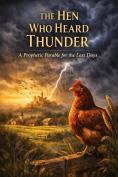
The Hen Who Heard Thunder

A Prophetic Parable for the Last Days

📘 Now Available on Amazon

A Prophetic Parable for the Last Days

The Hen Who Heard Thunder

There are moments in history when comfort grows louder than truth—and only the watchful are willing to listen.

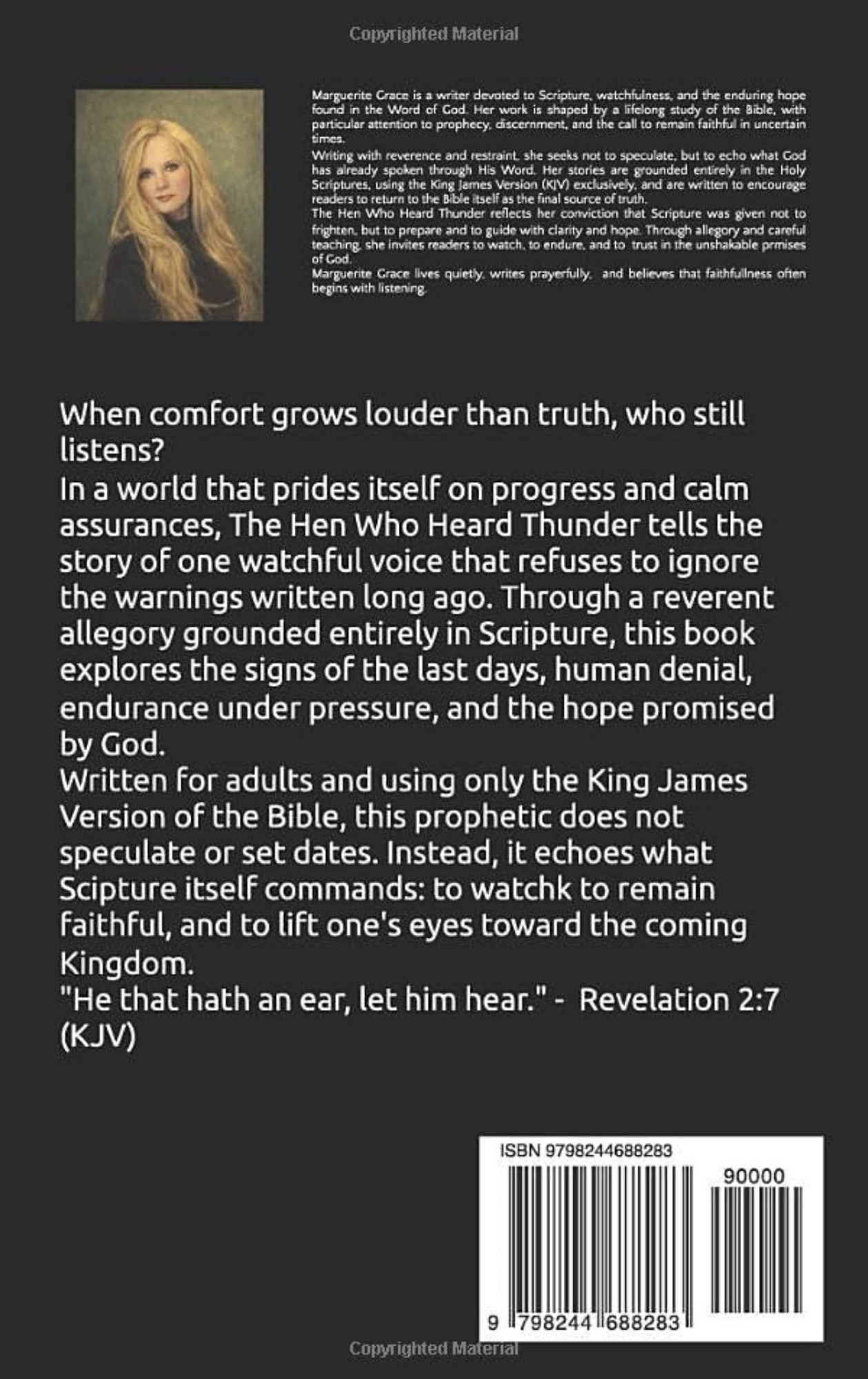
I’m honored to share that The Hen Who Heard Thunder is now available on Amazon. This reverent, Scripture-anchored parable is written for readers who sense the seriousness of the times we are living in and are seeking discernment rooted in God’s Word rather than speculation.

Grounded entirely in the King James Version of the Bible, this book does not predict dates or chase headlines. Instead, it reflects what Scripture has already spoken—calling readers to watchfulness, endurance, and faithfulness in the midst of uncertainty.

“He that hath an ear, let him hear.” — Revelation 2:7 (KJV)

🔗 Available now on Amazon:

https://a.co/d/eiFNoZC

🌐 Learn more and explore my writing at:

https://write-with-grace.com

#TheHenWhoHeardThunder

#NewBookRelease

The Hen Who Heard Thunder: A Prophetic Parable for the Last Days

a.co/d/0POJTiS

In a peaceful kingdom filled with comfort, progress, and confident assurances, one quiet voice refuses to ignore a warning that others no longer wish to hear.

The Hen Who Heard Thunder: A Prophetic Parable for the Last Days is an adult allegorical narrative grounded entirely in the Holy Scriptures and written using only the King James Version (KJV) of the Bible. Through the imagined setting of the Cloverleaf Kingdom and its animal inhabitants, this story explores the biblical warnings of the last days, the human tendency toward denial, the cost of watchfulness, and the hope promised by God to those who endure.

As leaders proclaim stability and peace, a watchful hen senses an approaching storm foretold long ago in Scripture. While others dismiss the warnings as unnecessary or inconvenient, she prepares – not in fear, but in obedience. Her preparation becomes a quiet testimony as deception increases, pressure grows, and the signs described in the Bible begin to unfold. What was once mocked slowly becomes undeniable.

This book does not speculate, assign dates, or identify modern nations. Instead, it faithfully echoes what Scripture itself declares about the last days: The rise of deception, the cooling of love, the testing of faith, the call to endurance, and the promise of restoration. Every warning and every hope presented in the story points back to what God and Jesus Christ have already revealed in His Word.

Written for adults seeking biblical clarity without sensationalism, The Hen Who Heard Thunder serves as both a teaching parable and a reflective narrative. It invites readers to watch to remain faithful, and to place their hope not in earthly systems, but in the unshakable Kingdom of God.

This story affirms the Bible as the inspired and authoritative Word of God and encourages readers to return to Scripture itself as the final source of truth, comfort, and hope in uncertain times.

January Snow

January Snow

January’s snow came not in whispered tread, But fell with sovereign weight on West Virginia’s crown,
Till mountains bowed and every forest fell to hush, As though the earth itself had drawn one breath And dared not loose it.

There, amid the shaping of a fragile man of snow, The wood did stir, and forth came Sacsquash—
No heralded thunder, nor shape the heart should fear.
But calm made flesh and kindly set,
As steady as the hills that knew him first.

We labored side by side in wordless mirth, While heaven’s white kept falling all around.
Though winter ruled the hour, warmth yet remained.
And when he turned again to shadowed trees,
The cold stayed on—
Yet in that January hour, He left me sunshine.

Love,
Marguerite Grace,

Written by Marguerite Grace

Copyright Protected