Percy: A Gospel of Staying
I did not know then that I was being taught how resurrection speaks.
It seemed good to me also, having had perfect understanding of all things from the very first, to write unto thee in order…
(Luke 1:3, KJV)
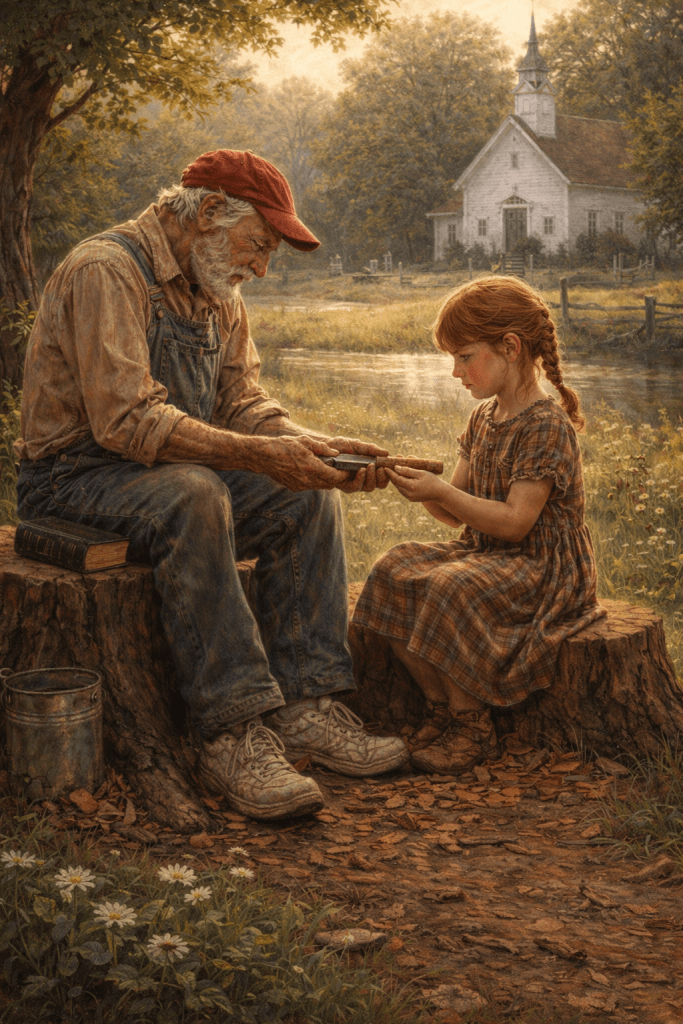
There was nothing hurried about the way Percy worked. Each day he returned to the stump and stayed there, shaping wood with a kind of attention that suggested time itself could be handled—turned, pressed, and left behind in solid form—if one was willing to move slowly enough.
And he came out, and went, as he was wont…
(Luke 22:39, KJV)
I called it widdling, and Percy laughed at the way I said it, then went on working, letting the word remain just as I had spoken it.
Percy was old when I knew him—around seventy-nine. That would have placed his birth somewhere near 1903 or 1904. I did not know that then. What I knew was the brightness of his white hair beneath the red cap he wore most days, tipped slightly to the side, as though he had learned long ago not to resist the lean of the world.
His hands were bent and knotted, fingers thick with swelling and stiff from severe arthritis. They looked like hands that had suffered. But Percy did not hide them. He worked with them openly and patiently, as though pain had never been given permission to lead.
Behold my hands and my feet, that it is I myself…
(Luke 24:39, KJV)
He wore white high-top tennis shoes that looked strange on him—too bright, too new, out of place on a man who remembered horse-and-buggy days. Percy did not seem concerned with matching expectations.
At his feet sat an old metal can. Every so often, Percy leaned to the side and spat Red Man chewing tobacco into it, the sound sharp and ordinary—like punctuation in a long, quiet sentence.
The yard around him was immaculate—not fussy, simply faithful. I never saw sticks lying about. Percy did not walk far; his back curved into a hump that made movement slow and measured. Yet every day there was wood. I never asked where it came from.
Give us day by day our daily bread.
(Luke 11:3, KJV)
One afternoon he told me he would make me something.
“A knife,” he said.
I did not know why a knife. I did not ask. I wanted whatever Percy chose to give.
And he took bread, and gave thanks, and brake it, and gave unto them…
(Luke 22:19, KJV)
After that, I went over every day. I watched the knife take shape slowly—the blade smoothed again and again, the handle rounded to fit my hand. Percy worked without hurry and without complaint. He talked while he worked—about the weather, about the white ducks drifting across the pond beyond the fence.
And it came to pass, as he sat at meat with them, he took bread, and blessed it, and brake, and gave to them.
(Luke 24:30, KJV)
We watched the honeybees together, moving low over the clover. We talked about how they never rushed, how they seemed to know where they were meant to go.
Consider the ravens: for they neither sow nor reap…
(Luke 12:24, KJV)
Sometimes, while the blade moved steadily through the grain, Percy spoke about Jesus.
Not loudly.
Not urgently.
He spoke as someone who had already placed his life there.
He said Christ knew what it was to labor without recognition, to suffer without spectacle, to love without any guarantee of return. He said Jesus did not save people by removing pain, but by standing inside it with them.
He said salvation was not escape.
It was presence.
Jesus himself drew near, and went with them. But their eyes were holden…
(Luke 24:15–16, KJV)
One evening after school, I walked over again. I had just eaten dinner and watched my favorite television show—the one that began with whistling, a father and son walking together, the boy skipping a stone across the water. The show always left me with the feeling that something important was being passed down, something quiet and steady.
And beginning at Moses and all the prophets, he expounded unto them…
(Luke 24:27, KJV)
Percy was already on the stump when I arrived. I sat beside him. It was big enough for both of us.
That evening, Percy began to talk about his wife.
“Her name was Marlene,” he said.
He told me how much he loved her. How he built the house they lived in together—small, but strong. He told me about the day they learned they were going to have a baby. A little girl.
I felt happy when he told me. I expected joy to follow.
Instead, Percy told me about winter. About deep snow that came too fast. About the doctor and the midwife who could not reach them. About the baby who lived only a few hours.
Then his wife passed too.
Percy did not rush the telling. He did not soften it. He did not ask for pity.
Blessed are ye that weep now: for ye shall laugh.
(Luke 6:21, KJV)
I went home that night carrying something heavy I did not yet know how to name.
I stayed away for a while.
Then one bright afternoon, I saw Percy again on the stump, alone, whittling as he always had. Something in me pulled hard toward him.
He wore his red cap. His jeans hung too loose. He looked the same—and older.
He asked if I had been busy.
We talked about the honeybees again.
Then he handed me the knife.
It was finished.
And their eyes were opened…
(Luke 24:31, KJV)
I hugged him.
The knife felt solid in my hand—balanced, intentional. It was not a toy. It was art. Art Percy had shaped with hands the world had tried to slow.
“You shouldn’t feel sad for me,” he said.
I was.
“I’m not alone,” he said. “Christ stayed.”
He pointed toward the old graveyard by the church.
“She’s there,” he said. “And my daughter. My daughter’s in her arms.”
He is not here, but is risen.
(Luke 24:6, KJV)
He spoke without fear—the way someone speaks who believes the grave does not get the final word.
Before I left, I asked him why he had made me a knife.
He smiled.
“It’s for remembering,” he said. “Wood remembers the hand that shaped it.”
Years later, I returned to that old graveyard.
Around the stone lay small carved wooden figures. Some might once have been dolls. Some might have been animals. Time and weather had taken their certainty. Flowers lay there too—roses pressed flat into the earth, their color gone but their stems still holding.
If these should hold their peace, the stones would immediately cry out.
(Luke 19:40, KJV)
I understood then that Percy had not been alone.
People had come.
People had stayed.
Hands had remembered him.
For the first time, the stone told the whole truth.
It named them.
His wife.
His daughter.
And beneath them—
Marguerite Grace.
The world did not move.
Then opened he their understanding…
(Luke 24:45, KJV)
Percy had never told me.
I stood very still, holding the weight of a name that had been written before I knew to look for it.
What I had been holding all those years—the knife, the memory, the teaching—had been shaped by a man who already knew my name.
Christ does not rush grief.
He does not erase loss.
He redeems it by remaining.
Fear not, little flock; for it is your Father’s good pleasure to give you the kingdom.
(Luke 12:32, KJV)
And I know now that Percy is not alone.
He is with them.
With the wife he spoke of often, whose name rested gently on his tongue even years after her passing. With the daughter he loved before he ever held her. There is no winter between them now. No waiting. No separation of hands.
For he is not a God of the dead, but of the living: for all live unto him.
(Luke 20:38, KJV)
I believe Percy’s hands are no longer bent with pain. I believe they are strong and steady now, taken first by his wife, then by his daughter. I believe there is laughter where there was once only endurance.
Not loud laughter.
The kind that breathes.
Blessed are ye that weep now: for ye shall laugh.
(Luke 6:21, KJV)
I do not imagine Percy working anymore.
I imagine him resting—the way a craftsman rests when the work is finished and nothing more needs shaping.
To day shalt thou be with me in paradise.
(Luke 23:43, KJV)
I still have the knife.
It fits my hand.
And when I hold it, I remember Percy—
and the Christ who stayed with him,
and who, it turns out, had been holding me the whole time.
And nothing that stayed was lost.
And they worshipped him, and returned… with great joy… praising and blessing God. Amen.
(Luke 24:52–53, KJV)
Written by Marguerite Grace
Copyright Protected

 verse, possies, sonnets, and short stories