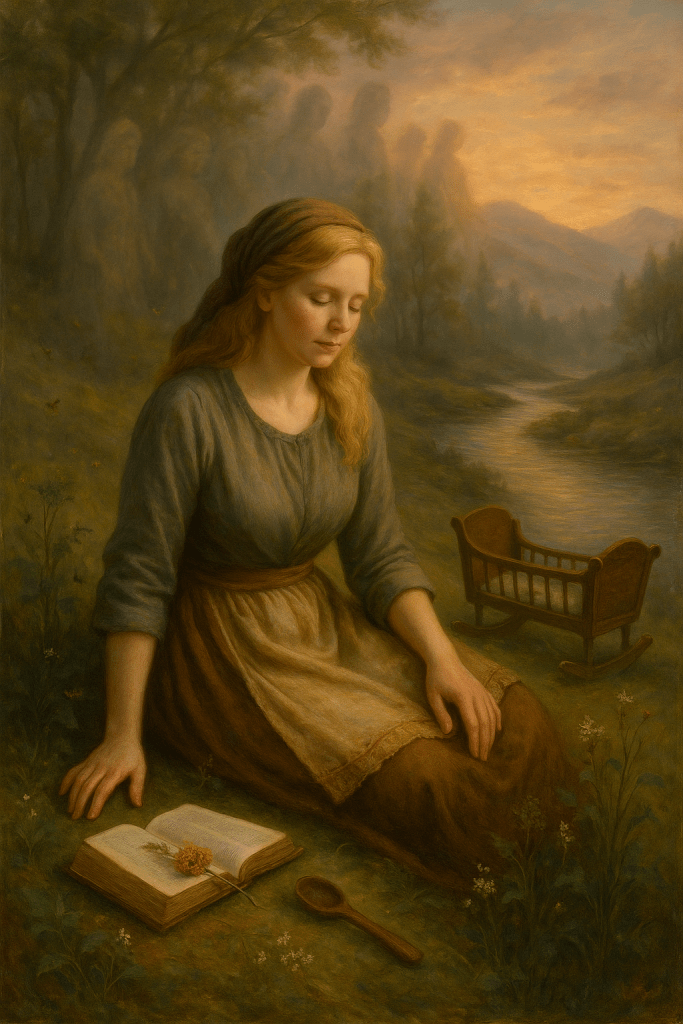
🕊 Requiem of the Daughter in the Hills
Sing, Mothers of Memory—
you who buried your names beneath the root to save your daughters,
you who walked through cotton fields, through cedar groves, through centuries of hush—
lend me the ember that lit your long and aching journey,
that I may see as you saw, and tread where you trod.
Let me bow in the cabins of your labor,
kneel at the cradles you rocked with lullabies no scribe recorded.
Let me return—not in pride, but in trembling reverence—
through every kitchen, riverbend, and birthing bed you crossed.
For I am the Daughter in the Hills,
born of your blood, shaped by your hush,
and I carry your fire through the coal-wet wind.
Some of you wore skin like the hush of dawn,
others like river clay, field bronze, or ridge-backed stone.
You came from many nations, spoke in scattered tongues,
and weathered this land with names both kept and taken.
The world called you many things—
but to me, you are one flame, one line of marrow,
and I walk in the fullness of your memory, barefoot and bowed.
Sing now of the first who stepped onto this land,
her feet still bruised from shipboards, her womb yet full—
a woman of two tongues: one stolen, one burning like coal.
She never wrote her name; the sea had swallowed it.
But she planted a seed beside the river
and whispered, If this grows, let them remember me.
Her hands bore children into a country that called her nothing,
yet her blood ran deeper than borders or maps.
I find her there—by the oak she chose—
and kneel where her fingers once pressed the earth.
She lived on the edges of ink,
her skin too shadowed for census, her silence too wide.
She raised children who knew how to vanish,
who spoke simply when watched,
and richly when safe.
She hung garlic in her windows,
read the weather in birds.
When death came, she gave no farewell—
only laid her hands on the bedpost and hummed.
Now her garden buzzes with bees.
Her name is not on stone,
but the marigolds whisper it every spring.
I remember the one whose blood sang in Cherokee,
but whose name was torn by law or by fear.
The soldiers came. The road west opened.
She did not follow it.
She stayed. She knelt. She took a name not hers.
But she stitched her language in quilts,
hid her memory in apron seams.
At night, she whispered her true name to the pine trees.
I sit beside her fire now.
She says nothing,
but lays her palm over mine.
And in that hush, the forest sings.
Tell of the one born free, yet bound to the field.
She worked from sun to dusk with cracked-red fingers—
but still, she sang.
Wade in the Water, she hummed,
as if her voice could carry her children toward Canaan.
She believed in Jesus—not the portrait—
but the man who knelt and bled.
She named her daughter Grace.
I sit with her under a cottonwood.
She says, We had nothing, but not no hope.
And I believe her.
The dirt still remembers her bare feet.
She came North on rails that bled through the South.
A pressed blouse, a Bible, a wedding spoon—her suitcase held only these.
She scrubbed hospital floors where white nurses did not learn her name.
But she knew every medicine by scent,
every sorrow by the weight of a footstep.
She wrapped her children’s sandwiches in waxed paper
and tucked scripture into their coat pockets.
Be kind. Don’t let them know they didn’t break you,
she told her son.
He became my grandfather.
And he never once raised his voice.
She was born to a woman who had no time to name her,
delivered in a storm, raised in borrowed rooms.
She never learned to write,
but she signed every soul she touched
with a hum, a hand, a pinch of holy salt.
She midwifed fifty babies—none of them hers.
When asked if she was lonely, she said,
Lonely is what you feel when you forget the Lord.
I sat with her while she snapped beans in silence.
I knew you were coming, she said.
You were the one I was humming to.
It was the spring of ’45 when the clouds broke open.
Victory rang in Europe, but the hills kept still.
She stood at the stove one final morning,
folding her apron over her swelling belly,
her youngest—just three—clinging to the back of her skirt.
The war was over, they said.
But another war rose in her blood.
For two days she labored in the back room,
as neighbors prayed on porches and the cows stood motionless.
Her daughters wept into their elbows.
She did not cry out—only whispered scripture
that turned the oil lamp into sanctuary.
She knew. She had seen it in a dream.
So the night before, she handed her eldest a ring:
This is yours if I don’t come back,
as calmly as if setting bread to rise.
The child was born. And then she left.
They buried her in the family plot before the sycamores leafed,
wrapped in linen, soft as gospel.
And at her feet, they laid the baby she never named.
Two angels in the red clay.
Her three-year-old son—my father—
would walk the hills for years listening for her voice in the wind.
They said she was like Heaven.
And the hills never denied it.
A room of woodsmoke, iron pots, and steam.
I enter quietly. She is singing low—no tune I know,
but my bones remember it. My ribs loosen.
She stirs beans with a spoon carved
from a tree her husband felled before the drink took him.
Her children sleep beside the stove.
She has not slept in years—only drifted, half-lit.
I sit at her table. She offers bread without asking my name.
She touches my face with flour-streaked hands,
and I want to weep—
but she hushes me with a look that says,
You’re not the first to carry pain.
I bow my head, and the room fades.
The hills hold her secret.
I follow water down a mossy slope to her—
she kneels at the bank, washing linens no longer claimed.
Her face is dark like riverbed clay, her hands swift and certain.
She hums Wade in the Water, and I dare not speak.
I sit close, silent, until she turns.
Her eyes burn with holy ache.
Freedom is a path that cuts the feet, she says.
I do not answer. I press my palm to the soil.
She rises, wrings the cloth, and the droplets
become stars in the mountain air.
I long to stay with her forever.
But the river flows.
And the hills call me on.
She tends herbs with names I do not know but feel.
Yarrow. Sweetroot. Ashweed. Bonebless.
Her skirt brushes bees. Her eyes do not lift
until I kneel, fingers plunged into the blessed dirt.
You came too clean, she says. Dig deeper.
So I do.
And I weep as the roots cling to my palms.
This garden knows what was stolen. It forgives nothing.
When she finally meets my gaze,
her face is not unkind—it is exact.
I thank her with silence.
And the hills echo with rain.
I find her in a cabin of stone, holding a child not yet named.
Her other children sleep in rows. Too many. Too still.
She rocks in a rhythm older than language,
murmuring to the baby not in words,
but in promises the flesh remembers.
They won’t know me, she says, but they will come from me.
I take her hand. It is calloused, warm, eternal.
You knew me before I knew myself, I whisper.
She nods.
And the cradle keeps rocking.
Outside, the hills hold their breath.
She bore my name—
and I, her flame.
In a kitchen washed with steam and Spirit,
she peeled potatoes for frying
and opened the Bible beside the cookstove,
teaching her children between the salt and the truth.
She spoke of God—not with thunder—
but with the quiet blaze of conviction.
They say she was called to preach—
and Heaven nodded.
And she did preach, in the church house and beyond.
She built pulpits out of aprons,
laid scripture beside bread,
and broke both daily.
She birthed eight children,
each one baptized by her hush and her hands.
But it is I—her namesake—
who carries her now,
who feels her prayers in the marrow,
who speaks and sees her watching.
She is the most endearing to me—
not because I knew her long,
but because I know her still.
Her name is mine.
Her God is mine.
Her voice still rises in the hills
when I speak.
I return. To the hills. To the wind. To the rain.
And they return to me. Every one.
Not as shadows, but as flame.
I am the Daughter in the Hills—
not because I remember,
but because I was born of their hush and their heat.
This earth is my cradle. Their grave. My song.
The world hums false light and restless screens,
but I carry their silence in my ribs, their songs in my spine.
Would they be proud?
I do not know.
But I pray their spirits are free—
and I live to be worthy of their fire.
In the hills.
Written by Marguerite Grace
Copyright Protected

 verse, possies, sonnets, and short stories